• HOME
  • NEWS
  • EXPLORE
    • CAREER
      • Companies
      • Jobs
    • EVENTS
    • iGEM
      • News
      • Team
    • PHOTOS
    • VIDEO
    • WIKI
  • BLOG
  • COMMUNITY
    • FACEBOOK
    • INSTAGRAM
    • TWITTER
Monday, October 5, 2026
BIOENGINEER.ORG
No Result
View All Result
  • Login
  • HOME
  • NEWS
  • EXPLORE
    • CAREER
      • Companies
      • Jobs
        • Lecturer
        • PhD Studentship
        • Postdoc
        • Research Assistant
    • EVENTS
    • iGEM
      • News
      • Team
    • PHOTOS
    • VIDEO
    • WIKI
  • BLOG
  • COMMUNITY
    • FACEBOOK
    • INSTAGRAM
    • TWITTER
  • HOME
  • NEWS
  • EXPLORE
    • CAREER
      • Companies
      • Jobs
        • Lecturer
        • PhD Studentship
        • Postdoc
        • Research Assistant
    • EVENTS
    • iGEM
      • News
      • Team
    • PHOTOS
    • VIDEO
    • WIKI
  • BLOG
  • COMMUNITY
    • FACEBOOK
    • INSTAGRAM
    • TWITTER
No Result
View All Result
Bioengineer.org
No Result
View All Result
Home Headlines

Closing the dyslexia achievement gap

Bioengineer.org by Bioengineer.org
January 25, 2018
in Headlines, Health, Science News
Reading Time: 2 mins read
0
Share on FacebookShare on TwitterShare on LinkedinShare on RedditShare on Telegram
IMAGE

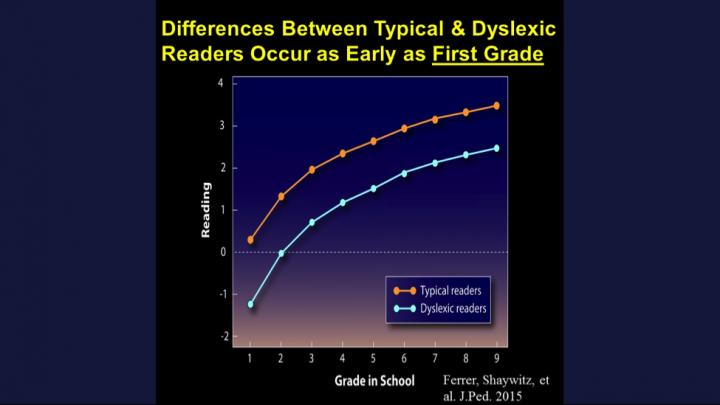
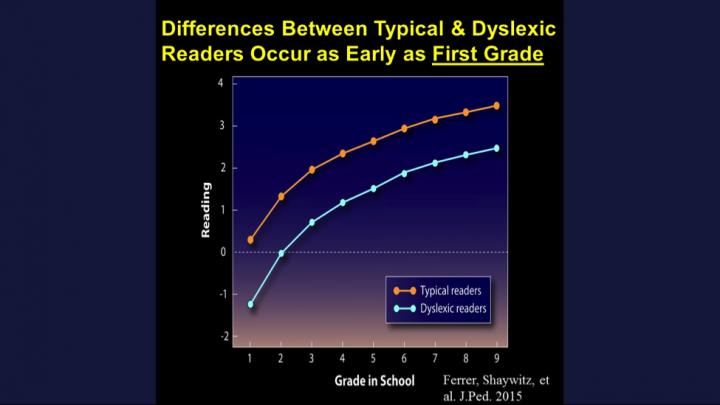
A large achievement gap between dyslexic and typical readers is already present at first grade and persists throughout school; therefore, it is critical to identify and provide effective interventions at the start of school, according to a report by the University of California-Davis and Yale School of Medicine.

The study is published online in the Journal of Pediatrics and in the Nov. 2015 print issue.

According to the researchers, it is no longer acceptable to wait until a child is in third grade or later before making efforts to identify or address dyslexia.

"These new data represent a paradigm shift in how dyslexia has been perceived up to now, with current emphasis often on reading by grade three," said senior author Sally Shaywitz, M.D., the Audrey G. Ratner Professor of Pediatrics (Neurology) and Professor in the Yale Child Study Center "We now know that the achievement gap between typical and dyslexic readers is already present and large at first grade. Developmentally, we know that reading growth is greatest in the very first years of school. This mandates that the screening and identification of children with dyslexia occur early, even prior to first grade."

Lead author Emilio Ferrer, professor of psychology at UC-Davis added, "If the persistent achievement gap between dyslexic and typical readers is to be narrowed, or even closed, reading interventions must be implemented early, when children are still developing the basic foundation for reading acquisition."

Ferrer and his Yale colleagues, Bennett and Sally Shaywitz, who lead the Yale Center for Dyslexia and Creativity, conducted a longitudinal study of reading from first grade to 12th grade and beyond. The team found that as early as first grade, compared with typical readers, dyslexic readers had lower reading scores and that their trajectories over time never converge with those of typical readers.

"These data demonstrate that such differences are not so much a function of increasing disparities over time, but instead reflect marked differences already present in first grade between typical and dyslexic readers," the authors write.

Implementing screening and effective reading programs as early as kindergarten or even preschool offers the potential to close the achievement gap, the researchers conclude.

###

Citation: DOI: http://dx.doi.org/10.1016/j.jpeds.2015.07.045

Share12Tweet8Share2ShareShareShare2

Related Posts

Fungal Killer's Achilles Heel Found in RNA Splicing Machinery

Fungal Killer’s Achilles Heel Found in RNA Splicing Machinery

October 5, 2026
Sound Waves and a Plant-Made Catalyst Turn Water Into a Drug-Making Machine

Sound Waves and a Plant-Made Catalyst Turn Water Into a Drug-Making Machine

October 5, 2026

New AI Reads Eyes With Uncertainty Built In, Promising Safer Driver Monitoring

October 5, 2026

Blood Methylation Study Tests Whether ANGPT1 Gene Marks Stroke Risk After Brain Aneurysm Rupture

October 5, 2026
Please login to join discussion

POPULAR NEWS

  • Alloys That Shrink Their Own Grains: New PIX Mechanism Refines Metals With Heat Alone

    Alloys That Shrink Their Own Grains: New PIX Mechanism Refines Metals With Heat Alone

    29 shares
    Share 12 Tweet 7
  • Endurance Exercise Reshapes the Liver in Males and Females Through Distinct Molecular Routes

    29 shares
    Share 12 Tweet 7
  • Single Transcription Factor PU.1 Rapidly Converts Fibroblasts into Macrophage-Lineage Cells

    29 shares
    Share 12 Tweet 7
  • New Scale Measures How Ready Nurse Educators Really Are for the AI Era

    29 shares
    Share 12 Tweet 7

About

We bring you the latest biotechnology news from best research centers and universities around the world. Check our website.

Follow us

Recent News

Alloys That Shrink Their Own Grains: New PIX Mechanism Refines Metals With Heat Alone

Endurance Exercise Reshapes the Liver in Males and Females Through Distinct Molecular Routes

Single Transcription Factor PU.1 Rapidly Converts Fibroblasts into Macrophage-Lineage Cells

Subscribe to Blog via Email

Success! An email was just sent to confirm your subscription. Please find the email now and click 'Confirm' to start subscribing.

Join 85 other subscribers
  • Contact Us

Bioengineer.org © Copyright 2023 All Rights Reserved.

Welcome Back!

Login to your account below

Forgotten Password?

Retrieve your password

Please enter your username or email address to reset your password.

Log In
No Result
View All Result
  • Homepages
    • Home Page 1
    • Home Page 2
  • News
  • National
  • Business
  • Health
  • Lifestyle
  • Science

Bioengineer.org © Copyright 2023 All Rights Reserved.