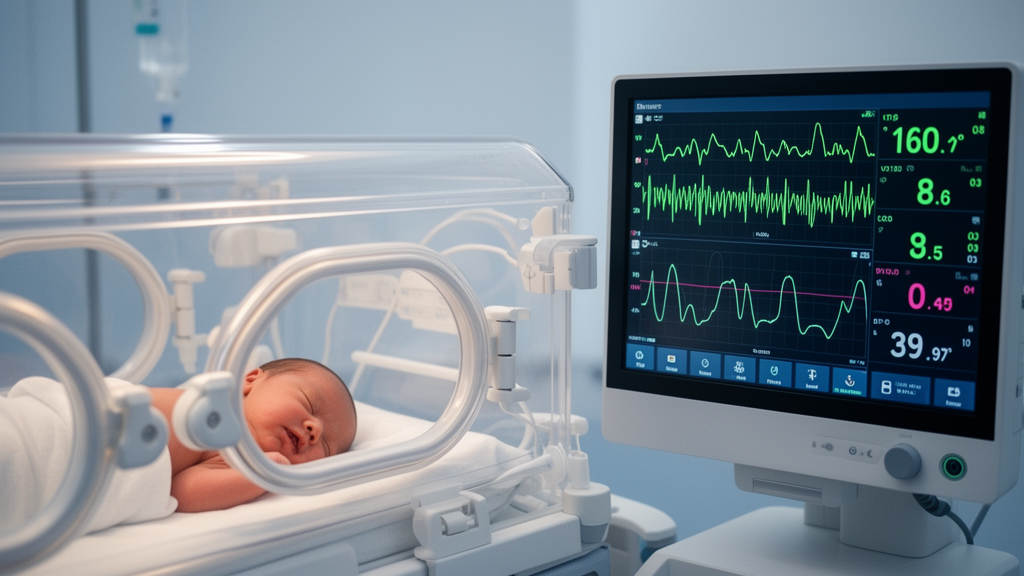
A large-scale investigation of vital sign trajectories in preterm infants has revealed that the risk of experiencing cardiorespiratory instability following an apnoea event is modulated by a combination of clinical characteristics, demographic traits, and recent physiological dynamics. Published in Pediatric Research, the clinical study examined 181,511 breathing pauses lasting at least five seconds across 146 preterm infants evaluated before 37 weeks of postmenstrual age. The research group found that while cardiorespiratory instability generally increases with longer respiratory pauses, standardized bedside alarm thresholds fail to capture substantial individual differences. Some vulnerable infants experience profound drops in oxygenation or heart rate during brief pauses of less than ten seconds, whereas more resilient infants maintain physiological stability during prolonged cessations lasting twenty seconds or more.
Apnoea of prematurity is a prevalent clinical complication that affects more than half of all infants born prematurely. In current neonatal intensive care practice, continuous monitors routinely employ universal fixed-duration thresholds, typically set at twenty seconds, to alert bedside clinicians to an event. However, apnoea can cause severe hypoxaemia, marked bradycardia, altered cerebral oxygenation, and temporary suppression of neural activity. Over time, repeated hypoxaemic episodes are linked to serious long-term complications, including neurodevelopmental impairments and retinopathy of prematurity. Because clinical practice across hospitals lacks a single, uniform definition of apnoea, the authors sought to understand which specific factors alter an infant’s susceptibility to instability and whether machine learning algorithms could accurately forecast these adverse cardiorespiratory responses.
To investigate these mechanisms, the researchers extracted continuous vital-sign data collected between 2017 and 2025 at the John Radcliffe Hospital within Oxford University Hospitals NHS Foundation Trust. The study cohort comprised 257 distinct recording sessions from 146 preterm infants who were either breathing spontaneously in room air or receiving respiratory support through low-flow or high-flow oxygen therapy. Infants on invasive mechanical ventilation were excluded to ensure that documented breathing pauses and cardiovascular responses were not confounded by mechanical ventilator breaths. Eligible recording sessions totaled 23,854 hours of continuous monitoring, with a median recording length of 50.2 hours per session. To avoid distortion from pre-existing physiological distress, each analyzed apnoea episode was required to originate from a stable 90-second baseline where oxygen saturation remained at or above 85 percent and heart rate stayed between 100 and 200 beats per minute.
Respiratory pauses were identified from high-resolution impedance pneumography signals captured alongside continuous electrocardiography and photoplethysmography. Cardiorespiratory instability was defined as oxygen desaturation below 85 percent lasting at least five consecutive seconds, bradycardia defined as a heart rate drop exceeding 30 percent from the pre-event baseline lasting at least five consecutive seconds, or a combination of both outcomes occurring within an observation window ending ten seconds after the apnoea concluded. The researchers noted that defining bradycardia as a percentage reduction from baseline prevented age-related baseline heart rate shifts from confounding the measurements.
Across all 181,511 detected pauses, the duration of breathing cessation demonstrated strong overall linear associations with decreasing heart rate and falling oxygen saturation. The overall Pearson correlation between apnoea duration and heart rate change reached negative 0.84, while the correlation with minimum oxygen saturation reached negative 0.96. The aggregate proportion of apnoeas accompanied by instability rose correspondingly, exhibiting a correlation coefficient of 0.82. However, detailed examination uncovered remarkable individual variability behind these aggregate trends. Among 157,989 brief respiratory pauses lasting only 5 to 10 seconds, 3.6 percent—amounting to 5,617 episodes in 95 infants—triggered cardiorespiratory instability. Conversely, among 3,620 prolonged apnoeas lasting 20 seconds or longer, 61.2 percent were not associated with either bradycardia or desaturation.
Using logistic mixed-effects models applied to 500 resampled datasets capped at 200 events per recording, the investigators differentiated between general risk factors and true interaction effects that alter the slope between apnoea duration and physiological instability. Postmenstrual age at recording, gestational age at birth, infant sex, weight z-score relative to reference growth data, and the mode of respiratory support all exerted significant independent effects on baseline instability risk. Male infants, infants born at earlier gestational ages, infants tested at younger postmenstrual ages, those with lower weight z-scores, and those supported with high-flow oxygen therapy were significantly more likely to experience cardiorespiratory instability. Furthermore, postmenstrual age, gestational age, weight z-score, and biological sex acted as statistically significant modulators of the duration-response relationship, indicating that these traits alter the rate at which longer pauses translate into physiological compromise.
The study also identified critical dynamic markers within the infant’s immediate physiological history that governed vulnerability to instability. Lower baseline oxygen saturation and a higher number of apnoea episodes occurring within the preceding five minutes significantly elevated the likelihood of bradycardia or desaturation. Both of these dynamic measures also functioned as significant modulators of the duration-response relationship. While brief recurrent pauses seen in periodic breathing have historically been viewed as benign, the authors noted that apnoea clustering within a five-minute window compounded physiological vulnerability during subsequent pauses. In contrast, the static interval of time elapsed since the immediately preceding apnoea did not exhibit a statistically significant effect in the mixed-effects models.
Building on these physiological insights, the researchers trained eXtreme Gradient Boosting classification models to predict whether an individual apnoea would trigger cardiorespiratory instability. Model development utilized a complete-case dataset of 153,947 apnoeas partitioned at the subject level into 131,638 training events and 22,309 held-out testing events. When integrating all available clinical, demographic, and dynamic variables, the optimized ensemble model attained a balanced test accuracy of 75.8 percent and an area under the receiver operating characteristic curve of 0.83, performing significantly better than chance in permutation testing. The full model correctly identified 75.2 percent of unstable apnoeas and 76.4 percent of stable events. A secondary model restricted solely to demographic and clinical indicators achieved a balanced test accuracy of 66.0 percent and an area under the curve of 0.72.
To interpret the predictive behavior of the model without confounding by empirical data gaps, the investigators evaluated the demographic-clinical algorithm across a synthetic dataset of 10,000 systematically generated patient profiles. Comparisons between profiles in the top and bottom deciles of predicted instability risk for short apnoeas between 5 and 10 seconds demonstrated that high-risk classifications were characterized by significantly lower gestational ages, lower postmenstrual ages, lower five-minute Apgar scores, male sex, and high-flow oxygen support. Synthetic risk mapping confirmed that infants possessing multiple vulnerability factors face substantial physiological compromise even during respiratory pauses that fall far below the conventional 20-second clinical alarm threshold.
The authors contextualized their findings by emphasizing that developmental physiological maturation explains why older preterm infants tolerate respiratory pauses more effectively. As postmenstrual age advances, functional residual lung capacity expands, pulmonary surfactant production improves, respiratory musculature strengthens, and alveolar development progresses. Concurrently, the physiological shift from fetal hemoglobin to adult hemoglobin enhances tissue oxygen delivery. Conversely, extremely preterm infants face persistent gas exchange limitations related to lung immaturity, history of mechanical ventilation, and potential bronchopulmonary dysplasia, which diminish resilience against intermittent pauses in breathing.
The investigators outlined several operational constraints that define the scope of their work. Because nasal airflow was not continuously recorded in the clinical unit, the dataset captured central and mixed apnoeas but could not isolate obstructive events. Furthermore, the single-center cohort primarily comprised infants older than 28 weeks of postmenstrual age, and transfer patterns at the regional hospital may have enriched late-preterm recordings with more complex patients. The authors concluded that while external validation in multi-center cohorts is necessary before clinical deployment, these findings provide an empirical foundation for replacing rigid, universal apnoea timers with adaptive, personalized monitoring algorithms that align alarm thresholds with an infant’s specific physiological resilience.
Subject of Research: Preterm infant apnoea and predictive modeling of cardiorespiratory instability
Article Title: Risk of apnoea-related cardiorespiratory instability in preterm infants is modulated by clinical, demographic and dynamic indicators
Article References: Chen, Y., Ketheeswaranathan, V., Fordington, S., Baxter, L., Stevens, F., Zandvoort, C. S., Gawthorpe, R., Villarroel, M., Berthouze, L., & Hartley, C. (2026). Risk of apnoea-related cardiorespiratory instability in preterm infants is modulated by clinical, demographic and dynamic indicators. Pediatric Research. https://doi.org/10.1038/s41390-026-05434-1
Image Credits: AI Generated
DOI: 10.1038/s41390-026-05434-1
Keywords: Apnoea of prematurity, Cardiorespiratory instability, Preterm infants, Machine learning, XGBoost, Bradycardia, Oxygen desaturation, Neonatal intensive care, Impedance pneumography, Gestational age, Postmenstrual age, Vital signs monitoring, High-flow oxygen therapy, Apnoea clustering, Pediatric research, Personalised alarms
News Source: Harold Sullivan. (November 15, 2026). Clinical and dynamic markers predict cardiorespiratory instability from preterm infant apnoea. Scienmag.