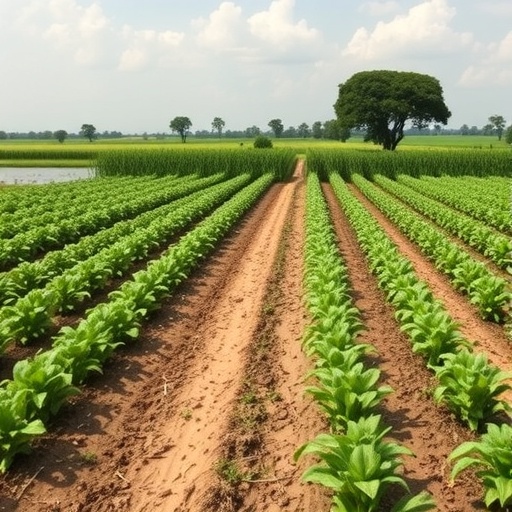
A global push to limit warming to 1.5 °C could create an unexpected threat to food security: less land available for farming. A new perspective published in Environmental and Biogeochemical Processes warns that climate strategies built heavily around afforestation, reforestation, and other land-based carbon removal measures could reduce global cropland by 12.8% by 2100 under a 1.5 °C pathway. The finding highlights a growing tension at the center of climate policy: the same land needed to absorb atmospheric carbon is also needed to grow food for a rapidly changing and increasingly vulnerable population.
Land-based carbon removal is attractive because forests, grasslands, and soils can absorb carbon dioxide through photosynthesis and store it in vegetation, roots, and organic matter. In many climate scenarios, expanding forests and restoring degraded ecosystems are used to compensate for emissions that are difficult to eliminate from aviation, heavy industry, agriculture, and other sectors. However, these strategies require large areas of land. When integrated assessment models allocate more territory to carbon uptake, cropland, pasture, and other human uses can be displaced or reduced.
The authors, led by Xiaoqian Chen and Shaokun Li, examined findings from recent integrated assessment studies and high-resolution land system models. These models combine information about energy systems, agricultural production, trade, land use, population, diets, and climate policy to estimate how societies might evolve under different warming pathways. Their analysis suggests that the land requirements associated with ambitious mitigation could lead to a 12.8% decline in global cropland by the end of the century compared with scenarios involving less aggressive land-based carbon removal.
The projected losses would not be distributed evenly. Countries in the Global South could experience an average cropland reduction of approximately 13.0%, placing additional pressure on regions that already face challenges involving poverty, infrastructure, climate exposure, and access to food markets. South America could see an especially sharp decline of about 23.7%. The region is a major agricultural producer and exporter, meaning that the consequences would not remain local. A reduction in cultivated land could affect both rural livelihoods and the international supply of soybeans, grains, meat, and other commodities.
Europe is projected to experience the largest absolute regional reduction, with approximately 440,000 square kilometers of cropland potentially lost. Although Europe has high agricultural productivity and strong trade networks, a decline of this scale could still alter production patterns and increase dependence on imports. Major exporters such as Brazil, the United States, and Argentina could also lose cropland under ambitious land-based mitigation pathways. This matters because global food security depends not only on how much food is produced, but also on where it is produced and how reliably it can move across borders.
A shrinking agricultural land base could amplify food price volatility through several interacting mechanisms. Reduced cropland may lower total production, while climate extremes such as heatwaves, droughts, floods, and storms create additional disruptions. If exporting countries experience simultaneous production losses, international markets may have fewer alternative suppliers. Import-dependent nations could then face rising prices, supply shortages, or sudden restrictions on exports. Poor households, which typically spend a larger share of their income on food, would be hit hardest by these shocks.
The analysis does not argue against climate action or ecological restoration. Instead, it warns that mitigation plans must account for trade-offs between carbon storage and food production. Restoring forests can deliver major benefits, including biodiversity protection, erosion control, water regulation, and long-term carbon storage. Yet poorly designed projects may compete directly with cropland or push farming into forests, grasslands, and other ecosystems. The authors therefore call for land-use strategies that protect high-value agricultural areas while directing restoration toward degraded or low-productivity land wherever possible.
Improving agricultural productivity could help reduce the pressure, but technological progress alone will not solve the problem. Higher yields may depend on irrigation, fertilizers, improved seeds, mechanization, and digital management systems, all of which can be costly or inaccessible to small farmers. Policies that raise productivity without protecting land rights and rural livelihoods could deepen inequality. The researchers also emphasize the importance of reducing unnecessary trade barriers, strengthening emergency food reserves, and developing price-stabilization mechanisms that can protect vulnerable populations during international disruptions.
The authors argue that governments should also accelerate direct reductions in fossil-fuel emissions rather than relying excessively on forests and other land systems to compensate for continued pollution. Rapid decarbonization of electricity, transport, buildings, and industry would reduce the amount of carbon that must be removed from the atmosphere through land-based approaches. They call for more detailed land system models capable of representing national policies, dietary change, extreme weather, local communities, and differences in farming systems. The central message is clear: climate targets and food security should not be treated as competing priorities. A successful 1.5 °C strategy must protect the land that stores carbon without sacrificing the land that feeds the world.
Subject of Research: Climate policy, land use, cropland, carbon removal, and global food security
Article Title: Ambitious climate pledges threaten global cropland: a 12.8% reduction projected by 2100 under a 1.5 °C pathway
News Publication Date: 21-Jul-2026
Web References: https://doi.org/10.48130/ebp-0026-0010; https://www.maxapress.com/ebp
References: Chen X, Li S, Tu B, Wang L, He W, et al. 2026. “Ambitious climate pledges threaten global cropland: a 12.8% reduction projected by 2100 under a 1.5 °C pathway.” Environmental and Biogeochemical Processes 2: e015. DOI: 10.48130/ebp-0026-0010
Image Credits: Xiaoqian Chen, Shaokun Li, Bin Tu, Lei Wang, Wenxi He & Hong Yang
Keywords
Climate change, 1.5 °C pathway, cropland loss, food security, carbon dioxide removal, afforestation, reforestation, land-use change, agricultural productivity, climate policy, global food systems, environmental science
Tags: afforestation and reforestation effectsbalancing carbon sequestration and food productionClimate Change Mitigationconsequences of 1.5°C warming pathwayeffect of climate pledges on agriculturefood security risks from climate policiesfuture of global food securityimpact on global croplandintegrated assessment modelingland allocation for climate mitigationland use conflictsland-based carbon removal strategies