Global monsoon is a critical component of the global atmospheric circulation system. Variations in summer precipitation over the global monsoon region have large impacts on freshwater resources, which support about two-thirds of the world’s population. Understanding the global monsoon variability and predicting its future changes are of great importance, which relies heavily on climate models. However, the current generation of climate models often exhibit pronounced biases in global monsoon simulations. Notably, the dry and wet biases found in the Northern and Southern Hemisphere monsoon regions in the Coupled Model Intercomparison Project Phase 3 (CMIP3) and 5 (CMIP5) persist in CMIP6 models, but the reasons for these biases remain unclear.
Global monsoon is a critical component of the global atmospheric circulation system. Variations in summer precipitation over the global monsoon region have large impacts on freshwater resources, which support about two-thirds of the world’s population. Understanding the global monsoon variability and predicting its future changes are of great importance, which relies heavily on climate models. However, the current generation of climate models often exhibit pronounced biases in global monsoon simulations. Notably, the dry and wet biases found in the Northern and Southern Hemisphere monsoon regions in the Coupled Model Intercomparison Project Phase 3 (CMIP3) and 5 (CMIP5) persist in CMIP6 models, but the reasons for these biases remain unclear.
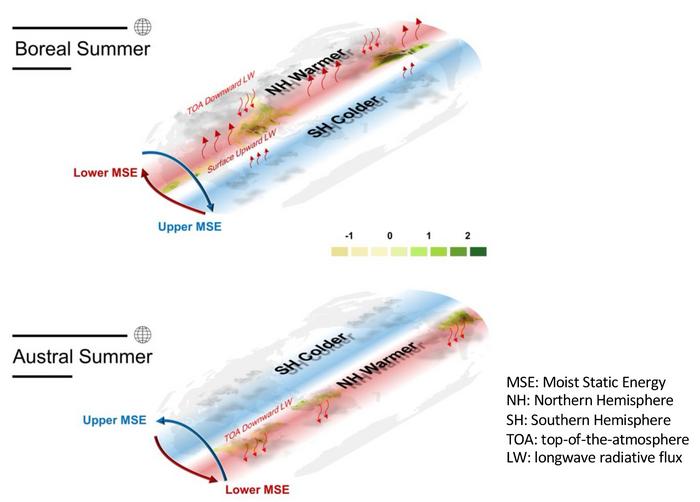
Research teams from the Institute of Atmospheric Physics (IAP) of the Chinese Academy of Sciences (CAS) and the Pacific Northwest National Laboratory in the U.S.A. are attempting to develop a diagnostic framework to identify the sources of the global monsoon simulation biases from an energy transport perspective. This framework focuses on the observed processes of interhemispheric energy transport that is closely linked to the summer precipitation in both the Northern Hemisphere and Southern Hemisphere monsoon regions. During the boreal summer, a pronounced interhemispheric thermal contrast promotes stronger southward and northward moist static energy transport in the upper and lower levels, respectively, leading to more vigorous monsoon circulation and increased precipitation in the Northern Hemisphere. Conversely, during the austral summer, similar processes enhance monsoon activity in the Southern Hemisphere. Interhemispheric energy transport is primarily driven by interhemispheric differences in net energy flux into the atmosphere, associated with downward longwave radiative flux from the top of the atmosphere and upward longwave radiative flux from the surface.
“By evaluating the skill of CMIP5 and CMIP6 climate models under the interhemispheric energy transport diagnostic framework, we have revealed an improvement in CMIP6 compared to CMIP5, which is attributed to reduced dry biases in Northern Hemisphere monsoon simulations”, said Dr. CHEN Ziming, the first author of the study, “These improvements are linked to smaller negative biases in downward surface longwave radiation and northward energy transport in CMIP6 compared to CMIP5”.
“By demonstrating the connections between model biases in the monsoon and energy transport, we highlight that accurately reproducing the meridional global atmospheric energy transportation is necessary for skillful global monsoon simulation. This finding is hoped to provide a useful reference for climate model developers in the improvement and development of next generation climate models”, said Prof. ZHOU Tianjun, the corresponding author of the study.
The study is published in Journal of Climate.
Journal
Journal of Climate
DOI
10.1175/JCLI-D-23-0444.1
Article Title
Understanding the biases in global monsoon simulations from the perspective of atmospheric energy transport
Article Publication Date
8-Jun-2024