• HOME
  • NEWS
  • EXPLORE
    • CAREER
      • Companies
      • Jobs
    • EVENTS
    • iGEM
      • News
      • Team
    • PHOTOS
    • VIDEO
    • WIKI
  • BLOG
  • COMMUNITY
    • FACEBOOK
    • INSTAGRAM
    • TWITTER
Thursday, June 25, 2026
BIOENGINEER.ORG
No Result
View All Result
  • Login
  • HOME
  • NEWS
  • EXPLORE
    • CAREER
      • Companies
      • Jobs
        • Lecturer
        • PhD Studentship
        • Postdoc
        • Research Assistant
    • EVENTS
    • iGEM
      • News
      • Team
    • PHOTOS
    • VIDEO
    • WIKI
  • BLOG
  • COMMUNITY
    • FACEBOOK
    • INSTAGRAM
    • TWITTER
  • HOME
  • NEWS
  • EXPLORE
    • CAREER
      • Companies
      • Jobs
        • Lecturer
        • PhD Studentship
        • Postdoc
        • Research Assistant
    • EVENTS
    • iGEM
      • News
      • Team
    • PHOTOS
    • VIDEO
    • WIKI
  • BLOG
  • COMMUNITY
    • FACEBOOK
    • INSTAGRAM
    • TWITTER
No Result
View All Result
Bioengineer.org
No Result
View All Result
Home NEWS Science News Biology

Climate change and infertility — a ticking time bomb?

Bioengineer by Bioengineer
January 31, 2019
in Biology
Reading Time: 2 mins read
0
IMAGE
Share on FacebookShare on TwitterShare on LinkedinShare on RedditShare on Telegram

IMAGE

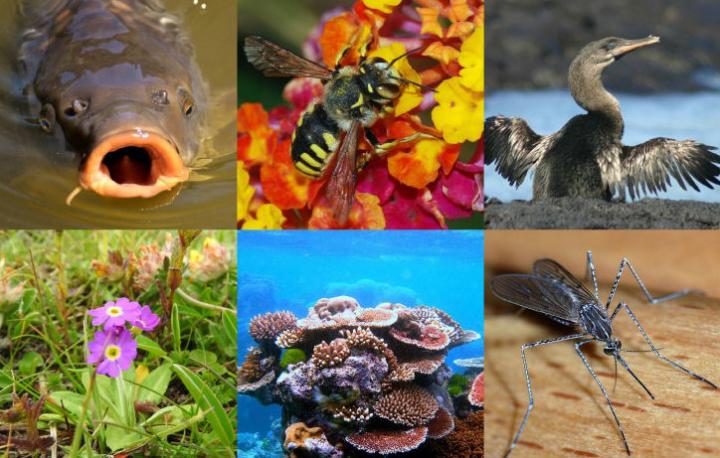
Credit: Joaquim Alves Gaspar, Charles Sharp, Toby Hudson, and David Glass.

Rising temperatures could make some species sterile and see them succumb to the effects of climate change earlier than currently thought, scientists at the University of Liverpool warn.

“There is a risk that we are underestimating the impact of climate change on species survival because we have focused on the temperatures that are lethal to organisms, rather than the temperatures at which organisms can no longer breed,” explains evolutionary biologist Dr Tom Price from the University’s Institute of Integrative Biology.

Currently, biologists and conservationists are trying to predict where species will be lost due to climate change, so they can build suitable reserves in the locations they will eventually need to move to. However, most of the data on when temperature will prevent species surviving in an area is based on the ‘critical thermal limit’ or CTL – the temperature at which they collapse, stop moving or die.

In a new opinion article published in Trends in Ecology and Evolution, the researchers highlight that extensive data from a wide variety of plants and animals suggests that organisms lose fertility at lower temperatures than their CTL.

Certain groups are thought to be most vulnerable to climate-induced fertility loss, including cold-blooded animals and aquatic species. “Currently the information we have suggests this will be a serious issue for many organisms. But which ones are most at risk? Are fertility losses going to be enough to wipe out populations, or can just a few fertile individuals keep populations going? At the moment, we just don’t know. We need more data,” says Dr Price.

To help address this, the researchers propose another measure of how organisms function at extreme temperatures that focuses on fertility, which they have called the Thermal Fertility Limit or ‘TFL’.

“We think that if biologists study TFLs as well as CTLs then we will be able to work out whether fertility losses due to climate change are something to worry about, which organisms are particularly vulnerable to these thermal fertility losses, and how to design conservation programmes that will allow species to survive our changing climate.

“We need researchers across the world, working in very different systems, from fish, to coral, to flowers, to mammals and flies, to find a way to measure how temperature impacts fertility in that organism and compare it to estimates of the temperature at which they die or stop functioning,” urges Dr Price.

The work was carried out in collaboration with scientists from the University of Leeds, University of Melbourne and Stockholm University and was funded by the UK Natural Environment Research Council (NERC).

###

Media Contact
Nicola Frost
[email protected]

Original Source

https://news.liverpool.ac.uk/2019/01/31/climate-change-infertility/

Related Journal Article

http://dx.doi.org/10.1016/j.tree.2018.12.002

Tags: BiodiversityBiologyClimate ChangeEcology/EnvironmentPopulation Biology
Share12Tweet8Share2ShareShareShare2

Related Posts

Natural Hallucinogens: Evolution’s Ecological Tools, Not Mere Chemical Byproducts

June 25, 2026

This Famous Butterfly Revealed: Three Distinct Species Hidden in One

June 25, 2026

Scientists Attack Soybean Cyst Nematode by Starving Its Food Source

June 25, 2026

Decoding the Secret Code of a Crucial Immune Sensor

June 24, 2026
Please login to join discussion

POPULAR NEWS

  • Saying Goodbye to PGY-6: Pediatric Fellowship Realities

    103 shares
    Share 41 Tweet 26
  • Multi-Hospital Study Reveals Long Covid Burden Is Twice as High as Current Estimates

    92 shares
    Share 36 Tweet 23
  • Detection of EDCs in Breast Milk and Infant Urine Up to Six Months Highlights Early Exposure Risks

    77 shares
    Share 31 Tweet 19
  • New Drug Candidate Developed at McMaster Shows Potential for Treating Brain Cancer

    58 shares
    Share 23 Tweet 15

About

We bring you the latest biotechnology news from best research centers and universities around the world. Check our website.

Follow us

Recent News

Tracking Lanthanide-Labeled Microplastics in Plants

POSTECH Researchers Slash Cost of Reconstituted Cell-Free Systems by 95%

AI and Physics Collaborate to Design Advanced Hydrogen Storage Materials

Subscribe to Blog via Email

Enter your email address to subscribe to this blog and receive notifications of new posts by email.

Join 82 other subscribers
  • Contact Us

Bioengineer.org © Copyright 2023 All Rights Reserved.

Welcome Back!

Login to your account below

Forgotten Password?

Retrieve your password

Please enter your username or email address to reset your password.

Log In
No Result
View All Result
  • Homepages
    • Home Page 1
    • Home Page 2
  • News
  • National
  • Business
  • Health
  • Lifestyle
  • Science

Bioengineer.org © Copyright 2023 All Rights Reserved.