September 15, 2022, CLEVELAND: Researchers from Cleveland Clinic’s Florida Research and Innovation Center (FRIC) found that disruption of a cellular structure, known as the actin cytoskeleton, is a “priming signal” for the body to respond to a virus. These findings, published in Cell this week, potentially lay the groundwork for development of new anti-viral vaccines and treatments.
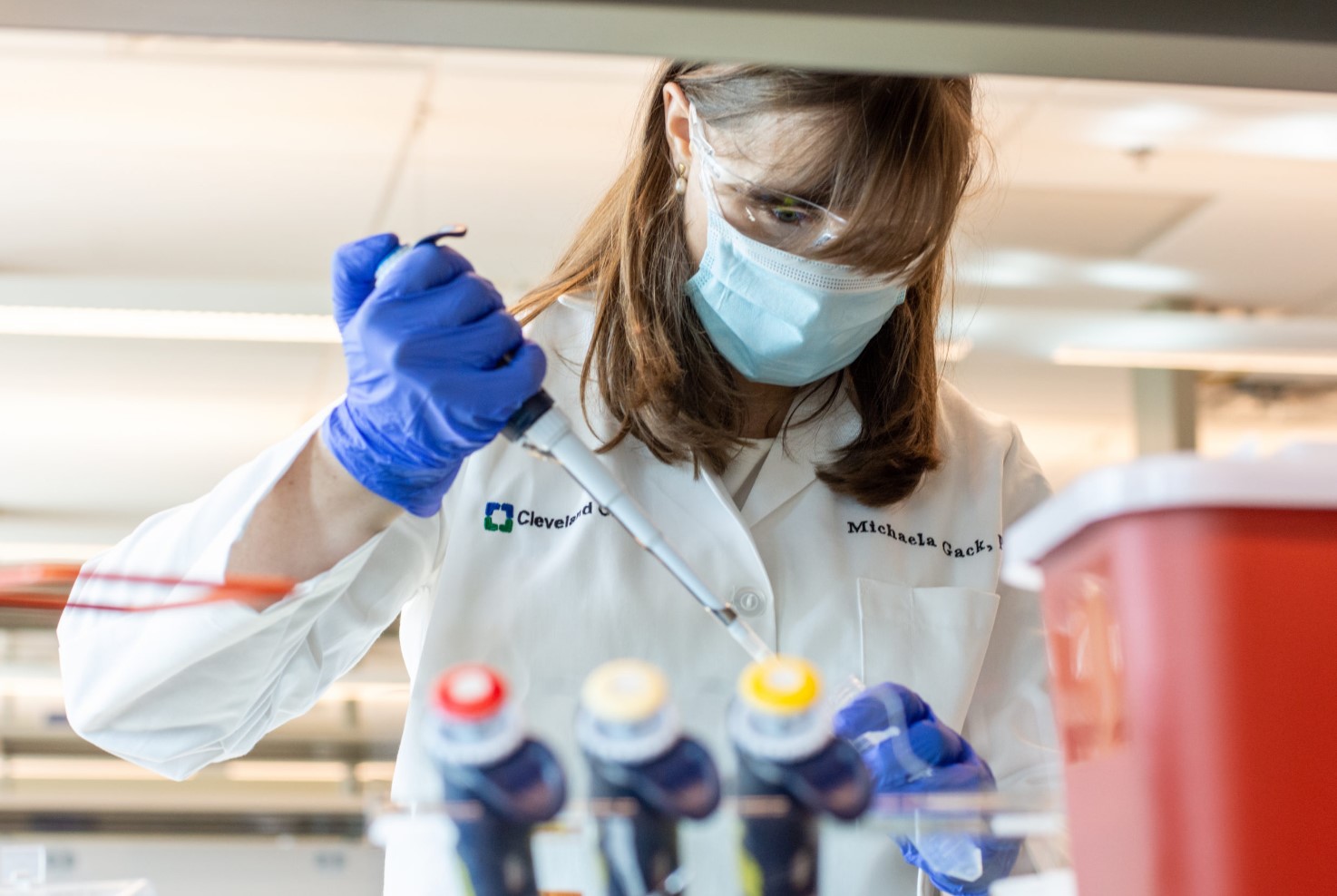
Credit: Cleveland Clinic
September 15, 2022, CLEVELAND: Researchers from Cleveland Clinic’s Florida Research and Innovation Center (FRIC) found that disruption of a cellular structure, known as the actin cytoskeleton, is a “priming signal” for the body to respond to a virus. These findings, published in Cell this week, potentially lay the groundwork for development of new anti-viral vaccines and treatments.
Previously, viral genetic material such as RNA was considered the sole requirement for certain sensor molecules that live in cells to trigger an immune response – an “alarm system” for many types of cells. RNA also serves as a basis for vaccines through training a patient’s immune system to recognize a virus. This new study showed that the signaling process also requires disrupting the actin cytoskeleton inside cells, which occurs when a virus infects cells.
“It’s a fundamental new way of considering how the immune system can be activated, and the implications are that this could lead to broad antiviral therapeutics,” says Michaela Gack, Ph.D., the Arthur and Marylin Levitt Endowed Chair and Scientific Director of the FRIC. “Our data shows this process is common across different types of RNA viruses.”
Cytoskeletons, made up of the protein actin, serve as structural support for cells but are also key in processes like the cell’s ability to grow, divide and internalize key substances. A virus disturbs the cytoskeleton, but so can vaccine components and certain therapeutics, Dr. Gack says.
“Whether this process is sensed by our cellular immune surveillance system and can trigger an antiviral response has been unknown,” says Dr. Gack. “Our work showed that specific immune receptors sense actin cytoskeleton rearrangements induced by viruses and then trigger alarm.”
Despite being around for decades, interest in using RNA as the basis for vaccines and therapeutics grew exponentially during the COVID-19 pandemic. The research showed that the triggering system is similar across multiple viruses, including Zika, the flu or SARS-CoV-2, the virus that causes COVID-19.
Dr. Gack’s team, including lead author Dhiraj Acharya, Ph.D., research associate at FRIC, also discovered that lipid components or virus-like particles such as those used in vaccines or RNA-based therapeutics can cause the cytoskeletal disturbance necessary for prompting an immune response. These results could help developers “fine-tune” the immunostimulatory potencies of therapeutics or vaccines.
Dr. Gack’s lab, operating under Cleveland Clinic’s multi-site Global Center for Pathogen and Human Health Research, investigates virus-host interactions on a molecular level, identifying host responses that can play a key role in developing new treatments and vaccines. The center is a cornerstone of the Cleveland Innovation District.
The study was a collaboration with Konstantin Sparrer, Ph.D., Ulm University in Germany, and other collaborators from multiple institutions. Funding was provided by the National Institutes of Health, the Federal Ministry of Education and Research Germany, and the German Research Foundation.
About Cleveland Clinic
Cleveland Clinic is a nonprofit multispecialty academic medical center that integrates clinical and hospital care with research and education. Located in Cleveland, Ohio, it was founded in 1921 by four renowned physicians with a vision of providing outstanding patient care based upon the principles of cooperation, compassion and innovation. Cleveland Clinic has pioneered many medical breakthroughs, including coronary artery bypass surgery and the first face transplant in the United States. U.S. News & World Report consistently names Cleveland Clinic as one of the nation’s best hospitals in its annual “America’s Best Hospitals” survey. Among Cleveland Clinic’s 72,500 employees worldwide are more than 5,050 salaried physicians and researchers, and 17,800 registered nurses and advanced practice providers, representing 140 medical specialties and subspecialties. Cleveland Clinic is a 6,500-bed health system that includes a 173-acre main campus near downtown Cleveland, 22 hospitals, more than 220 outpatient facilities, including locations in northeast Ohio; southeast Florida; Las Vegas, Nevada; Toronto, Canada; Abu Dhabi, UAE; and London, England. In 2021, there were 10.2 million total outpatient visits, 304,000 hospital admissions and observations, and 259,000 surgical cases throughout Cleveland Clinic’s health system. Patients came for treatment from every state and 185 countries. Visit us at clevelandclinic.org. Follow us at twitter.com/ClevelandClinic. News and resources available at newsroom.clevelandclinic.org.
Journal
Cell
DOI
10.1016/j.cell.2022.08.011
Article Title
Actin Cytoskeleton Remodeling Primes RIG-I-like Receptor Activation
Article Publication Date
15-Sep-2022