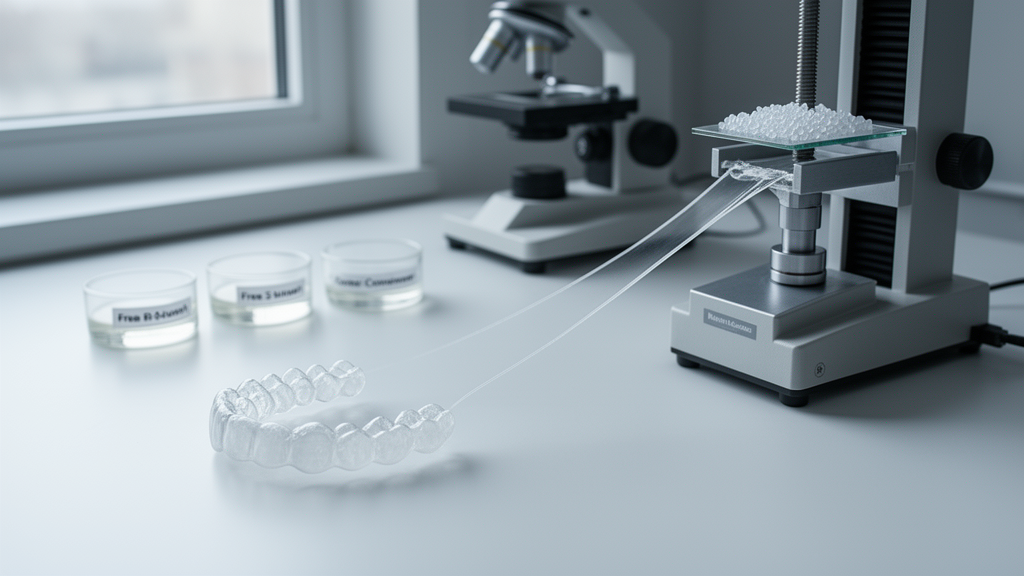
Clear aligners have quietly become one of the most successful consumer-facing technologies in modern orthodontics, but the plastics that make them work have never been as interchangeable as the marketing suggests. A structured literature review published on 1 October 2026 in the journal Digital and Aligner Orthodontics pulls together the materials science behind thermoformed PETG and thermoplastic polyurethane (TPU) aligners and the newer generation of directly 3D-printed photopolymers, and its central message is blunt: broad material labels are meaningless unless the exact formulation, thickness, processing route and ageing conditions are reported alongside them.
The commercial stakes are considerable. The global clear aligner market was valued at roughly USD 4.9 billion in 2022 and is projected to exceed USD 18 billion by 2030, driven by patient demand for less visible appliances, advances in digital scanning and CAD/CAM manufacturing, and the spread of direct-to-consumer brands that put materials into clinical use outside specialist oversight.
What makes material choice so consequential is that in aligner therapy the appliance is the force-delivery system. Unlike fixed braces, where forces can be tuned through archwires and auxiliaries, an aligner must generate force, hold its shape, stay transparent, resist degradation and remain biocompatible through wear cycles of roughly 22 hours per day for 7 to 14 days. Those functions rest on stiffness, thickness, viscoelasticity, surface quality, water uptake and ageing behaviour, and the review argues that material selection is a major determinant of the force system delivered, alongside geometry, staging, attachment design, fit and patient compliance.
The two dominant thermoplastic families behave very differently at the molecular level. PETG is made by replacing part of the ethylene glycol in polyethylene terephthalate with 1,4-cyclohexanedimethanol, a bulky comonomer that disrupts chain regularity, suppresses crystallisation and yields a fully amorphous, optically clear material with a glass transition temperature of 75 to 81 °C. At oral temperature it sits about 40 °C below its Tg and is therefore mostly elastic, with reported elastic moduli around 1,800 to 2,200 MPa — one comparative study measured approximately 2,083 MPa dry and 1,858 MPa after 24 hours in artificial saliva at 37 °C, with a yield stress near 50 MPa. The catch is stress relaxation. In a wet 37 °C three-point bending test, a commercial 0.75 mm PETG material lost roughly 44 percent of its initial stress within 8 hours and 62 percent over 24 hours, with most of the loss concentrated in the first 8 hours; other studies report 30 to 50 percent decay within a day depending on formulation and test conditions.
TPU, by contrast, is not one polymer but a family of segmented block copolymers built from a diisocyanate, a macroglycol and a short-chain chain extender. Hard segments form hydrogen-bonded crystalline microdomains that act as physical crosslinks, while the soft-segment matrix supplies flexibility, giving the combination of extensibility, tear strength and elastic recovery that distinguishes TPU from PETG. TPU also carries two glass transitions — a soft-segment transition typically between −30 °C and −5 °C and a hard-segment transition between 85 °C and 130 °C — so at mouth temperature the soft phase is rubbery while the hard phase stays glassy. But relaxation data vary wildly with formulation: a single-layer TPU showed about 54.5 percent force decay over 24 hours, comparable to PETG in the same study, while a double-layer material, Durasoft, decayed only 18 percent over 24 hours, albeit with much lower initial forces. The authors warn that blanket claims about TPU force retention are unreliable unless formulation and layer structure are specified.
The manufacturing route itself changes the material. Thermoforming heats a 0.5 to 1.0 mm sheet above its glass transition and presses it over a dental model, inducing molecular chain orientation, residual internal stress and thickness reductions of 10 to 25 percent depending on model curvature and forming pressure. Specifications taken from flat sheets may therefore not predict the finished aligner’s behaviour. Direct 3D printing by vat photopolymerisation — stereolithography, digital light processing, LCD printing or continuous liquid interface production — skips the model and the forming step entirely and may improve geometric control, but the resulting covalently crosslinked thermoset network depends heavily on print orientation, washing, post-curing and degree of conversion. Commercial aligner resins typically reach conversion values of 60 to 80 percent during printing; below roughly 55 to 60 percent, mechanical properties drop and unreacted monomer elution rises. Layer-by-layer construction also introduces anisotropy, with reported estimates of 15 to 30 percent reductions in tensile strength and stiffness along the build direction, although robust quantitative data for true aligner geometries remain limited.
Shape-memory photopolymers are the most eye-catching development. The Tera Harz TC-85 resin has a glass transition of 42.3 °C with onset near 30.4 °C, and in shape-recovery tests specimens bent to 180 degrees recovered 54.9 percent of their deformation at 37 °C and 86.1 percent at 45 °C after 10 minutes in a water bath, while conventional thermoformed PETG and TPU recovered a negligible 1.5 to 2.9 percent. Full recovery, however, required more than an hour at elevated temperature, and the review is careful about what this proves: the underlying study measured flexural force at a fixed 2 mm deflection at three temperatures, not over time, so claims of sustained force delivery across a 14-day wear interval remain speculative. Direct comparisons under identical conditions are still lacking, and measured tensile forces after 14 days of immersion tell a sobering story — printed resins generated 4.04 to 7.24 N at 1 percent strain versus 26.26 to 32.91 N for thermoformed Zendura materials.
Surface and optical behaviour add further clinical texture. Thermoformed PETG aligners start with surface roughness of 0.05 to 0.30 µm but climb to 0.5 to 2.5 µm with intraoral wear from toothbrushing abrasion, dietary acids and enzymatic degradation — crossing the roughly 0.2 µm threshold above which biofilm formation accelerates. Directly printed aligners start rougher, at 0.5 to 2.5 µm, owing to layer-by-layer fabrication and support marks, and chemical smoothing can cut roughness by 40 to 60 percent, though its effect on mechanical properties needs further testing. Printed aligners may also yellow more than thermoformed ones because of residual photoinitiator fragments and surface porosity; one study found greater colour change in printed polyurethane aligners after two weeks of in vitro ageing, with yellowing inversely correlated with degree of conversion. On biocompatibility, thermoformed PETG and most commercial TPUs carry more than two decades of regulatory history, while printed resins are more formulation-dependent, and one study found lower pre-osteoblast viability for specimens post-cured in air rather than under the prescribed nitrogen-assisted protocol.
The review’s conclusions cut against easy generalisations. Even the intuitive rule that force scales with the cube of thickness fails in practice: beam theory predicts a 3.4-fold force increase between 0.5 mm and 0.75 mm aligners, yet direct measurements on incisor displacements recorded increases of only about 1.1- to 1.2-fold, because shell geometry and thermoforming-induced thinning attenuate the idealised scaling. Reported PETG stress relaxation spans roughly 30 percent to over 60 percent depending on test conditions, no randomised clinical trial has yet compared tooth movement outcomes between material classes, and time-dependent force decay of printed aligners under realistic oral conditions remains inadequately measured. The authors call for standardised force-decay and ageing protocols, disclosure of proprietary compositions and post-processing parameters, and comparative clinical trials — arguing that until then, treatment planning should rest on the specific formulation, processing route, thickness and ageing behaviour of each product rather than on the familiar but insufficient labels of PETG, TPU or printed resin.
Subject of Research: Materials science of thermoplastic and 3D-printed clear aligner polymers
Article Title: Materials science of clear aligner therapy: composition, microstructure, and physical properties of thermoplastic and 3D-printed polymer systems: a structured literature review
Article References: Abela, S., Castroflorio, T., Migliorati, M., & Terentjev, E. (2026). Materials science of clear aligner therapy: composition, microstructure, and physical properties of thermoplastic and 3D-printed polymer systems: a structured literature review. Digital and Aligner Orthodontics, 1(1), Article 11. https://doi.org/10.1007/s44525-026-00013-5
Image Credits: AI Generated
DOI: 10.1007/s44525-026-00013-5
Keywords: clear aligners, PETG, thermoplastic polyurethane, 3D printing, photopolymers, stress relaxation, force decay, shape-memory polymers, biocompatibility, thermoforming, orthodontics, degree of conversion
News Source: Denise Maddox. (October 28, 2026). Clear Aligner Materials Under the Microscope: Why PETG, TPU and Printed Resins Behave So Differently. Scienmag.