• HOME
  • NEWS
  • EXPLORE
    • CAREER
      • Companies
      • Jobs
    • EVENTS
    • iGEM
      • News
      • Team
    • PHOTOS
    • VIDEO
    • WIKI
  • BLOG
  • COMMUNITY
    • FACEBOOK
    • INSTAGRAM
    • TWITTER
Tuesday, June 2, 2026
BIOENGINEER.ORG
No Result
View All Result
  • Login
  • HOME
  • NEWS
  • EXPLORE
    • CAREER
      • Companies
      • Jobs
        • Lecturer
        • PhD Studentship
        • Postdoc
        • Research Assistant
    • EVENTS
    • iGEM
      • News
      • Team
    • PHOTOS
    • VIDEO
    • WIKI
  • BLOG
  • COMMUNITY
    • FACEBOOK
    • INSTAGRAM
    • TWITTER
  • HOME
  • NEWS
  • EXPLORE
    • CAREER
      • Companies
      • Jobs
        • Lecturer
        • PhD Studentship
        • Postdoc
        • Research Assistant
    • EVENTS
    • iGEM
      • News
      • Team
    • PHOTOS
    • VIDEO
    • WIKI
  • BLOG
  • COMMUNITY
    • FACEBOOK
    • INSTAGRAM
    • TWITTER
No Result
View All Result
Bioengineer.org
No Result
View All Result
Home NEWS Science News Biology

Clay-assisted organic carbon burial induced early Paleozoic atmospheric oxygenation

Bioengineer by Bioengineer
April 12, 2024
in Biology
Reading Time: 3 mins read
0
The schematic diagram of marine organic matter production and burial in the continental shelf ocean, regulated by marine nutrient cycling and mineral protection
Share on FacebookShare on TwitterShare on LinkedinShare on RedditShare on Telegram

According to a new study published in Science Advances, scientists have used new lithium isotope (δ7Li) data to show that continental clay export promoted organic carbon burial and thus atmospheric oxygenation during the Cambrian period. 
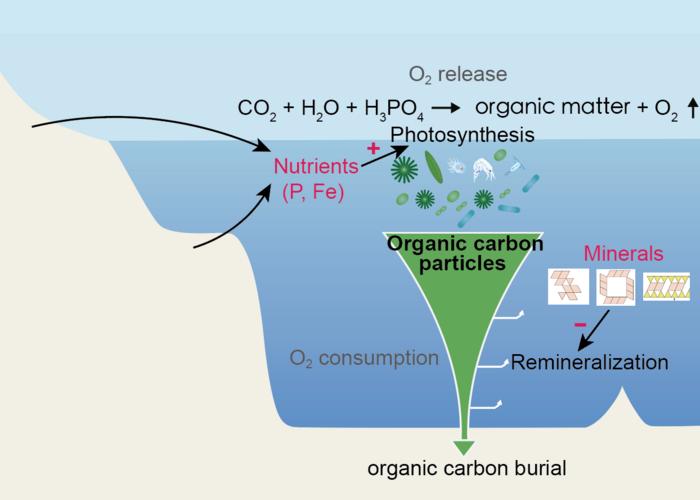
The schematic diagram of marine organic matter production and burial in the continental shelf ocean, regulated by marine nutrient cycling and mineral protection

Credit: IGGCAS

According to a new study published in Science Advances, scientists have used new lithium isotope (δ7Li) data to show that continental clay export promoted organic carbon burial and thus atmospheric oxygenation during the Cambrian period. 

Animals depend on oxygen for respiration. Thus, the emergence and proliferation of early animals from the late Neoproterozoic to the early Paleozoic era (~600–500 million years ago or mya) has traditionally been attributed to a significant increase in marine oxygen levels. However, geochemical tracers and numerical models suggest that both atmospheric and marine oxygen levels during the Late Neoproterozoic–Early Paleozoic were significantly lower than today, with highly variable marine redox states. 

During this period, marine oxygenation occurred under conditions of low atmospheric oxygen, attributed to an enhanced marine biological pump. However, the role of other factors, such as the mineral carbon pump promotion of organic matter burial by mineral protection, has not been thoroughly explored for this epoch. 

To address this gap, Prof. WEI Guangyi of Nanjing University and Prof. ZHAO Mingyu of the Institute of Geology and Geophysics of the Chinese Academy of Sciences (IGGCAS), together with their collaborators, developed δ7Li in marine siliciclastic sediments, such as mudstones, to track the proportions of continentally derived clays preserved in continental shelf sediments.  

During chemical weathering, isotopically light lithium is preferentially taken up by secondary silicate minerals (i.e., clays), resulting in more negative δ7Li values in highly weathered products. In contrast, primary silicate minerals and weakly weathered products (e.g., feldspar and mica) exhibit higher δ7Li signatures similar to those of the average upper continental crust.  

In addition, marine authigenic clays formed by marine reverse weathering generally exhibit higher δ7Li values due to seawater-derived lithium. Therefore, the δ7Li values of marine mudstones serve as potentially reliable indicators of the proportions of different types of silicate minerals preserved in ancient continental shelf sediments. 

The researchers collected about 600 mudstone samples spanning the late Neoproterozoic to mid-Cambrian (~660–500 mya) and analyzed their lithium isotope compositions alongside potassium relative to aluminum (K/Al) ratios to track changes in continental silicate weathering and clay mineral composition during this interval. Significant decreases in δ7Li and K/Al ratios of marine mudstones after the Early Cambrian (~525 mya) indicate increased continental silicate weathering and clay mineral preservation in marine sediments. 

Furthermore, the new mudstone δ7Li database was compared with phosphorus (P), total organic carbon (TOC), and uranium (U) contents in marine siliciclastic sediments from the Sedimentary Geochemistry and Paleoenvironments Project compilations. Synchronous occurrences of decreased δ7Li and increased P, TOC, and U in marine sediments provide compelling evidence for correlations between continental clay formation, marine P reservoirs, organic carbon burial flux, and marine oxygenation levels.  

Results from a global biogeochemical model suggest that increased continental clay influx into marine sediments have drove increased atmospheric and deep marine oxygen levels, particularly under initial conditions of low atmospheric oxygen. 


Journal

Science Advances

DOI

10.1126/sciadv.adk2152

Method of Research

Meta-analysis

Subject of Research

Not applicable

Article Title

Lithium isotopic constraints on the evolution of continental clay mineral factory and marine oxygenation in the earliest Paleozoic Era

Article Publication Date

29-Mar-2024

Share12Tweet8Share2ShareShareShare2

Related Posts

How Screens Are Reshaping Childhood: New Research Reveals the Developing Brain Integrates Experience Until Age 25, Impacting Mental Health Deeply — Biology

How Screens Are Reshaping Childhood: New Research Reveals the Developing Brain Integrates Experience Until Age 25, Impacting Mental Health Deeply

June 2, 2026
Why Most Biology Education Guidelines Overlook Society — UW Researchers Highlight the Consequences — Biology

Why Most Biology Education Guidelines Overlook Society — UW Researchers Highlight the Consequences

June 2, 2026

Mount Sinai Scientists Identify Significant Genetic Factors in Postpartum Psychosis, Shedding Light on Severe Maternal Mental Illness

June 2, 2026

Jumping Genes Surprise Scientists on the Y Chromosome

June 1, 2026

POPULAR NEWS

  • ESMO 2025: mRNA COVID Vaccines Enhance Efficacy of Cancer Immunotherapy

    320 shares
    Share 128 Tweet 80
  • Multi-Hospital Study Reveals Long Covid Burden Is Twice as High as Current Estimates

    86 shares
    Share 34 Tweet 21
  • Saying Goodbye to PGY-6: Pediatric Fellowship Realities

    63 shares
    Share 25 Tweet 16
  • Common Food Preservatives Associated with Elevated Blood Pressure and Increased Heart Disease Risk

    57 shares
    Share 23 Tweet 14

About

We bring you the latest biotechnology news from best research centers and universities around the world. Check our website.

Follow us

Recent News

Student-Athletes’ Struggle: Inside Their Sleep Challenges

Experimental Molecule “Reprograms” Brain’s Defenses to Combat Alzheimer’s Disease

How Screens Are Reshaping Childhood: New Research Reveals the Developing Brain Integrates Experience Until Age 25, Impacting Mental Health Deeply

Subscribe to Blog via Email

Enter your email address to subscribe to this blog and receive notifications of new posts by email.

Join 82 other subscribers
  • Contact Us

Bioengineer.org © Copyright 2023 All Rights Reserved.

Welcome Back!

Login to your account below

Forgotten Password?

Retrieve your password

Please enter your username or email address to reset your password.

Log In
No Result
View All Result
  • Homepages
    • Home Page 1
    • Home Page 2
  • News
  • National
  • Business
  • Health
  • Lifestyle
  • Science

Bioengineer.org © Copyright 2023 All Rights Reserved.