• HOME
  • NEWS
  • EXPLORE
    • CAREER
      • Companies
      • Jobs
    • EVENTS
    • iGEM
      • News
      • Team
    • PHOTOS
    • VIDEO
    • WIKI
  • BLOG
  • COMMUNITY
    • FACEBOOK
    • INSTAGRAM
    • TWITTER
Monday, May 18, 2026
BIOENGINEER.ORG
No Result
View All Result
  • Login
  • HOME
  • NEWS
  • EXPLORE
    • CAREER
      • Companies
      • Jobs
        • Lecturer
        • PhD Studentship
        • Postdoc
        • Research Assistant
    • EVENTS
    • iGEM
      • News
      • Team
    • PHOTOS
    • VIDEO
    • WIKI
  • BLOG
  • COMMUNITY
    • FACEBOOK
    • INSTAGRAM
    • TWITTER
  • HOME
  • NEWS
  • EXPLORE
    • CAREER
      • Companies
      • Jobs
        • Lecturer
        • PhD Studentship
        • Postdoc
        • Research Assistant
    • EVENTS
    • iGEM
      • News
      • Team
    • PHOTOS
    • VIDEO
    • WIKI
  • BLOG
  • COMMUNITY
    • FACEBOOK
    • INSTAGRAM
    • TWITTER
No Result
View All Result
Bioengineer.org
No Result
View All Result
Home NEWS Science News Chemistry

Classifying galaxies with artificial intelligence

Bioengineer by Bioengineer
August 11, 2020
in Chemistry
Reading Time: 2 mins read
0
IMAGE
Share on FacebookShare on TwitterShare on LinkedinShare on RedditShare on Telegram

IMAGE

Credit: Credit: NAOJ/HSC-SSP

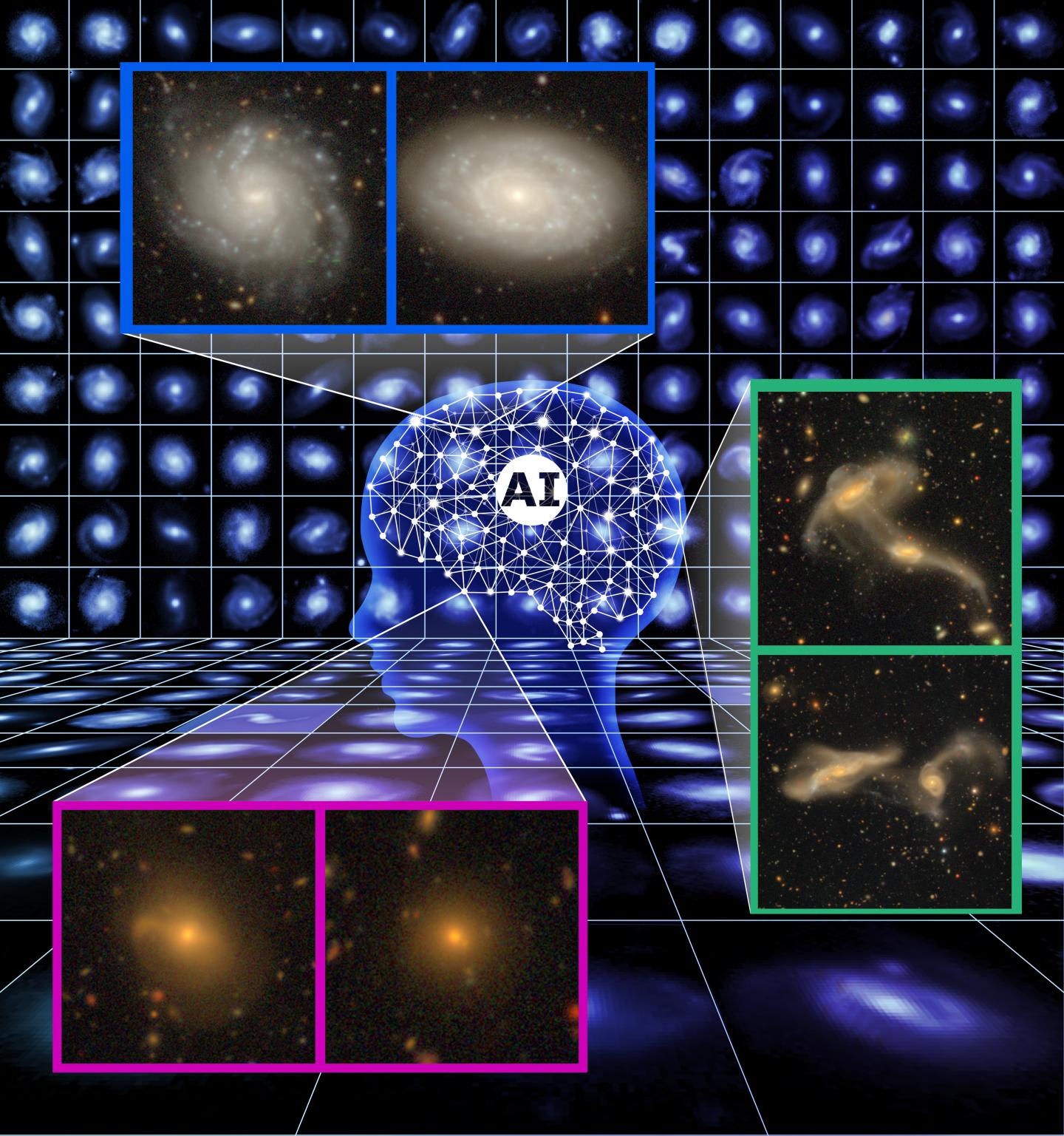
Astronomers have applied artificial intelligence (AI) to ultra-wide field-of-view images of the distant Universe captured by the Subaru Telescope, and have achieved a very high accuracy for finding and classifying spiral galaxies in those images. This technique, in combination with citizen science, is expected to yield further discoveries in the future.

A research group, consisting of astronomers mainly from the National Astronomical Observatory of Japan (NAOJ), applied a deep-learning technique, a type of AI, to classify galaxies in a large dataset of images obtained with the Subaru Telescope. Thanks to its high sensitivity, as many as 560,000 galaxies have been detected in the images. It would be extremely difficult to visually process this large number of galaxies one by one with human eyes for morphological classification. The AI enabled the team to perform the processing without human intervention.

Automated processing techniques for extraction and judgment of features with deep-learning algorithms have been rapidly developed since 2012. Now they usually surpass humans in terms of accuracy and are used for autonomous vehicles, security cameras, and many other applications. Dr. Ken-ichi Tadaki, a Project Assistant Professor at NAOJ, came up with the idea that if AI can classify images of cats and dogs, it should be able to distinguish “galaxies with spiral patterns” from “galaxies without spiral patterns.” Indeed, using training data prepared by humans, the AI successfully classified the galaxy morphologies with an accuracy of 97.5%. Then applying the trained AI to the full data set, it identified spirals in about 80,000 galaxies.

Now that this technique has been proven effective, it can be extended to classify galaxies into more detailed classes, by training the AI on the basis of a substantial number of galaxies classified by humans. NAOJ is now running a citizen-science project “GALAXY CRUISE,” where citizens examine galaxy images taken with the Subaru Telescope to search for features suggesting that the galaxy is colliding or merging with another galaxy. The advisor of “GALAXY CRUISE,” Associate Professor Masayuki Tanaka has high hopes for the study of galaxies using artificial intelligence and says, “The Subaru Strategic Program is serious Big Data containing an almost countless number of galaxies. Scientifically, it is very interesting to tackle such big data with a collaboration of citizen astronomers and machines. By employing deep-learning on top of the classifications made by citizen scientists in GALAXY CRUISE, chances are, we can find a great number of colliding and merging galaxies.”

###

Media Contact
Hideaki Fujiwara
[email protected]

Original Source

https://www.nao.ac.jp/en/news/science/2020/20200811-subaru.html

Related Journal Article

http://dx.doi.org/10.1093/mnras/staa1880

Tags: AstronomyAstrophysicsSpace/Planetary Science
Share12Tweet8Share2ShareShareShare2

Related Posts

SKKU Research Team Uncovers Chemical Pathway to Advance Next-Generation Infrared III–V Nanocrystals — Chemistry

SKKU Research Team Uncovers Chemical Pathway to Advance Next-Generation Infrared III–V Nanocrystals

May 18, 2026
Cellulose Aerogel Inspired by White Beetles Enables Passive Daytime Cooling — Chemistry

Cellulose Aerogel Inspired by White Beetles Enables Passive Daytime Cooling

May 18, 2026

Decoding Interfacial Dynamics in Zinc-Ion Batteries Using Multiscale Advanced Characterization Techniques

May 18, 2026

TEGNet: AI Revolutionizes the Design of Thermoelectric Devices

May 18, 2026
Please login to join discussion

POPULAR NEWS

  • Research Indicates Potential Connection Between Prenatal Medication Exposure and Elevated Autism Risk

    845 shares
    Share 338 Tweet 211
  • New Study Reveals Plants Can Detect the Sound of Rain

    731 shares
    Share 292 Tweet 182
  • Salmonella Haem Blocks Macrophages, Boosts Infection

    62 shares
    Share 25 Tweet 16
  • Breastmilk Balances E. coli and Beneficial Bacteria in Infant Gut Microbiomes

    58 shares
    Share 23 Tweet 15

About

We bring you the latest biotechnology news from best research centers and universities around the world. Check our website.

Follow us

Recent News

Gigahertz Lithium Niobate Receiver Boosts Quantum Communication

Minute-Scale Control Reveals Dynamics of Bacterial Effectors

Microfluidic Platforms Reveal Neuronal Network Recovery

Subscribe to Blog via Email

Enter your email address to subscribe to this blog and receive notifications of new posts by email.

Join 82 other subscribers
  • Contact Us

Bioengineer.org © Copyright 2023 All Rights Reserved.

Welcome Back!

Login to your account below

Forgotten Password?

Retrieve your password

Please enter your username or email address to reset your password.

Log In
No Result
View All Result
  • Homepages
    • Home Page 1
    • Home Page 2
  • News
  • National
  • Business
  • Health
  • Lifestyle
  • Science

Bioengineer.org © Copyright 2023 All Rights Reserved.