• HOME
  • NEWS
  • EXPLORE
    • CAREER
      • Companies
      • Jobs
    • EVENTS
    • iGEM
      • News
      • Team
    • PHOTOS
    • VIDEO
    • WIKI
  • BLOG
  • COMMUNITY
    • FACEBOOK
    • INSTAGRAM
    • TWITTER
Monday, October 5, 2026
BIOENGINEER.ORG
No Result
View All Result
  • Login
  • HOME
  • NEWS
  • EXPLORE
    • CAREER
      • Companies
      • Jobs
        • Lecturer
        • PhD Studentship
        • Postdoc
        • Research Assistant
    • EVENTS
    • iGEM
      • News
      • Team
    • PHOTOS
    • VIDEO
    • WIKI
  • BLOG
  • COMMUNITY
    • FACEBOOK
    • INSTAGRAM
    • TWITTER
No Result
View All Result
Bioengineer.org
No Result
View All Result
Home NEWS Science News Biology

Classification-coordination-collaboration

Bioengineer by Bioengineer
May 12, 2020
in Biology
Reading Time: 2 mins read
0
IMAGE
Share on FacebookShare on TwitterShare on LinkedinShare on RedditShare on Telegram

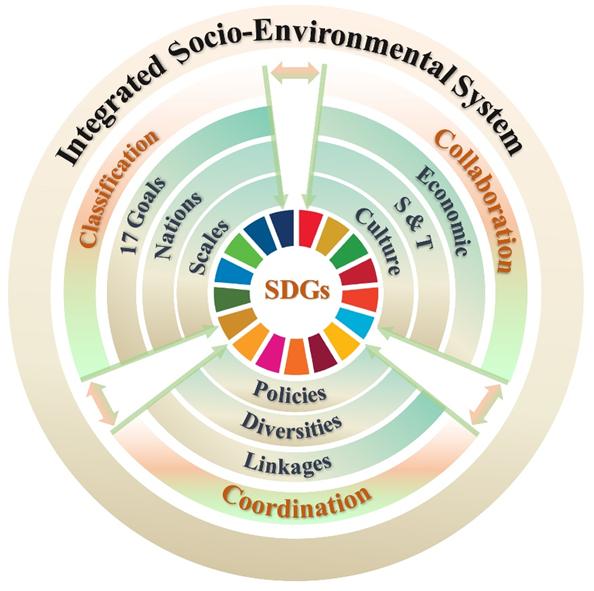
A systems approach for advancing sustainable development
IMAGE

Credit: ©Science China Press

The 17 SDGs and 169 targets set out in the 2030 Agenda set the direction for countries around the world to work on sustainable development from 2015 to 2030. After more than four years, various countries have made a series of breakthroughs. However, recent reports indicate that, based on current progress, there is no guarantee that all goals will be achieved by 2030, and that more in-depth and rapid measures will be needed to advance the implementation of SDGs.

Faced with the above difficulties and challenges, people have explored countermeasures from multiple perspectives. However, due to the scale effect, a single country’s plan may have a negative external impact on other countries. To overcome this, a new article by Bojie Fu and his research group from the Beijing Normal University, China, now proposes a systems approach, Classification-Coordination-Collaboration (3C), to promote the overall realization of SDGs.

Among the 3C constituents, classification refers to the assignment of objects to groups by considering their properties, grades, or other characteristics. This process can lay foundation for relational analysis, comparison and the joint management of objects. Coordination is a top-down management process. In SDG-oriented management, the purpose of coordination is not only to integrate the various components, but also to synchronize the functions of the various departments in order to achieve the SDGs with minimal effort. Finally, compared to coordination, collaboration is a bottom-up, as well as a top-down process; it can spontaneously occur through the initiatives of different individuals or organizations.

In this approach, each constituent interacts with one another. For example, the classification requires multi-stakeholders’ coordination and collaboration, and classification can also enhance coordination and promote more efficient collaboration.

###

See the article:

Fu B, Zhang J, Wang S, Zhao W, 2020. Classification-coordination-collaboration: A systems approach for advancing sustainable development goals. National Science Review, doi: 10.1093/nsr/nwaa048
https://doi.org/10.1093/nsr/nwaa048

Media Contact
Bojie Fu
[email protected]

Related Journal Article

http://dx.doi.org/10.1093/nsr/nwaa048

Tags: Earth ScienceEcology/Environment
Share12Tweet8Share2ShareShareShare2

Related Posts

Deep Learning Tool Reads RNA Tails Straight From Nanopore Signals

Deep Learning Tool Reads RNA Tails Straight From Nanopore Signals

October 5, 2026
Two Gut Microbe Types Split IBD Patients Into Very Different Diseases

Two Gut Microbe Types Split IBD Patients Into Very Different Diseases

October 5, 2026

Epigenetic Clocks Stay Ticking in Brain Fluid After Bleeding Stroke

October 5, 2026

Ribosomes Are Not All Alike: Review Maps the Rise of Specialized Protein Factories

October 5, 2026
Please login to join discussion

POPULAR NEWS

  • Alloys That Shrink Their Own Grains: New PIX Mechanism Refines Metals With Heat Alone

    Alloys That Shrink Their Own Grains: New PIX Mechanism Refines Metals With Heat Alone

    29 shares
    Share 12 Tweet 7
  • Endurance Exercise Reshapes the Liver in Males and Females Through Distinct Molecular Routes

    29 shares
    Share 12 Tweet 7
  • Single Transcription Factor PU.1 Rapidly Converts Fibroblasts into Macrophage-Lineage Cells

    29 shares
    Share 12 Tweet 7
  • New Scale Measures How Ready Nurse Educators Really Are for the AI Era

    29 shares
    Share 12 Tweet 7

About

We bring you the latest biotechnology news from best research centers and universities around the world. Check our website.

Follow us

Recent News

Alloys That Shrink Their Own Grains: New PIX Mechanism Refines Metals With Heat Alone

Endurance Exercise Reshapes the Liver in Males and Females Through Distinct Molecular Routes

Single Transcription Factor PU.1 Rapidly Converts Fibroblasts into Macrophage-Lineage Cells

Subscribe to Blog via Email

Success! An email was just sent to confirm your subscription. Please find the email now and click 'Confirm' to start subscribing.

Join 85 other subscribers
  • Contact Us

Bioengineer.org © Copyright 2023 All Rights Reserved.

Welcome Back!

Login to your account below

Forgotten Password?

Retrieve your password

Please enter your username or email address to reset your password.

Log In
No Result
View All Result
  • Homepages
    • Home Page 1
    • Home Page 2
  • News
  • National
  • Business
  • Health
  • Lifestyle
  • Science

Bioengineer.org © Copyright 2023 All Rights Reserved.