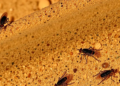
Annapolis, Md.; July 5, 2017 — Thanks to citizen volunteers, scientists now know more than ever about the flies that attack monarch butterfly caterpillars.
Since 1999, volunteers participating in the Monarch Larva Monitoring Project have collected and raised more than 20,000 monarch eggs and caterpillars, and they've recorded incidents of those specimens being parasitized by fly larvae. They have also collected more than 1,100 specimens of those flies and sent them to entomologists at the University of Minnesota for identification. Findings from this long-running collaboration are published today in the Annals of the Entomological Society of America.
"Our paper provides an unprecedented view of monarch-parasitoid associations across space and time. It documents the main parasitoid enemies of monarchs, their relative abundance and impact on monarchs, and how parasitism varies with host stage. This sheds new light on understanding monarch larval ecology," says Karen Oberhauser, Ph.D., professor in the Department of Fisheries, Wildlife, and Conservation Biology at the University of Minnesota and director of the UM Monarch Lab.
Monarch butterflies (Danaus plexippus) are well known for their vibrant colors and their incredible migration through North America, but they are also threatened by habitat loss. Fly species that parasitize monarchs aren't considered a major threat to their survival, but knowing typical rates of parasitism helps scientists better discern between natural and human-driven impacts on monarchs as they continue to monitor their populations.
Volunteers in the Monarch Larva Monitoring Project (MLMP) are trained in rearing caterpillars and accurately reporting data, and the pool of more than 1,300 monitoring sites across the United States comprises schools, museums, and other community programs, in addition to individuals. Participants report monarch larvae collection and rearing outcomes through a data portal, and those who collect parasitoid specimens are asked to wait until the flies hatch and then freeze them until sending them to the researchers.
Oberhauser and colleagues identified seven different species of flies, all from the family Tachinidae, among the parasitoid specimens collected from monarchs by volunteers.
- Overall, 9.8 percent of monitored monarchs were parasitized, though frequency increased through larval stages, with a maximum of 17 percent among fifth-stage larvae.
- By far, the most abundant parasitoid species (75 percent of tachinid fly specimens collected) was Lespesia archippivora, currently known as a generalist parasitoid of several moth and butterfly species. However, the researchers suspect the species may represent a "complex" of multiple, closely related subspecies, one of which specializes in parasitizing monarchs. This will be a focus of future research, Oberhauser says.
- Three of the tachinid species identified had not been previously reported as monarch parasitoids, one of which appears to be a new, previously unknown species.
- The third most abundant parasitoid species collected (10 percent) was Compsilura concinnata, a species that was introduced to North America in the 20th century to control gypsy moth. Specimens sent in by volunteers in Texas represent the first recording of C. concinnata in that state.
- The researchers found a small number of cases of multiparasitism, in which more than one tachinid species emerged from a monarch host, which had previously never been reported.
"Our large, comprehensive dataset could not have been collected without the participation of citizen scientists spread through monarchs' range," says Oberhauser. Collection continues, and as the researchers accumulate more data, they hope to further analyze patterns in monarch parasitism over space, time and plant habitat, she says. And the ensuing analysis gives volunteers the chance to see the results of their citizen science.
"Contributing to a project like this is not only fun and interesting, but it also is deeply satisfying to contribute to our understanding of the natural world and hopefully make a difference in conservation of that world," says Ilse Gebhard, a Monarch Larva Monitoring Project volunteer and co-author of the study.
###
"Tachinid Fly (Diptera: Tachinidae) Parasitoids of Danaus plexippus (Lepidoptera: Nymphalidae)," by Karen Oberhauser, Dane Elmquist, Juan Manuel Perilla-Lopez, Ilse Gebhard, Laura Lukens, and John Stireman, will be published online on July 10 in the Annals of the Entomological Society of America. Journalists may request advance copies of the article via the contact below.
CONTACT: Joe Rominiecki, [email protected], 301-731-4535 x3009
ABOUT: ESA is the largest organization in the world serving the professional and scientific needs of entomologists and people in related disciplines. Founded in 1889, ESA today has over 6,000 members affiliated with educational institutions, health agencies, private industry, and government. Headquartered in Annapolis, Maryland, the Society stands ready as a non-partisan scientific and educational resource for all insect-related topics. For more information, visit http://www.entsoc.org.
The Annals of the Entomological Society of America publishes cutting-edge entomological research, reviews, collections of articles, and discussions of topics of broad interest and national or international importance. It aims to stimulate interdisciplinary dialogue across the entomological disciplines and advance cooperative interaction among diverse groups of entomologists. For more information, visit https://academic.oup.com/aesa, or visit https://academic.oup.com/insect-science to view the full portfolio of ESA journals and publications.
Media Contact
Joe Rominiecki
[email protected]
301-731-4535 x3009
@EntsocAmerica
http://www.entsoc.org
http://dx.doi.org/10.1093/aesa/sax048