• HOME
  • NEWS
  • EXPLORE
    • CAREER
      • Companies
      • Jobs
    • EVENTS
    • iGEM
      • News
      • Team
    • PHOTOS
    • VIDEO
    • WIKI
  • BLOG
  • COMMUNITY
    • FACEBOOK
    • INSTAGRAM
    • TWITTER
Monday, May 11, 2026
BIOENGINEER.ORG
No Result
View All Result
  • Login
  • HOME
  • NEWS
  • EXPLORE
    • CAREER
      • Companies
      • Jobs
        • Lecturer
        • PhD Studentship
        • Postdoc
        • Research Assistant
    • EVENTS
    • iGEM
      • News
      • Team
    • PHOTOS
    • VIDEO
    • WIKI
  • BLOG
  • COMMUNITY
    • FACEBOOK
    • INSTAGRAM
    • TWITTER
  • HOME
  • NEWS
  • EXPLORE
    • CAREER
      • Companies
      • Jobs
        • Lecturer
        • PhD Studentship
        • Postdoc
        • Research Assistant
    • EVENTS
    • iGEM
      • News
      • Team
    • PHOTOS
    • VIDEO
    • WIKI
  • BLOG
  • COMMUNITY
    • FACEBOOK
    • INSTAGRAM
    • TWITTER
No Result
View All Result
Bioengineer.org
No Result
View All Result
Home NEWS Science News Chemistry

CIC nanoGUNE reaches new depths in infrared nanospectroscopy

Bioengineer by Bioengineer
July 23, 2020
in Chemistry
Reading Time: 2 mins read
0
IMAGE
Share on FacebookShare on TwitterShare on LinkedinShare on RedditShare on Telegram

IMAGE

Credit: CIC nanoGUNE

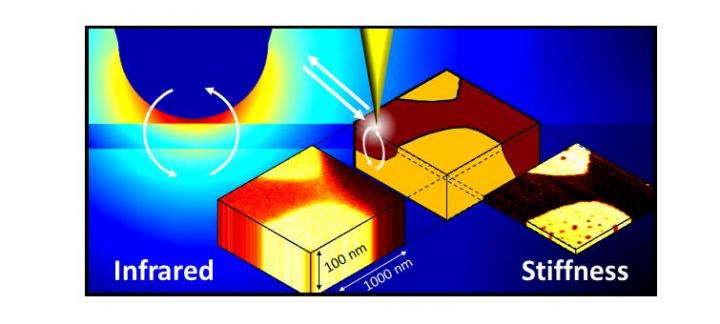
Researchers from the Nanooptics Group at CIC nanoGUNE (San Sebastian) demonstrate that nanoscale infrared imaging – which is established as a surface-sensitive technique – can be employed for chemical nanoidentification of materials that are located up to 100 nm below the surface. The results further show that the infrared signatures of thin surface layers differ from that of subsurface layers of the same material, which can be exploited to distinguish the two cases. The findings, recently published in Nature Communications, push the technique one important step further to quantitative chemometrics at the nanoscale in three dimensions.

Optical spectroscopy with infrared light, such as Fourier transform infrared (FTIR) spectroscopy, allows for chemical identification of organic and inorganic materials. The smallest objects which can be distinguished with conventional FTIR microscopes have sizes on the micrometre-scale. Scientists at CIC nanoGUNE (San Sebastian), however, employed nano-FTIR to resolve objects, which can be as small as a few nanometres.

In nano-FTIR (which is based on near-field optical microscopy), infrared light is scattered at a sharp metallized tip of a scanning-probe microscope. The tip is scanned across the surface of a sample of interest and the spectra of scattered light are recorded using Fourier transform detection principles. Recording of the tip-scattered light yields the sample’s infrared spectral properties and thus the chemical composition of an area located directly below the tip apex. Because the tip is scanned across the sample surface, nano-FTIR is typically considered to be a surface-characterization technique.

Importantly though, the infrared light that is nano-focussed by the tip does not only probe a nanometric area below the tip, but in fact probes a nanometric volume below the tip. Now the researchers at CIC nanoGUNE showed that spectral signatures of materials located below the sample surface can be detected and chemically identified up to a depth of 100 nm. Furthermore, the researchers showed that nano-FTIR signals from thin surface layers differ from that of subsurface layers of the same material, which can be exploited for determination of the materials distribution within the sample. Remarkably, surface layers and subsurface layers can be distinguished directly from experimental data without involving time-consuming modelling. The findings have recently been published in Nature Communications.

###

Media Contact
Irati Kortabitarte
[email protected]

Original Source

https://www.nanogune.eu/nanooptics/newsroom/nanogune-reaches-new-depths-infrared-nanospectroscopy

Related Journal Article

http://dx.doi.org/10.1038/s41467-020-17034-6

Tags: Chemistry/Physics/Materials SciencesNanotechnology/MicromachinesOpticsParticle Physics
Share12Tweet8Share2ShareShareShare2

Related Posts

Miniature Sensor Uses Light to Detect Touch — Chemistry

Miniature Sensor Uses Light to Detect Touch

May 8, 2026
Iron Minerals Determine Whether Dissolved Organic Matter Fuels Microbes or Becomes Long-Term Carbon Storage — Chemistry

Iron Minerals Determine Whether Dissolved Organic Matter Fuels Microbes or Becomes Long-Term Carbon Storage

May 8, 2026

Kate Evans Appointed Associate Lab Director for Biological and Environmental Systems Science at ORNL

May 8, 2026

Advancing Multiscale Modeling and Overcoming Operational Challenges in Autothermal COâ‚‚-to-Methanol Reactors

May 8, 2026
Please login to join discussion

POPULAR NEWS

  • Research Indicates Potential Connection Between Prenatal Medication Exposure and Elevated Autism Risk

    840 shares
    Share 336 Tweet 210
  • New Study Reveals Plants Can Detect the Sound of Rain

    728 shares
    Share 290 Tweet 182
  • Salmonella Haem Blocks Macrophages, Boosts Infection

    62 shares
    Share 25 Tweet 16
  • Breastmilk Balances E. coli and Beneficial Bacteria in Infant Gut Microbiomes

    57 shares
    Share 23 Tweet 14

About

We bring you the latest biotechnology news from best research centers and universities around the world. Check our website.

Follow us

Recent News

Mapping Skin Lesions in Lupus Types Explored

Umbilical IL-6 Levels Reveal Preterm Brain Injury Risk

New Cell Model Accelerates Rhinovirus C Research

Subscribe to Blog via Email

Enter your email address to subscribe to this blog and receive notifications of new posts by email.

Join 82 other subscribers
  • Contact Us

Bioengineer.org © Copyright 2023 All Rights Reserved.

Welcome Back!

Login to your account below

Forgotten Password?

Retrieve your password

Please enter your username or email address to reset your password.

Log In
No Result
View All Result
  • Homepages
    • Home Page 1
    • Home Page 2
  • News
  • National
  • Business
  • Health
  • Lifestyle
  • Science

Bioengineer.org © Copyright 2023 All Rights Reserved.