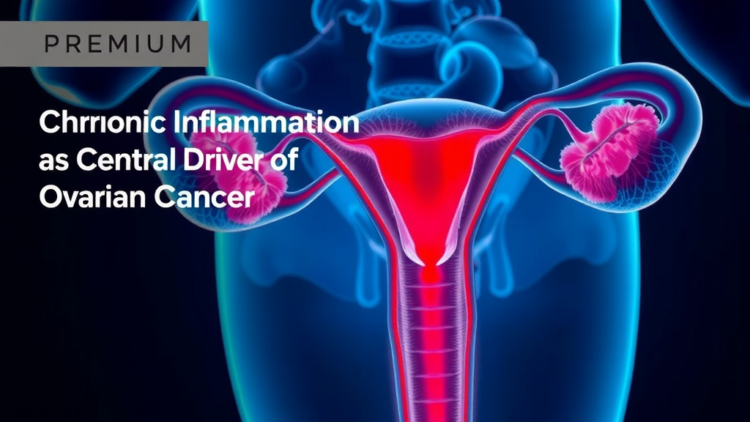
Ovarian cancer remains one of the deadliest malignancies affecting women, largely because it is frequently diagnosed only after the disease has reached an advanced stage. A new review published in the Journal of Ovarian Research argues that a long-underappreciated accomplice deserves far more attention in both research and treatment planning: chronic inflammation. The review, authored by Liming Tan of Jishou University, Kang Wang of the First Affiliated Hospital of Army Medical University, and Aseel Smerat of Saveetha Institute of Medical and Technical Sciences and Al-Ahliyya Amman University, synthesizes evidence that persistent inflammatory signaling is not merely a byproduct of ovarian tumors but an active engine of their initiation, growth, and spread.
The authors center their analysis on four molecular signaling pathways that are repeatedly activated in chronically inflamed tissue: NF-κB, JAK/STAT, PI3K/AKT, and MAPK. Each of these cascades normally serves essential functions in immune defense and cellular communication, but when inflammatory stimuli keep them switched on for prolonged periods, the consequences for tissue can be profound. NF-κB, for instance, is a master regulator of inflammatory gene expression; sustained activation allows tumor cells to resist apoptosis, the programmed cell death that would otherwise eliminate damaged cells. The JAK/STAT pathway, meanwhile, relays signals from cytokines such as interleukin-6 directly to the nucleus, promoting proliferation and survival programs that cancer cells exploit to keep dividing under hostile conditions.
The PI3K/AKT pathway adds another layer of malignant capability. When chronically stimulated by inflammatory mediators, it enhances cell growth, metabolism, and survival, helping ovarian cancer cells tolerate stressors that would kill healthy cells. The MAPK cascade, which transmits growth and differentiation signals through a chain of protein kinases, similarly contributes to uncontrolled proliferation when inflammatory cues keep it engaged. The review emphasizes that these pathways do not operate in isolation. They form an interconnected network in which chronic inflammation continuously feeds signals that reinforce one another, creating a self-sustaining loop in which the tumor microenvironment becomes progressively more hospitable to malignancy.
A substantial portion of the review is devoted to the tumor microenvironment, the complex ecosystem of cells, blood vessels, and signaling molecules that surrounds and interacts with the tumor itself. Within this environment, three populations of immune cells come under particular scrutiny: tumor-associated macrophages, regulatory T cells, and myeloid-derived suppressor cells. Rather than attacking the tumor, these cells are co-opted by it. Tumor-associated macrophages, often polarized toward an anti-inflammatory, tissue-repairing state, secrete cytokines and growth factors that stimulate angiogenesis, the formation of new blood vessels that supply the tumor with oxygen and nutrients, and facilitate invasion into surrounding tissue.
Regulatory T cells, which normally prevent the immune system from attacking the body’s own tissues, are recruited to the tumor site where they suppress the cytotoxic lymphocytes that would otherwise recognize and destroy cancer cells. Myeloid-derived suppressor cells perform a similar immunosuppressive function while also contributing to the inflammatory milieu that drives tumor progression. Together, these three cell populations sustain the chronic inflammatory state that the review identifies as central to ovarian cancer biology. The authors argue that understanding how these cells influence tumor properties, from metastatic potential to drug resistance, is essential for designing therapies that address the disease at its immunological roots.
The therapeutic implications of this framework form the most forward-looking part of the review. The authors survey a set of targeted agents that interfere with specific inflammatory signaling nodes, highlighting bortezomib, ruxolitinib, everolimus, and trametinib as representative examples of the emerging pharmacological toolkit. Bortezomib, a proteasome inhibitor best known for its use in multiple myeloma, disrupts the degradation of regulatory proteins and thereby interferes with NF-κB activation, one of the key inflammatory drivers in ovarian tumors. Ruxolitinib, a JAK inhibitor already approved for myelofibrosis and other conditions, blocks the cytokine signaling that flows through the JAK/STAT pathway, potentially cutting off a major survival signal for ovarian cancer cells.
Everolimus targets the PI3K/AKT pathway downstream by inhibiting mTOR, a central controller of cell growth and metabolism, while trametinib blocks MEK, a critical kinase within the MAPK cascade. By intervening at these distinct molecular checkpoints, the drugs illustrate a broader principle: chronic inflammation in ovarian cancer can, in principle, be pharmacologically disarmed at multiple points. The review suggests that such targeted approaches may be more precise than conventional cytotoxic chemotherapy, which damages rapidly dividing cells indiscriminately and often produces severe side effects alongside limited durable benefit in advanced ovarian cancer.
Perhaps the most consequential argument in the review concerns combination therapy. The authors explore how targeted anti-inflammatory agents might be paired with immunotherapy and other treatment strategies to enhance therapeutic response and overcome drug resistance. The logic is compelling: if tumor-associated macrophages, regulatory T cells, and myeloid-derived suppressor cells are actively suppressing the immune response, then blocking inflammatory signaling pathways may help dismantle that immunosuppressive shield, allowing immune checkpoint inhibitors and other immunotherapies to work more effectively. Conversely, immunotherapy alone has shown limited success in ovarian cancer, and the review implies that this may be precisely because the chronic inflammatory microenvironment has not been addressed. Combining a JAK inhibitor with checkpoint blockade, or an NF-κB-targeting agent with existing chemotherapeutic regimens, could attack the tumor from multiple angles simultaneously, reducing the likelihood that resistant clones will emerge.
The authors are candid about the challenges and limitations that stand between this framework and routine clinical practice. Targeted therapies developed for other cancers may not translate directly to ovarian tumors, whose molecular heterogeneity means that not every patient’s cancer depends on the same signaling pathways to the same degree. Toxicity is another concern, since pathways such as NF-κB and JAK/STAT perform essential functions in normal immunity, and systemic inhibition can leave patients vulnerable to infection. Biomarker development also lags behind: clinicians currently lack reliable tools to identify which patients will benefit from which pathway-targeted agent, making patient selection a significant obstacle. The review calls for continued research into the molecular mechanisms regulated by inflammatory pathways within the tumor microenvironment, so that therapeutic decisions can be guided by a deeper understanding of each tumor’s inflammatory profile.
By reframing ovarian cancer as a disease sustained by chronic inflammation, the review opens a conceptual door that could reshape how researchers and clinicians approach one of oncology’s most stubborn challenges. If the inflammatory circuits that fuel tumor growth and immune evasion can be mapped, measured, and pharmacologically interrupted, the prospects for earlier intervention and more durable responses may improve considerably. The work of Tan, Wang, and Smerat does not announce a cure, but it consolidates a growing body of evidence into a coherent strategic vision: that the war against ovarian cancer may be won not only by attacking the tumor cells themselves, but by quieting the inflammatory storm that surrounds and sustains them.
Subject of Research: The role of chronic inflammatory signaling pathways in ovarian cancer progression and targeted therapy
Article Title: Chronic inflammation in ovarian cancer: molecular signaling pathways and advances in targeted therapeutic strategies
Article References: Tan, L., Wang, K., & Smerat, A. (2026). Chronic inflammation in ovarian cancer: molecular signaling pathways and advances in targeted therapeutic strategies. Journal of Ovarian Research. https://doi.org/10.1186/s13048-026-02241-4
Image Credits: AI Generated
DOI: 10.1186/s13048-026-02241-4
Keywords: ovarian cancer, chronic inflammation, NF-κB, JAK/STAT, PI3K/AKT, MAPK, tumor microenvironment, tumor-associated macrophages, targeted therapy, immunotherapy, drug resistance, signaling pathways
Cite Scienmag News
APA MLA Chicago
Nathaniel Bowman. (September 27, 2026). Chronic Inflammation Emerges as a Central Driver of Ovarian Cancer Progression. Scienmag. https://scienmag.com/chronic-inflammation-emerges-as-a-central-driver-of-ovarian-cancer-progression/
Nathaniel Bowman. “Chronic Inflammation Emerges as a Central Driver of Ovarian Cancer Progression.” Scienmag, 27 September 2026, https://scienmag.com/chronic-inflammation-emerges-as-a-central-driver-of-ovarian-cancer-progression/. Accessed 27 September 2026.
Nathaniel Bowman. “Chronic Inflammation Emerges as a Central Driver of Ovarian Cancer Progression.” Scienmag. September 27, 2026. https://scienmag.com/chronic-inflammation-emerges-as-a-central-driver-of-ovarian-cancer-progression/
Copy citation Download RIS
Tags: Cancer immunologyChronic inflammationdrug resistanceImmunotherapyinflammation and tumor initiationinflammation-driven cancer growthinflammatory signaling pathwaysJAK-STATJAK/STAT pathway in tumor developmentMAPKMAPK pathway role in cancermolecular mechanisms of ovarian cancerNF-κBNF-κB signaling in cancerOvarian cancerovarian cancer progressionPI3K/AKTPI3K/Akt pathway in ovarian cancersignaling pathwaystargeted therapies for ovarian cancerTargeted therapytumor microenvironmenttumor-associated macrophages