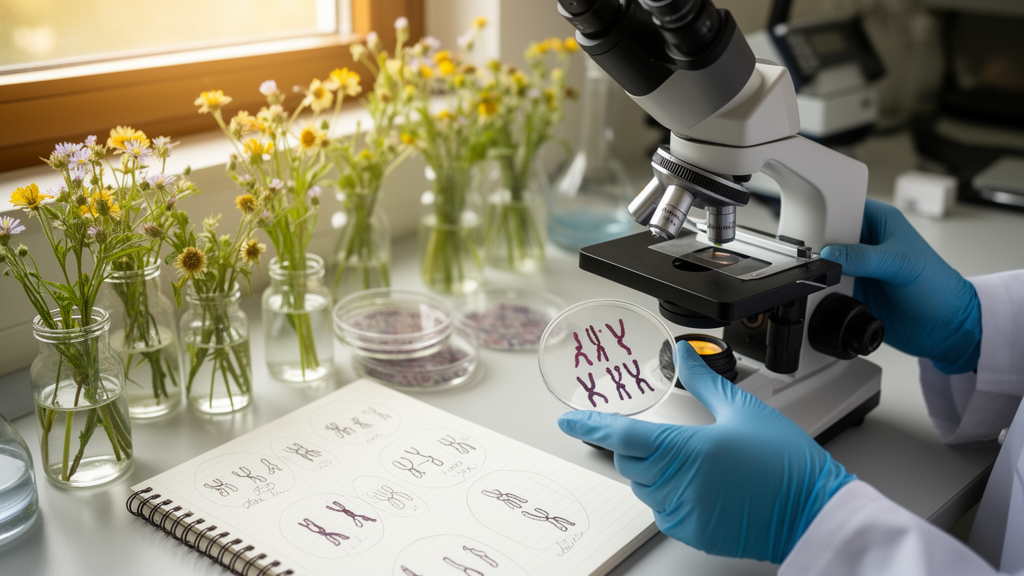
A botanical chromosome-count study reported a chromosome number of 2n = 24 for Atocion rupestre and 2n = 22 for Mantisalca duriaei from Italian populations. The observations were based on squash preparations of root tips and document chromosome numbers for one Alpine locality of A. rupestre in Lombardy and one locality of M. duriaei in Campania.
For A. rupestre, seeds were collected on 1 July 2024 at 1,983 m above sea level in siliceous screes at Valle delle Messi, Ponte di Legno, Brescia, in Lombardy, at 46.3225° N, 10.4856° E. The seeds were deposited at the germplasm bank of the Department of Biology at the University of Pisa, while a herbarium specimen collected from the same area was conserved at PI under barcode PI069158. Root tips obtained from germinated seeds were pre-treated with 0.4% colchicine for three hours, fixed in Carnoy solution for one hour, hydrolysed in 1 N hydrochloric acid at 60 °C for seven minutes and stained with leuco-basic fuchsine. The authors described this as the first chromosome count for an Alpine population of the species and noted its consistency with previously reported numbers from Scandinavia, the Sierra Nevada and Corsica. A. rupestre was described as a perennial herb distributed on siliceous outcrops and soils in Scandinavia and southern Europe, including the Alps and Apennines in Italy.
For M. duriaei, the specimen was collected on 13 June 2024 at 620 m on the dry margins of fields at Monte della Pila, Monteverde, Avellino, in Campania, at 41.026182° N, 15.514559° E; the voucher was recorded as NAP0007941. Root tips from germinating seeds were pre-treated with 0.3% colchicine for three hours, fixed in Carnoy solution, comprising absolute ethanol and glacial acetic acid in a 3:1 ratio, for 30 minutes, hydrolysed in 1 N hydrochloric acid at 60 °C for seven minutes and stained with leuco-basic fuchsine for three hours. The count was the first reported for M. duriaei in Italy and was consistent with a previously published count from Spain. The authors noted that the species had recently been reported for Campania and that earlier records of M. salmantica in the same area may instead have referred to M. duriaei, as may be the case for many Italian locations.
The findings are limited to chromosome observations from two specified Italian localities and do not establish chromosome-number variation across the full geographic ranges of either species. The Italian records also concern populations collected in 2024, while the comparison counts cited for A. rupestre and M. duriaei came from earlier studies in other regions.
Subject of Research: Chromosome-number observations for Atocion rupestre and Mantisalca duriaei in Italy
Article Title: Chromosome numbers for the Italian flora: 16
Article References: Giacò, A., Franzoni, J., Carta, A., Cruz-Tejada, D., Zanatto, P. A., Paino, L., & Del Guacchio, E. (2025). Chromosome numbers for the Italian flora: 16. Italian Botanist, 19, 167-170. https://doi.org/10.3897/italianbotanist.19.160327
Image Credits: AI Generated
DOI: 10.3897/italianbotanist.19.160327
Keywords: botany, chromosome counts, Atocion rupestre, Mantisalca duriaei, Italian flora, plant cytology, Lombardy, Campania, Chromosome, numbers, Italian, flora
News Source: Drew Townsend. (October 20, 2026). Chromosome counts document two Italian plant populations in a botanical study. Scienmag.