


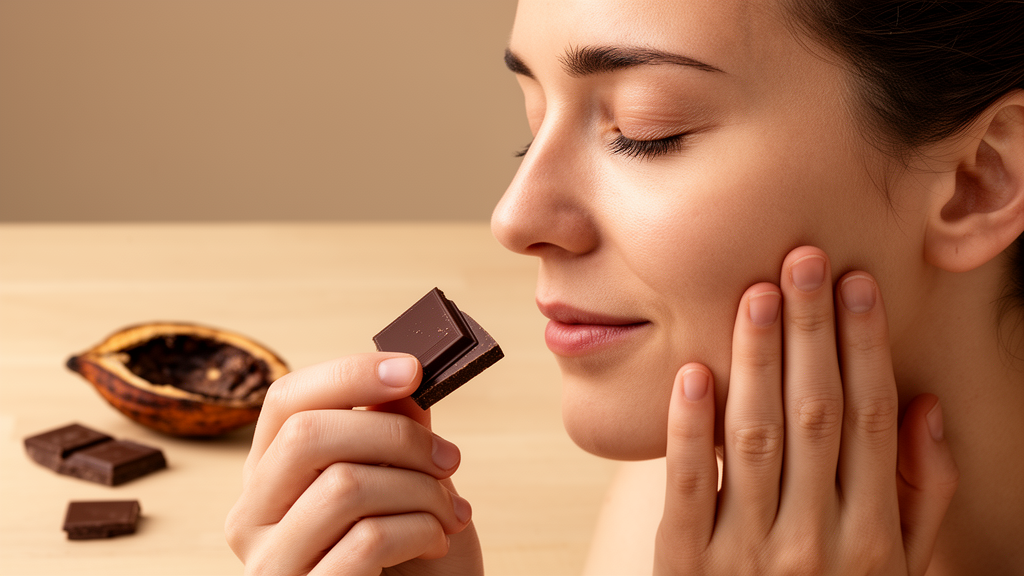
A small but carefully controlled Swedish experiment suggests that when chocolate dulls acute muscle pain, what matters most is not the cocoa percentage on the label but how much the eater likes the chocolate. In a randomized, double-blind, crossover study of thirty healthy young adults, milk chocolate containing only 34 percent cocoa produced the strongest reduction in both the peak intensity and the duration of experimentally induced jaw muscle pain, outperforming dark chocolate with 70 percent cocoa. The effect tracked individual preference closely, pointing to reward-related, sensory-affective mechanisms rather than any direct biochemical action of cocoa compounds.
The work, published open access in the Springer Nature journal Food, Nutrition and Health on 24 August 2026, is a secondary analysis of data from a previously published trial by the same research group. Ethical approval came from the Swedish Ethical Review Authority, and the underlying study was registered on ClinicalTrials.gov. All experimental sessions took place between March and December 2020 at the clinical research laboratory of the Department of Dental Medicine, Karolinska Institutet in Huddinge, Sweden, with participants recruited mainly through advertisements at that department.
The participants were thirty healthy, pain-free volunteers, fifteen men and fifteen women, with a mean age of 24.6 years. Inclusion required age-matched men and women between 18 and 40 years in good general health, while anyone with temporomandibular disorder pain, headaches, systemic muscular or joint diseases, neuropathic or psychiatric disorders, dental pain, recent use of anti-inflammatory drugs, or allergies to the study substances was excluded. Before enrollment, all volunteers completed validated screening questionnaires covering stress, depression, pain catastrophizing, anxiety, and somatization, and underwent a blinded clinical examination according to the Diagnostic Criteria for Temporomandibular Disorders. Baseline psychosocial scores were generally low, and no marked differences appeared between men and women.
The experimental protocol was deliberately standardized. Each participant attended three sessions of roughly one hour, separated by at least one week of washout, and served as their own control. In each session, acute muscle pain was induced twice by injecting 0.2 milliliters of sterile hypertonic saline at 58.5 milligrams per milliliter into the right masseter muscle, the prominent jaw-closing muscle about two centimeters above the lower border of the mandible. This model mimics deep, diffuse acute orofacial pain and is considered safe and valid. Pain intensity was continuously graded on a 0 to 100 millimeter visual analogue scale, marked every fifteen seconds for five minutes. Peak pain intensity was defined as the highest value recorded, and pain duration as the time from injection until the participant reported no pain, or until the end of the five-minute observation window.
Thirty minutes after the first, baseline pain induction, each participant received a single 3.6-gram piece of chocolate, either white chocolate with 30 percent cocoa, milk chocolate with 34 percent, or dark chocolate with 70 percent, in a randomized, double-blind order. Five minutes later, the saline injection was repeated and pain was assessed again. The chocolates were professionally packaged in Vancouver, Canada, from Belgian Belcolade wafers, made uniform in shape, texture, firmness, and aroma, and presented in identical white bags so that participants could not distinguish them by anything other than taste. After the third session, participants ranked the three chocolates from most to least preferred; twenty-eight of the thirty provided complete rankings, and milk chocolate was the favorite for twenty-eight participants, fifteen men and thirteen women.
The results were striking in their direction. Using multilevel Poisson regression models for repeated measures, the researchers found that milk chocolate produced significantly lower peak pain intensity than dark chocolate, with an incidence rate ratio of 0.75 (95 percent confidence interval 0.64 to 0.88), and significantly shorter pain duration, with an incidence rate ratio of 0.64 (95 percent confidence interval 0.57 to 0.72), both at p below 0.01. White chocolate showed weaker effects, with incidence rate ratios of 1.09 for peak pain and 1.11 for duration. Preference told the same story: the most favored chocolate produced significantly lower peak pain and shorter duration than the second and least preferred types, with incidence rate ratios ranging from 0.61 to 0.69.
Equally telling was what did not predict pain. Pearson correlation analyses between chocolate composition and the two pain outcomes found only weak coefficients, ranging from minus 0.07 to 0.07 for peak pain intensity and from minus 0.05 to 0.08 for pain duration. Despite meaningful differences in sugar, fat, protein, fiber, and cocoa-related content across the three chocolates, none of the ingredients correlated with either outcome. The authors emphasize that this null result applies only to the conditions tested: a single 3.6-gram dose consumed five minutes before pain induction cannot capture delayed pharmacological or anti-inflammatory effects, since cocoa flavanols are known to act in a dose- and time-dependent manner. The findings therefore reflect immediate sensory exposure rather than systemic biochemical effects.
The interpretation the authors favor is reward-induced analgesia. Palatable foods are known to activate endogenous opioid and dopaminergic circuits, including the nucleus accumbens and periaqueductal gray, which facilitate descending pain inhibition, and neuroimaging studies have shown opioid release during feeding and reduced pain-related cortical activity after sweet taste stimulation. Milk chocolate, ranked favorite by nearly all participants, delivered the greatest relief, underscoring the role of hedonic valuation in pain modulation. The authors caution, however, that chocolate type and preference were strongly aligned in this sample, so the independent effects of the two cannot be fully disentangled. They also note that because the chocolates differed in taste, complete blinding cannot be guaranteed, and gustatory recognition may have influenced the results.
Several limitations frame how far these findings travel. The sample consisted of healthy young adults, limiting generalizability to chronic pain populations or older people, and laboratory settings cannot fully reproduce the psychosocial context of real pain. Preference rankings were retrospective, introducing possible recall bias, habitual physical activity was not recorded, and the authors themselves acknowledge that linear mixed-effects models may be more appropriate than Poisson regression for continuous outcomes such as visual analogue scale scores. An exploratory secondary finding that women showed shorter pain duration than men was not a primary objective and the study was not powered for it, so it should be interpreted with caution and kept distinct from the epidemiology of chronic orofacial pain, in which women show higher prevalence.
The clinical implications, the researchers stress, should be read conservatively. The study does not support eating chocolate as a pain remedy, nor does it translate directly to patients with temporomandibular disorders or other chronic pain conditions. What it does suggest is that subjective liking and reward may engage endogenous pain inhibition in acute experimental settings, a mechanism that future studies could probe with neuroimaging, dose-response designs, and clinical populations. Within the narrow window of this experiment, the pleasantness of the eating experience, not the cocoa content, appears to have done the analgesic work.
Subject of Research: How chocolate preference and cocoa content modulate experimentally induced masseter muscle pain in healthy adults
Article Title: Effect of chocolate preference and cocoa content on experimentally induced muscle pain
Article References: Christidis, M., Medina Flores, D., Grigoriadis, A., Kumar, A., Serendero, G. E. L., Brondani, M., Hajati, A., De la Torre Canales, G., Brondani, B., & Christidis, N. (2026). Effect of chocolate preference and cocoa content on experimentally induced muscle pain. Food, Nutrition and Health, 3(1), Article 30. https://doi.org/10.1007/s44403-026-00076-x
Image Credits: AI Generated
DOI: 10.1007/s44403-026-00076-x
Keywords: chocolate, pain modulation, cocoa content, masseter muscle, hypertonic saline, reward-induced analgesia, crossover study, temporomandibular disorders, hedonic preference, Karolinska Institutet, experimental pain model, visual analogue scale
News Source: Ophelia Keating. (October 29, 2026). Chocolate Preference, Not Cocoa Content, Eases Experimentally Induced Jaw Muscle Pain. Scienmag.



