


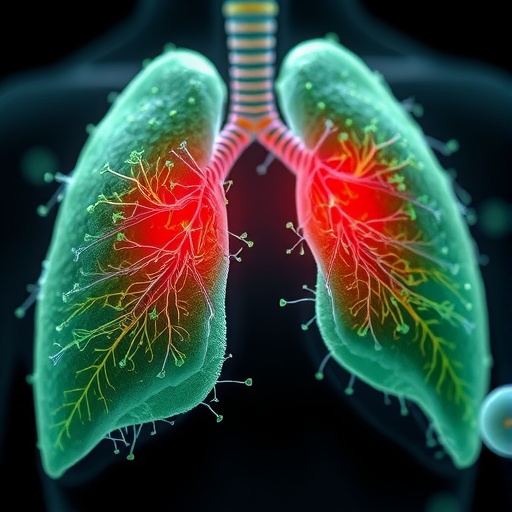
In a groundbreaking advancement at the intersection of biotechnology and radiation medicine, researchers have identified a novel nanogel derived from Chlorella extracellular vesicles that demonstrates remarkable therapeutic potential against radiation-induced lung injury (RILI). Published in Nature Communications in 2026, this study by Hu, Lu, Zhang, and colleagues unveils an innovative approach targeting the cGAS-STING signaling pathway, a critical mediator of innate immune responses that exacerbate lung tissue damage following radiation exposure. As radiation therapy remains a cornerstone treatment for thoracic malignancies, mitigating collateral pulmonary damage continues to be a clinical priority—this new work promises to redefine the therapeutic landscape surrounding RILI by harnessing nature-derived nanotechnologies.
Radiation-induced lung injury consists of an initial acute inflammatory phase, often manifesting as pneumonitis, followed by a chronic fibrotic stage that severely impairs respiratory function. The underlying molecular mechanisms involve the activation of innate immune sensors such as cyclic GMP-AMP synthase (cGAS), which detects cytosolic DNA fragments generated by radiation-induced cellular damage. Subsequent stimulation of the stimulator of interferon genes (STING) pathway triggers a cascade of pro-inflammatory cytokines and type I interferon responses that perpetuate tissue injury. Therapeutic strategies that can selectively attenuate this pathway without broadly suppressing immune function have long been elusive—until now.
Researchers turned to Chlorella, a genus of unicellular green algae known for its rich bioactive molecule composition and established biocompatibility, as a source of extracellular vesicles (EVs). These nano-sized lipid bilayer-enclosed particles naturally participate in intercellular communication, carrying proteins, lipids, and nucleic acids. By isolating and engineering Chlorella-derived EVs, the team developed a nanogel platform capable of delivering targeted therapeutic payloads directly to injured lung tissue while simultaneously exerting intrinsic immunomodulatory effects. This dual functionality positions the nanogel as both a delivery vector and an active agent in modulating immune responses.
Mechanistically, the nanogels function by interfering with the cGAS-STING axis at multiple levels. The nanogel components appear to inhibit cGAS enzymatic activation, reducing the synthesis of cyclic GMP-AMP (cGAMP), the secondary messenger essential for STING activation. Additionally, modulation of downstream interferon regulatory factors (IRFs) dampens the transcription of inflammatory cytokines, effectively curbing the immune overactivation that drives lung tissue fibrosis. Importantly, this suppression is highly localized and transient, preserving the host’s ability to mount essential defense responses against pathogens.
The methodology employed to generate the nanogels leveraged advanced biofabrication techniques, including ultracentrifugation to purify EVs and hydrogel crosslinking to stabilize the final nanoparticle architecture. Characterization studies utilizing dynamic light scattering and electron microscopy confirmed the uniform size distribution and morphological integrity of these constructs. In vitro assays demonstrated excellent biocompatibility and potent suppression of cGAS-STING-induced inflammatory signaling in cultured lung epithelial cells and macrophages. Such comprehensive evaluation underscores the translational viability of these nanogels for clinical applications.
In vivo, murine models of thoracic radiation emulated clinically relevant RILI, enabling rigorous assessment of therapeutic efficacy. Administration of Chlorella-derived nanogels post-radiation resulted in significant attenuation of lung injury markers, reduced inflammatory infiltrates, and decreased collagen deposition as evidenced by histopathological analysis. Moreover, pulmonary function tests revealed improved respiratory mechanics, indicating preservation of lung compliance and gas exchange capacity. These findings highlight the nanogels’ potential not only to prevent but also to reverse established pathological sequelae of radiation damage.
Safety profiles are critical when introducing novel nanomaterials into human subjects, especially in the context of radiation-compromised tissues. The Chlorella-derived nanogels exhibited an impressively low immunogenicity index, with minimal off-target toxicity or systemic immune suppression. Pharmacokinetic studies showed appropriate retention within lung parenchyma and efficient clearance without accumulation in secondary organs. This favorable safety margin stems from both the natural origin of the EVs and the biodegradable nature of the hydrogel network, addressing a major concern often limiting nanomedicine translation.
The implications of this work extend beyond RILI alone. The cGAS-STING pathway has emerged as a pivotal regulatory node in numerous inflammatory and autoimmune disorders, as well as in tumor immunity. The ability to finely tune this signaling cascade using EV-based nanogels could pave the way for novel immunotherapies in diseases where excessive or chronic inflammation is deleterious. Moreover, the modularity of the EV platform allows potential customization with various payloads, including nucleic acid therapeutics, enabling combinatorial approaches to complex lung diseases.
This study also contributes valuable insights to the rapidly evolving field of extracellular vesicle research. Whereas mammalian-derived EVs have historically dominated the spotlight, Chlorella-derived vesicles present distinct biochemical advantages, including a greener, potentially more scalable production process and unique membrane compositions conferring enhanced stability and cellular uptake. This underlines the untapped reservoir of natural nanomaterials in maritime and algal ecosystems, representing a fertile ground for biotechnological innovation.
Looking forward, translation of this nanogel platform into clinical practice will require extensive validation in larger animal models and human trials to confirm efficacy and monitor long-term outcomes. Dosage optimization, delivery modalities (e.g., inhalable aerosols versus systemic injection), and combination with existing radioprotectors or antifibrotics will be crucial investigational threads. Anticipated challenges include regulatory approval pathways for bioengineered EVs and scalable manufacturing under good manufacturing practice (GMP) conditions.
Nonetheless, this pioneering research signifies an epochal step towards precision nanomedicine for radiation-induced complications, encompassing a harmonious integration of natural biological materials and cutting-edge nanotechnology. By harnessing a ubiquitous and sustainable resource like Chlorella to temper hyperactive innate immunity, scientists have opened a promising therapeutic avenue that could dramatically improve patient outcomes in oncology, pulmonology, and beyond.
In sum, the convergence of algal biotechnology, immunology, and nanoscience has unveiled a highly innovative solution to a stubborn clinical challenge. The Chlorella-derived extracellular vesicle-based nanogel exemplifies a next-generation biotherapeutic capable of mitigating the devastating pulmonary consequences of radiation exposure. This innovation not only enriches the armamentarium against RILI but also exemplifies broader principles of biomimetic design and immune modulation that may resonate throughout future biomedical research endeavors. As these technologies mature, the prospect of translating such nature-inspired solutions into routine clinical use appears increasingly within reach.
This study amplifies enthusiasm for exploring environmentally sourced nanomaterials, leveraging evolutionary design principles refined over millions of years, to tackle complex human diseases. It also underscores the importance of interdisciplinary collaboration—merging phycology, molecular immunology, materials science, and clinical medicine—to unlock novel therapies where conventional approaches have plateaued. With continued investment and intellectual synergy, the vision of effectively healing radiation-injured lungs through Chlorella-based nanomedicine might soon materialize as a lifesaving reality.
Ultimately, this advancement reaffirms the potential of leveraging the natural world’s microscopic architectures and biochemical pathways to engineer sophisticated, efficacious, and safe therapeutics. Against the backdrop of rising cancer survivorship and expanding radiation use, these developments herald a new era of patient-centric, biologically inspired interventions poised to rewrite the prognosis for those exposed to pulmonary radiation injury across the globe.
Subject of Research: The study investigates the use of Chlorella-derived extracellular vesicle-based nanogels to suppress the cGAS-STING signaling pathway for the treatment of radiation-induced lung injury.
Article Title: Chlorella-derived extracellular vesicle-based nanogels suppress cGAS-STING for treatment of radiation-induced lung injury.
Article References:
Hu, H., Lu, F., Zhang, W. et al. Chlorella-derived extracellular vesicle-based nanogels suppress cGAS-STING for treatment of radiation-induced lung injury. Nat Commun (2026). https://doi.org/10.1038/s41467-025-68140-2
Image Credits: AI Generated
Tags: cGAS-STING signaling pathwayChlorella nanogelschronic lung injury managementcytokine response to radiationextracellular vesicles for therapyinnate immune response modulationinnovative biotechnological solutionsnanotechnology in medicinenature-derived therapeutic innovationspulmonary inflammation treatmentradiation-induced lung injuryRILI therapeutic approaches



