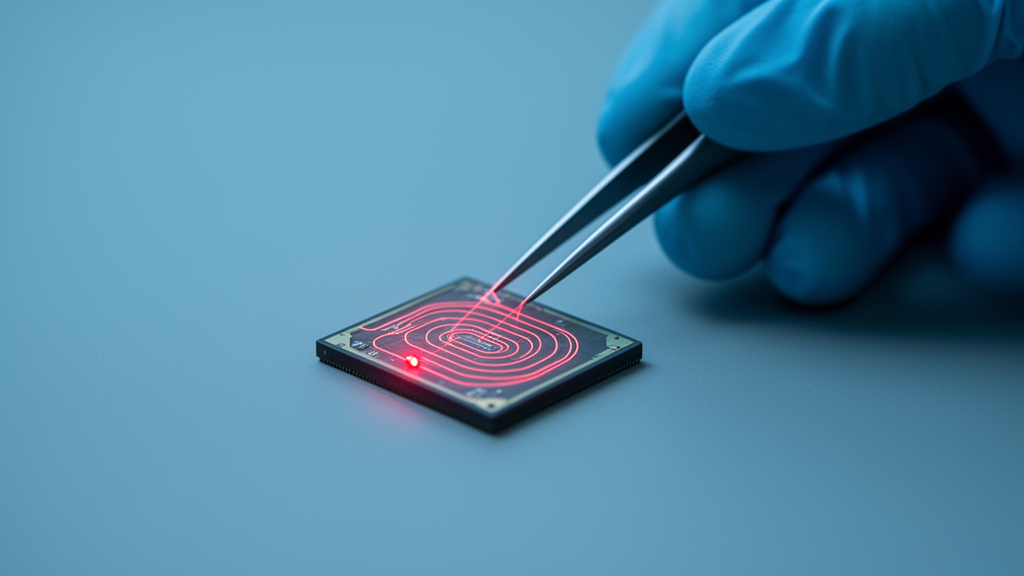
A gyroscope small enough to fit on a fingertip has just set a remarkable benchmark for precision sensing. Researchers at the University of California, Santa Barbara and the California Institute of Technology, working with the Air Force Research Laboratory, have built a chip-scale optical ring-laser gyroscope capable of detecting rotation as slow as 37 degrees per hour. That figure is extraordinary for an integrated device: it approaches the rotation rate of the Earth itself, which turns once every 24 hours at a steady 15 degrees per hour. The achievement, reported in the journal Optics Letters, represents a nearly 2,000-fold improvement over the team’s earlier silicon nitride Brillouin gyroscope, which could only resolve rotations of about 72,000 degrees per hour. For a device manufactured with standard chip-processing techniques and consuming just milliwatts of optical power, the leap in sensitivity is nothing short of stunning.
Gyroscopes are the quiet workhorses of modern navigation. They measure how an object rotates, allowing systems to track orientation and movement over time. The tiny microelectromechanical gyroscopes found in smartphones and everyday gadgets rely on vibrating mechanical structures, and their sensitivity is fundamentally limited by that approach. For demanding applications such as aircraft navigation, spacecraft attitude control, or autonomous vehicles operating in GPS-denied environments, engineers have long preferred optical gyroscopes, which exploit the physics of light rather than moving parts. The problem is that conventional optical gyroscopes, such as the fiber-optic and ring-laser units used in commercial aviation, are bulky, expensive, and difficult to miniaturize. The new device promises to change that calculus by bringing optical-grade precision onto a chip that could, in principle, be mass-produced.
The heart of the innovation lies in a technique known as Brillouin lasing. When light travels through an optical waveguide, it interacts with tiny acoustic vibrations naturally present in the material, a phenomenon called stimulated Brillouin scattering. This interaction can generate new laser light with exceptionally stable and narrow frequency characteristics. Brillouin gyroscopes harness this effect to create the ultra-low-noise laser signals needed for rotation sensing. The collaboration married two complementary technologies: a Brillouin laser gyroscope architecture developed by Kerry Vahala’s team at Caltech, and a Brillouin laser-on-a-chip built on a silicon nitride photonic platform developed by Daniel J. Blumenthal’s group at UC Santa Barbara in partnership with the Air Force Research Laboratory.
Vahala’s contribution centers on a ring-shaped microresonator that confines light with extraordinarily little loss. The quality of such a resonator is described by its Q factor, a measure of how well the ring stores light before the energy dissipates. A high Q factor allows light to circulate around the ring many thousands of times, which makes the device exquisitely sensitive to the minute frequency shifts that rotation induces. Vahala’s team first demonstrated this gyroscope concept in 2017 and later used a tiny silica optical resonator to detect the rotation of the Earth itself, a landmark demonstration for a device of such modest size.
Blumenthal’s group supplied the missing piece: a practical, manufacturable platform. Silicon nitride is a material that guides light with remarkably low loss and, crucially, is compatible with standard CMOS chip-manufacturing processes, the same industrial infrastructure that produces billions of electronic chips each year. Using this platform, the team fabricated chip-scale Brillouin lasers that emit highly stable, narrow-frequency light, exactly what is needed to detect the vanishingly small signatures of slow rotation. In 2019, they used this technology to measure the Earth’s rotation on a chip. Combining the two approaches, Blumenthal explained, made it possible to measure much slower rotation than has been achieved before with integrated technologies, and to move toward a fully integrated laser optical gyroscope.
The sensing portion of the new chip is a ring-shaped optical circuit roughly 24 millimeters across, which is large by photonic-integration standards but still compact enough for practical deployment. Two semiconductor lasers inject light into the ring in opposite directions. Through interactions between the circulating light and acoustic vibrations in the silicon nitride, two highly stable Brillouin laser signals are generated and travel around the ring in opposite senses. The relatively large ring area is not an aesthetic choice: the Sagnac effect, the physical phenomenon underlying all optical gyroscopes, dictates that sensitivity scales with the area enclosed by the light path. When the chip is stationary, the two counter-propagating signals behave identically. When the chip rotates, however, the rotation produces a tiny difference between their optical frequencies, and the chip detects that difference to determine the rotation rate.
The numbers behind the device reveal why it performs so well. The silicon nitride ring achieved an intrinsic Q factor exceeding 163 million, allowing the resonator to act as an extremely selective optical filter, isolating a narrow 2 MHz bandwidth from a 200 THz optical signal. The resonator can hold onto photons for nearly 100 nanoseconds, an eternity in the world of integrated photonics, during which each photon samples the ring’s geometry many times over. This combination of very high optical Q, very large resonator area, and CMOS-compatible fabrication is what the researchers identify as the recipe for a high-sensitivity optical gyroscope on a chip.
To validate the device, the researchers packaged the chip, which measured just a few centimeters across, and mounted it on a small piezoelectric rotation stage. The stage was moved back and forth at a series of controlled testing frequencies, while a separate optical interferometer independently measured the true motion. The team then compared the interferometer’s readings with the gyroscope’s output. The response was linear across the tested range, and the device reliably resolved rotations as small as 37 degrees per hour, confirming the record sensitivity for an integrated optical gyroscope. The demonstration shows that the long-sought goal of navigation-grade optical sensing in a chip-scale package is no longer a distant aspiration but an engineering trajectory.
The potential applications extend well beyond the laboratory. A fully integrated optical gyroscope would be smaller than today’s systems, contain no moving parts, and therefore be highly resilient to vibrations and shocks, qualities that matter enormously in cars, aircraft, and spacecraft. Vahala noted that with further development, this type of optical gyroscope could eventually bring the high-precision sensing of optical gyroscopes to compact, chip-based devices, offering a more mass-manufacturable and rugged alternative for precision navigation and orientation, particularly where GPS is unavailable or jammed. Underwater vehicles, deep-space probes, and autonomous systems operating in tunnels or urban canyons all stand to benefit from navigation that does not depend on external signals.
Work remains before the technology reaches that maturity. The researchers are now refining the device’s material and resonator design to reduce unwanted backward scattering of pump light, which should make the rotation measurement more stable. Their next step is to package the entire system into a single compact unit for testing outside the laboratory environment. Ultimately, the team aims to integrate all the lasers, photodetectors, and supporting gyro components onto the same chip using a full photonic integration process, which would yield a complete laser optical gyroscope on a single piece of silicon nitride. If they succeed, the humble gyroscope, an instrument that has guided ships, aircraft, and spacecraft for over a century, may soon shrink onto a chip and quietly transform how machines find their way through the world.
Subject of Research: Chip-scale integrated Brillouin laser ring gyroscope for high-sensitivity rotation sensing
Article Title: New chip-scale gyroscope measures rotation with unprecedented sensitivity
Article References: New chip-scale gyroscope measures rotation with unprecedented sensitivity. (n.d.). Original publication
Image Credits: AI Generated
DOI: Not provided
Keywords: gyroscope, Brillouin laser, silicon nitride, photonics, integrated optics, rotation sensing, navigation, microresonator, CMOS, Sagnac effect, Optics Letters, chip-scale sensing
News Source: Denise Maddox. (October 15, 2026). Chip-scale optical gyroscope detects rotation as slow as 37 degrees per hour. Scienmag.