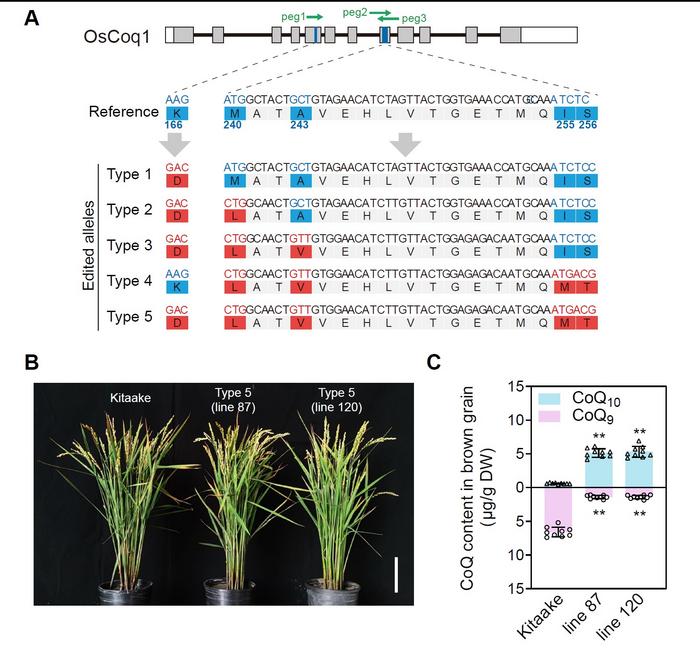

A team of innovative scientists from China has carved a niche in agricultural biotechnology by employing targeted gene editing techniques to engineer rice varieties capable of synthesizing coenzyme Q10 (CoQ10), a compound recognized for its vital role in human health. This landmark achievement holds significant implications for both nutrition and crop science, presenting a pioneering approach to enhancing dietary intake of an essential nutrient.
The research, led by prominent figures in plant sciences, Professors Chen Xiaoya and Gao Caixia, signifies a monumental shift in the genetic manipulation of crops. The study was anchored at the Chinese Academy of Sciences (CAS), where the team identified and modified just five amino acids within the Coq1 enzyme of rice, setting the stage for the development of novel rice strains that naturally produce CoQ10. This groundbreaking work exemplifies how gene editing can be harnessed to address nutritional deficiencies through agricultural innovations.
CoQ10 is a crucial antioxidant that fortifies the human heart and powers the mitochondrial electron transport chain, a key component in energy production within cells. Unlike humans, who generate CoQ10 with a ten-isoprene unit side chain, many food crops, including rice and wheat, typically create a shorter variant called CoQ9, with nine isoprene units. The introduction of rice that synthesizes CoQ10 not only enhances the nutritional profile of plant-based foods but also targets health issues by potentially increasing the bioavailability of this important compound in everyday diets.
The molecular underpinnings dictating the difference in CoQ side-chain lengths had long remained enigmatic. However, the research team capitalized on the extensive collections of plant species housed at the Shanghai Chenshan Botanical Garden. By analyzing 134 plant samples from a diverse range of families, including ferns and flowering plants, they discovered that the ability to produce CoQ10 is an ancestral trait predominantly retained by most plant species. Yet, certain groups such as grasses and cucurbits primarily synthesize CoQ9, underscoring the evolutionary divergences in CoQ synthesis among plant species.
Through cutting-edge analysis techniques, including the assessment of evolutionary trends across over 1,000 terrestrial plant species and the application of machine learning, the researchers pinpointed critical amino acid sites responsible for the variations in CoQ side-chain length. Such intricate analysis not only elucidates the genetic factors at play but also serves as a template for future genetic engineering endeavors in crops, emphasizing the potential of integrating bioinformatics with traditional breeding methods.
Following their strategic gene edits, the rice plants produced in this study showcased promising results, achieving CoQ10 synthesis levels of up to 5 micrograms per gram per rice grain. This remarkable output showcases the efficacy of gene editing technologies in modern crop breeding and its capacity to enhance the nutritional value of staple foods, marking a significant leap toward addressing global food and health challenges.
The development of CoQ10-producing rice has far-reaching consequences, greatly expanding the array of dietary sources for this essential nutrient. In addition to meeting consumer demands for healthier food options, this innovation presents a sustainable strategy for nutritional fortification, as it leverages agricultural advancements to promote public health without reliance on synthetic supplements or fortified products.
Furthermore, this research exemplifies how big data and artificial intelligence can be strategically employed in agricultural science, offering a novel lens through which crop breeding can evolve. The integration of these technologies not only accelerates the pace of discovery but also enhances the precision with which scientists can modify plant traits, thereby fostering more resilient and nutritionally valuable crop varieties.
The implications of this study extend beyond basic research into practical applications, giving rise to a potential revolution in food production systems. As the world grapples with the challenges of food security and malnutrition, the ability to bioengineer crops that produce essential nutrients stands out as a beacon of hope, potentially altering the landscape of agriculture and nutrition for generations to come.
This remarkable research effort, published in the renowned journal Cell, received financial backing from esteemed organizations such as the National Natural Science Foundation of China and the CAS, indicating robust institutional support for groundbreaking scientific explorations. As the scientific community continues to forge ahead, the innovative methodologies employed in this study will likely inspire further inquiries into the genetic manipulation of other staple crops, with the goal of enhancing their nutritional profiles.
In conclusion, the targeted gene editing of rice for enhanced CoQ10 production represents a significant milestone in the intersection of genetics, nutrition, and agricultural science. The successful completion of this study not only illustrates the tremendous possibilities inherent in gene editing technologies but also serves as a compelling case for the integration of modern science into pressing global health issues. The research stands as an exemplary model for the future of crop innovation, paving the way for a healthier and more sustainable food ecosystem.
Subject of Research: Genetic engineering of rice for CoQ10 synthesis
Article Title: Design of CoQ10 crops based on evolutionary history
News Publication Date: 13-Feb-2025
Web References: https://doi.org/10.1016/j.cell.2025.01.023
References: Not available
Image Credits: Credit: XU Jingjing
Keywords: Gene editing, CoQ10, Agricultural biotechnology, Nutritional fortification, Plant genetics, Rice cultivation, Mitochondrial health, Sustainable food production, Evolutionary biology, Antioxidants, Crop innovation, Big data in agriculture.
Tags: addressing nutritional deficienciesagricultural biotechnology innovationsantioxidant-rich cropsChinese Academy of Sciences researchCoQ10 health benefitsenhancing CoQ10 synthesisgene-edited rice productionmitochondrial energy production in cropsnovel rice varieties developmentnutritional enhancement through gene editingplant sciences advancementstargeted gene editing techniques