• HOME
  • NEWS
  • EXPLORE
    • CAREER
      • Companies
      • Jobs
    • EVENTS
    • iGEM
      • News
      • Team
    • PHOTOS
    • VIDEO
    • WIKI
  • BLOG
  • COMMUNITY
    • FACEBOOK
    • INSTAGRAM
    • TWITTER
Monday, August 31, 2026
BIOENGINEER.ORG
No Result
View All Result
  • Login
  • HOME
  • NEWS
  • EXPLORE
    • CAREER
      • Companies
      • Jobs
        • Lecturer
        • PhD Studentship
        • Postdoc
        • Research Assistant
    • EVENTS
    • iGEM
      • News
      • Team
    • PHOTOS
    • VIDEO
    • WIKI
  • BLOG
  • COMMUNITY
    • FACEBOOK
    • INSTAGRAM
    • TWITTER
  • HOME
  • NEWS
  • EXPLORE
    • CAREER
      • Companies
      • Jobs
        • Lecturer
        • PhD Studentship
        • Postdoc
        • Research Assistant
    • EVENTS
    • iGEM
      • News
      • Team
    • PHOTOS
    • VIDEO
    • WIKI
  • BLOG
  • COMMUNITY
    • FACEBOOK
    • INSTAGRAM
    • TWITTER
No Result
View All Result
Bioengineer.org
No Result
View All Result
Home NEWS Science News Biology

Chinese paleontologists find new fossil link in bird evolution

Bioengineer by Bioengineer
September 6, 2023
in Biology
Reading Time: 3 mins read
0
Life reconstruction of the 150-million-year-old avialan theropod Fujianvenator prodigiosus
Share on FacebookShare on TwitterShare on LinkedinShare on RedditShare on Telegram

Birds descended from theropod dinosaurs by the Late Jurassic, but our understanding of the earliest evolution of the Avialae, the clade comprising all modern birds but not Deinonychus or Troodon, has been hampered by a limited diversity of fossils from the Jurassic.
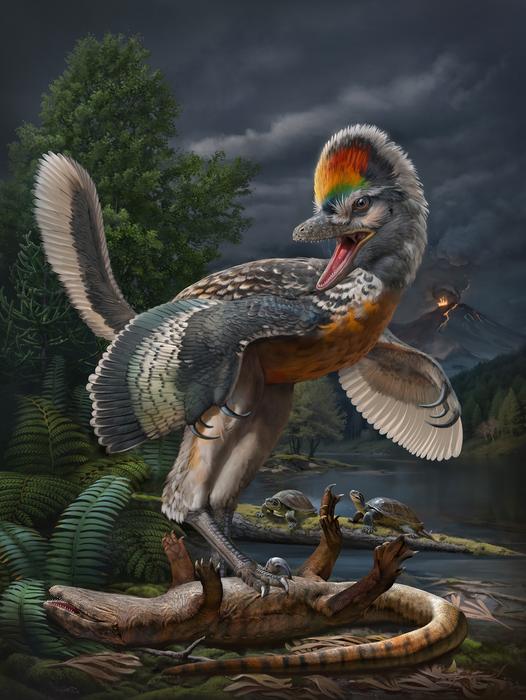
Life reconstruction of the 150-million-year-old avialan theropod Fujianvenator prodigiosus

Credit: ZHAO Chuang

Birds descended from theropod dinosaurs by the Late Jurassic, but our understanding of the earliest evolution of the Avialae, the clade comprising all modern birds but not Deinonychus or Troodon, has been hampered by a limited diversity of fossils from the Jurassic.

As of now, no definitive avialans have been reported except from the Middle–Late Jurassic Yanliao Biota in northeast China (166–159 million years ago; Ma) and the slightly younger German Solnhofen Limestones, which preserve Archaeopteryx. Consequently, there is a gap of about 30 million years before the oldest known record of Cretaceous birds. However, the Jurassic avialans are key to deciphering the evolutionary origin of the characteristic avialan body plan. More importantly, they are key to reconciling the phylogenetic controversy about the origin of birds.

A joint research team from the Institute of Vertebrate Paleontology and Paleoanthropology (IVPP) of the Chinese Academy of Sciences in Beijing and the Fujian Institute of Geological Survey (FIGS) described and analyzed a new 150-million-year-old avialan theropod from Zhenghe County, Fujian Province.

The findings were published in Nature on Sept. 6.

The new species, named Fujianvenator prodigiosus, exhibits a bizarre assembly of morphologies that are shared with other avialans, troodontids, and dromaeosaurids, showing the impact of evolutionary mosaicism in early bird evolution.

“Our comparative analyses show that marked changes in body plan occurred along the early avialan line, which is largely driven by the forelimb, eventually giving rise to the typical bird limb proportion,” said Dr. WANG Min from IVPP, lead and corresponding author of the study. “However, Fujianvenator is an odd species that diverged from this main trajectory and evolved bizarre hindlimb architecture.”

The surprisingly elongate lower leg and other morphologies, in combination with other geological observations, suggest that Fujianvenator lived in a swamp-like environment and was a high-speed runner or a long-legged wader, representing a previously unknown ecology for early avialans.

“Besides Fujianvenator, we have found abundant other vertebrates, including teleosts, testudines and choristoderes,” said XU Liming from FIGS, lead author of the study.

During the Late Jurassic–Early Cretaceous, southeastern China underwent intensive tectonic activities due to subduction of the paleo-Pacific plate, resulting in widespread magmatism and coeval fault-depression basins, where Fujianvenator was found. This geological background is essentially the same as in the Late Jurassic in north and northeastern China, where the older Yanliao Biota is preserved.

“The extraordinary diversity, unique vertebrate composition, and paleoenvironment strongly indicate that this locality documents a terrestrial fauna, which we named the Zhenghe Fauna,” said Dr. ZHOU Zhonghe from IVPP, co-author of the study. In-situ radioisotopic dating and stratigraphic surveys constrain the Zhenghe Fauna to the period from 150–148 Ma. Therefore, Fujianvenator documents one of the stratigraphically youngest and geographically southernmost members of the Jurassic avialans.

The discovery of the Zhenghe Fauna opens a new window into the Late Jurassic terrestrial ecosystem of the planet, and the joint research team from IVPP and FIGS plan to continue their exploration of Zhenghe and nearby areas.


Journal

Nature

DOI

10.1038/s41586-023-06513-7

Article Title

A new avialan theropod from an emerging Jurassic terrestrial fauna

Article Publication Date

6-Sep-2023
Share12Tweet8Share2ShareShareShare2

Related Posts

Methylation puts parasites in motion

Methylation puts parasites in motion

August 31, 2026
Desiccation promotes DNA damage and rifampin resistance in Mycobacterium tuberculosis

Desiccation promotes DNA damage and rifampin resistance in Mycobacterium tuberculosis

August 31, 2026

Gastrointestinal Parasitism in Cattle and Water Buffaloes in Pakistan: Prevalence and Associated Risk Factors

August 31, 2026

Development of HPLC–PDA method for steviol glycosides analysis in food matrices

August 31, 2026

POPULAR NEWS

  • β-Sitosterol from Ipomoea carnea Jacq. As a promising anti-inflammatory agent: Evidence from in silico modeling and in vitro validation

    29 shares
    Share 12 Tweet 7
  • Design, fabrication and characterization of a wearable Fiber Bragg grating sensor for cardiorespiratory monitoring using finger plethysmography

    29 shares
    Share 12 Tweet 7
  • KAIST opens the era of industrial-scale microbial foods, proposing growth strategies for the next-generation protein market

    29 shares
    Share 12 Tweet 7
  • Virologist awarded $2 million NIH grant to investigate how virus-infected cells live and die

    29 shares
    Share 12 Tweet 7

About

We bring you the latest biotechnology news from best research centers and universities around the world. Check our website.

Follow us

Recent News

β-Sitosterol from Ipomoea carnea Jacq. As a promising anti-inflammatory agent: Evidence from in silico modeling and in vitro validation

Design, fabrication and characterization of a wearable Fiber Bragg grating sensor for cardiorespiratory monitoring using finger plethysmography

KAIST opens the era of industrial-scale microbial foods, proposing growth strategies for the next-generation protein market

Subscribe to Blog via Email

Enter your email address to subscribe to this blog and receive notifications of new posts by email.

Join 85 other subscribers
  • Contact Us

Bioengineer.org © Copyright 2023 All Rights Reserved.

Welcome Back!

Login to your account below

Forgotten Password?

Retrieve your password

Please enter your username or email address to reset your password.

Log In
No Result
View All Result
  • Homepages
    • Home Page 1
    • Home Page 2
  • News
  • National
  • Business
  • Health
  • Lifestyle
  • Science

Bioengineer.org © Copyright 2023 All Rights Reserved.