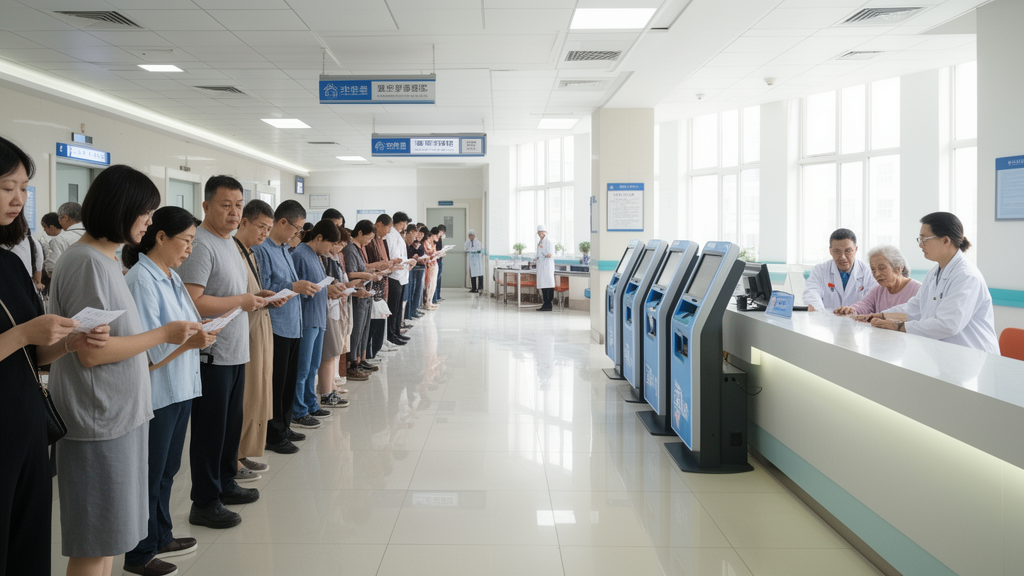
A reform that extended insurance pooling to outpatient care in China’s Urban Employee Basic Medical Insurance was associated with a sustained decline in monthly inpatient expenditure per admission, according to an interrupted time series analysis of claims data published in BMC Health Services Research. The study, led by Chen Chen and colleagues, analyzed micro-level claims records for urban employee inpatients in one Chinese province from January 2022 to December 2024, comparing expenditure and quality-of-care trends before and after the outpatient pooling reform took effect.
The reform was designed to address a long-standing structural imbalance in China’s basic medical insurance system, which had favored inpatient over outpatient services despite the country achieving near-universal insurance coverage. By pooling funds for outpatient care under the UEBMI, policymakers aimed to redistribute healthcare utilization more rationally, optimize resource allocation, and improve the efficiency with which insurance funds are used. The researchers used an interrupted time series design to estimate whether the policy’s implementation changed the level and trajectory of inpatient spending and care-related indicators.
The results showed a two-phase pattern. At the moment the policy was implemented, the monthly mean expenditure per inpatient admission rose immediately, as did several itemized expenditure categories. However, the post-reform monthly trend then fell significantly relative to the pre-reform trajectory: monthly mean expenditure per admission declined by approximately 45 yuan per month during the post-reform period, a change that was statistically significant at P < 0.001. Both health insurance reimbursement payments and out-of-pocket payments followed significant downward post-reform trends as well, with both estimates reaching P < 0.001.
The analysis also examined spending components. Pre-policy rising trends in drug expenditure, examination expenditure, treatment expenditure, and bed expenditure were effectively curbed after the reform, suggesting that the slowdown in overall inpatient costs was broad rather than confined to a single category of care. The authors interpret these changes as potentially easing the financial burden on insured inpatients, while emphasizing that the estimates describe policy-associated changes in observed trends rather than proven causal effects.
Quality-of-care indicators told a more nuanced story. The average length of stay showed a decreasing post-reform trend, which the researchers highlight as a favorable process-of-care signal. The 30-day readmission rate, by contrast, showed a small but statistically significant immediate increase at the time of policy implementation, with a level shift coefficient of 0.016 (P = 0.048). Neither the subsequent change in slope nor the net post-reform trend in readmission rates was statistically significant, meaning the data did not show a sustained deterioration or improvement in readmissions after the initial shift.
Heterogeneity analysis revealed that the estimated magnitude of change varied across hospital levels. Larger point estimates were observed in higher-level hospitals, while primary hospitals showed relatively limited changes. This pattern matters for policy design: the authors note that future reforms should strengthen the capacity of primary healthcare institutions and further advance payment system reforms to enhance policy effectiveness, since the observed expenditure effects were concentrated where higher-level facilities dominate.
Several features of the study define its scope. The evidence comes from a single province and covers urban employee inpatients specifically, so the findings speak most directly to the UEBMI population rather than all Chinese residents. The interrupted time series approach controls for underlying pre-reform trends by comparing trajectories before and after implementation, but it remains an observational design, and the authors frame their conclusions in terms of association with the reform rather than definitive causation. The immediate uptick in spending at implementation followed by a declining trend illustrates why short-window evaluations could reach different conclusions than this multi-year analysis.
For health systems researchers, the study offers a quantitative picture of how extending insurance pooling from inpatient to outpatient services coincided with measurable shifts in inpatient economics. The sustained monthly decline of roughly 45 yuan per admission, the parallel downward trends in both reimbursed and out-of-pocket amounts, and the flattening of previously rising drug, examination, treatment, and bed costs together suggest that the reform altered the spending trajectory of hospitalizations in this insured population. At the same time, the small immediate rise in 30-day readmissions and the muted response in primary hospitals indicate that the policy’s effects were neither uniform across outcomes nor uniform across the hospital hierarchy, underscoring the authors’ call for complementary reforms in primary care capacity and provider payment systems.
Subject of Research: Effects of China's outpatient pooling reform on inpatient expenditure and quality of care
Article Title: Impact of outpatient pooling reform on inpatient expenditure and quality of care: evidence from an interrupted time series analysis in China
Article References: Chen, C., Li, H., Chang, Y., & Yan, J. (2026). Impact of outpatient pooling reform on inpatient expenditure and quality of care: evidence from an interrupted time series analysis in China. BMC Health Services Research. https://doi.org/10.1186/s12913-026-15577-w
Image Credits: AI Generated
DOI: 10.1186/s12913-026-15577-w
Keywords: outpatient pooling reform, Urban Employee Basic Medical Insurance, inpatient expenditure, interrupted time series, health insurance, China, length of stay, 30-day readmission, hospital levels, health policy, claims data, health services research
News Source: Ophelia Keating. (October 26, 2026). China’s outpatient insurance reform linked to falling inpatient costs over time. Scienmag.