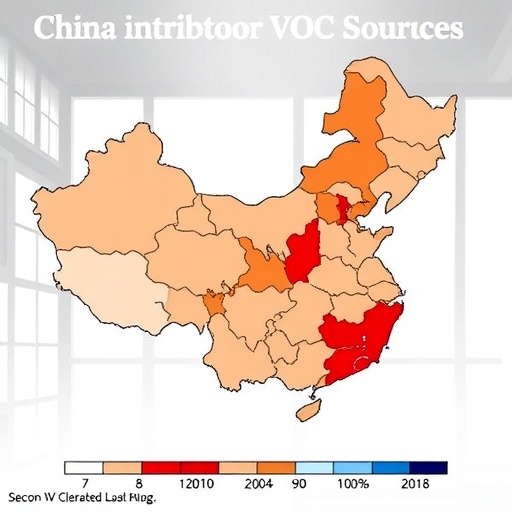
China’s indoor air problem is moving into sharper scientific focus as researchers examine not only how much pollution people breathe inside buildings, but also where that pollution comes from. A study published in the Journal of Exposure Science & Environmental Epidemiology investigates the sources of indoor volatile organic compounds (VOCs) and ranks them according to their attributable burden of disease across China. The work addresses a critical gap in environmental health research: although indoor pollutants are known to contribute substantially to illness, the relative responsibility of individual sources has remained poorly understood.
VOCs are a broad family of carbon-containing chemicals that readily evaporate into indoor air at room temperature. They include substances released from paints, adhesives, cleaning products, furnishings, building materials, personal-care products and combustion activities. Some VOCs are associated with irritation of the eyes and airways, while others can affect the nervous system or contribute to cancer risk after long-term exposure. Indoor concentrations can become much higher than outdoor levels because buildings restrict ventilation and because emissions are often generated close to where people spend much of their time.
The health significance of indoor VOCs is amplified by the amount of time people spend indoors. Homes, offices, schools and other enclosed environments can expose occupants continuously or repeatedly, creating a pattern of exposure that differs from short-term contact with outdoor pollution. Concentrations may also vary dramatically between buildings. Newly renovated rooms, for example, can release chemicals from fresh coatings, flooring, furniture and composite wood products, while kitchens and other areas where fuels are burned may contain a different mixture of pollutants. Understanding these patterns is essential for determining which interventions could deliver the greatest health benefits.
Liu, Huang, Yin and their colleagues approach this challenge through the concept of attributable burden of disease. Rather than simply ranking pollutants by their measured concentration, this framework estimates the amount of illness or premature mortality that can be linked statistically to exposure under defined health-risk assumptions. It combines information about exposure levels, the size and characteristics of the exposed population, the relationship between exposure and health outcomes, and the severity or frequency of those outcomes. The approach can therefore reveal why a source with moderate concentrations may still represent a major public-health concern if it affects millions of people or emits chemicals with particularly serious effects.
Source attribution is technically difficult because indoor air contains complex chemical mixtures. A single compound may be released by several products, while one source can emit dozens of VOCs at different rates. Researchers must distinguish between direct emissions and secondary pollutants formed after chemicals react with oxidants such as ozone or hydroxyl radicals. Ventilation, temperature, humidity, building age and occupant behavior further alter indoor concentrations. Cooking, cleaning, smoking, renovation and the use of fragrances can produce short-lived peaks that may be missed by occasional sampling, even though repeated peaks can contribute substantially to cumulative exposure.
The study’s central contribution is to place these sources into a health-oriented ranking for China, rather than treating indoor VOC pollution as one undifferentiated problem. Such a ranking could help policymakers, building managers and households prioritize action. Measures might include improving product standards, reducing emissions from construction and furnishings, strengthening ventilation requirements, controlling combustion-related pollution and providing clearer information about chemical ingredients. The value of a source-based assessment is that it connects exposure science with prevention: reducing a high-impact source may protect more people than targeting a pollutant that is easier to measure but contributes less to the overall disease burden.
China provides an especially important setting for this analysis. Rapid urbanization, extensive construction and renovation, changing lifestyles and the widespread use of manufactured materials have transformed indoor environments over the past two decades. At the same time, differences in housing quality, ventilation, climate, energy use and regional economic conditions can create sharply contrasting exposure profiles. A national assessment must therefore account for a population living in diverse buildings and climatic zones, while recognizing that indoor air pollution is not distributed evenly. Vulnerability may also vary with age, health status, occupation and the amount of time spent indoors.
The researchers’ focus on attributable burden also highlights the difference between hazard and risk. A chemical may be hazardous because it can cause harm under certain conditions, but the public-health risk depends on the concentration, duration and number of people exposed. Risk assessment must additionally address uncertainty in toxicological evidence and exposure measurements. For some VOCs, health effects are well characterized; for others, evidence may be limited or complicated by simultaneous exposure to multiple chemicals. Ranking sources does not eliminate these uncertainties, but it can make them more transparent and identify where better measurements or targeted studies are most urgently needed.
The findings are likely to have implications beyond China because many of the products and building practices associated with indoor VOC emissions are used internationally. Yet the study also underscores why indoor-air policies cannot simply be copied from one country to another. Building design, climate, fuel use, consumer behavior and regulatory standards all influence exposure. A strategy that works in a tightly sealed, mechanically ventilated office may not work in a naturally ventilated home, just as advice developed for one climate may be unsuitable elsewhere. By linking sources to disease burden at a national scale, the research offers a framework for designing interventions that reflect real-world conditions rather than relying on a single universal solution.
Indoor air pollution is often invisible, intermittent and chemically complicated, making it easy to underestimate. The new analysis shifts attention from the question of whether VOCs are present to the more consequential question of which sources matter most for health. That change in perspective could accelerate improvements in building materials, consumer products, ventilation practices and public-health surveillance. As China continues to urbanize and people spend much of their lives indoors, identifying the sources responsible for the greatest share of VOC-related disease burden may prove as important as measuring the pollutants themselves.
Subject of Research: Indoor volatile organic compound sources and their attributable burden of disease in China
Article Title: Ranking sources of indoor volatile organic compounds by attributable burden of disease in China
Article References: Liu, N., Huang, CS., Yin, Y. et al. Ranking sources of indoor volatile organic compounds by attributable burden of disease in China. J Expo Sci Environ Epidemiol (2026). https://doi.org/10.1038/s41370-026-00964-6
Image Credits: AI Generated
DOI: 10.1038/s41370-026-00964-6
Keywords: Indoor air pollution, volatile organic compounds, VOCs, attributable burden of disease, exposure assessment, China, environmental health, source apportionment, public health
Tags: building materials and indoor pollutiondisease burden from indoor air pollutantseffects of cleaning products on indoor airhealth risks of VOC exposureindoor air pollution epidemiologyindoor air pollution health impactsindoor air pollution policy and regulationindoor air quality research ChinaIndoor VOC sourcesranking indoor pollution sourcesventilation and VOC concentrationvolatile organic compounds in buildings