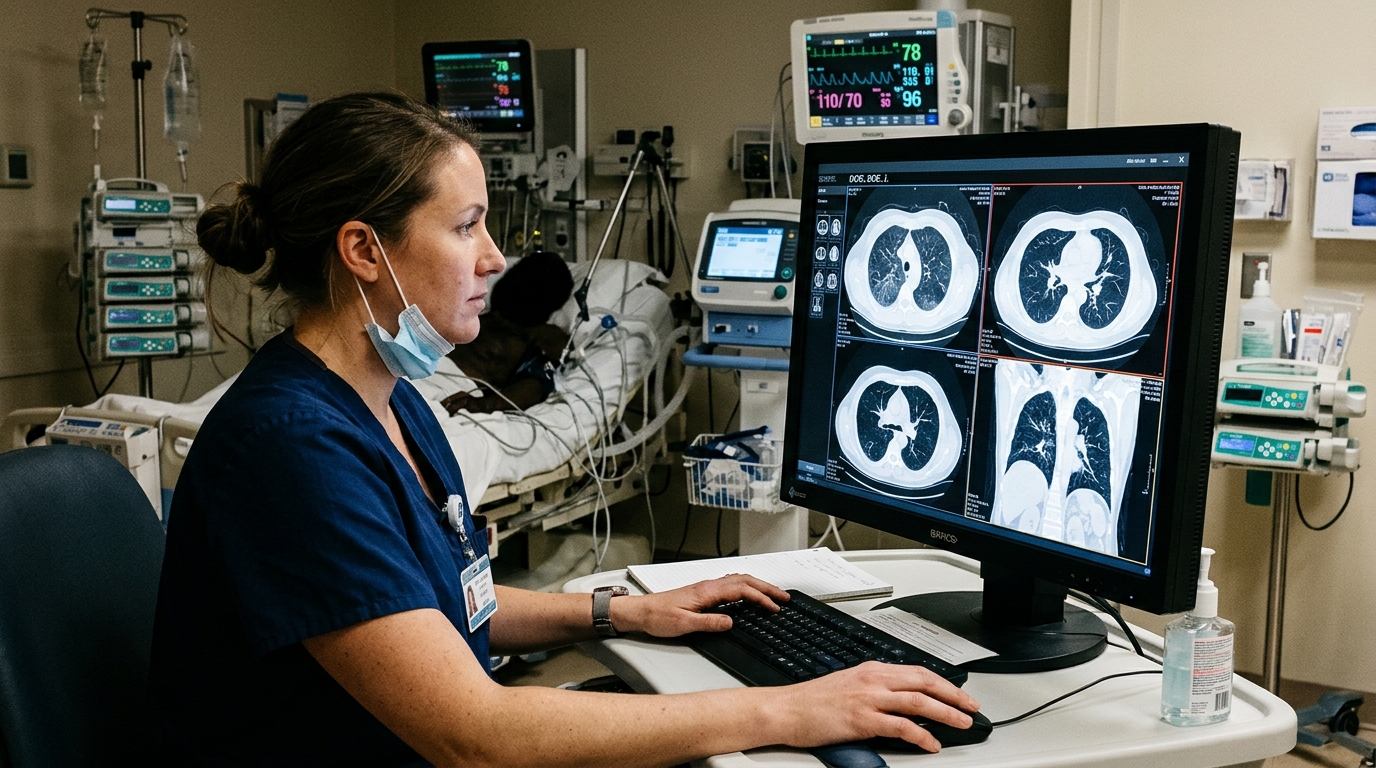
Patients with traumatic brain injury face a hidden danger that often emerges days after the initial trauma: severe hospital-acquired pneumonia. A retrospective cohort study now reports that a bedside nomogram combining early chest CT findings with routine clinical and laboratory variables can estimate this risk with an area under the curve of 0.880 in a training cohort and 0.871 in an independent validation cohort. The work, published in Frontiers in Medicine, drew on 781 patients admitted to the Department of Neurosurgery at Chongqing Emergency Medical Center between January 2020 and December 2024, and it offers neurocritical care teams a structured way to flag high-risk individuals within the first 48 hours of hospitalization.
Severe hospital-acquired pneumonia, abbreviated sHAP, is an advanced form of pneumonia that appears at least 48 hours after admission and was neither present nor incubating when the patient arrived. Among patients with traumatic brain injury, previous studies cited in the paper report that hospital-acquired pneumonia occurs in roughly 40% to 65% of cases, particularly among those requiring intensive care or mechanical ventilation. The condition prolongs mechanical ventilation, intensive care unit stays and overall hospitalization while increasing disability and mortality. In this study cohort, 247 of the 781 patients developed sHAP, corresponding to an overall incidence of 31.6%, with 184 events in the training set and 63 in the validation set.
The biological backdrop helps explain why brain injury predisposes the lungs to trouble. Injury to the central nervous system triggers a systemic inflammatory response that may evolve into immunosuppression mediated by autonomic nervous system activation and neuroendocrine dysregulation. This immune dysfunction compromises host defense against pathogens, while brain injury–related reductions in consciousness and impaired airway protective reflexes increase the risk of secretion aspiration. Conventional laboratory markers such as blood cell counts, procalcitonin and C-reactive protein mainly reflect systemic inflammation and lack specificity, because traumatic brain injury itself drives non-infectious inflammation. The study team therefore turned to the lungs themselves, adapting a semi-quantitative CT scoring framework originally proposed for COVID-19 prognosis.
All chest CT scans were obtained within 48 hours of hospital admission using a 256-slice CT system covering the entire lung field. Two experienced respiratory physicians who were blinded to clinical outcomes independently reviewed the images, resolving discrepancies by consensus; no formal interobserver reliability analysis such as kappa statistics was performed, a limitation the authors acknowledge. Each lung was segmented into lobes, and the extent of ground-glass opacity and consolidation was scored separately in each of the five lobes on a scale from 0 to 5, where 0 indicated no involvement, 1 indicated less than 5% of the lobe, 2 indicated 5% to 25%, 3 indicated 26% to 50%, 4 indicated 51% to 75%, and 5 indicated more than 75%. The five lobar scores were summed to produce a GGO score and a consolidation score, each ranging from 0 to 25, with higher values indicating greater pulmonary involvement.
A crucial methodological decision shaped how these scores were interpreted. In the acute trauma setting, pulmonary contusion, intraparenchymal hemorrhage, edema, aspiration-related injury and early inflammation can overlap on CT, so these lesions were not regarded as pneumonia at admission and were not excluded from scoring. Instead, reviewers assigned them to the GGO or consolidation category by attenuation pattern and included them in the total score, treating the values as semi-quantitative descriptors of early parenchymal involvement. Ground-glass opacity was defined as a mild increase in pulmonary attenuation with preserved bronchial and vascular margins, whereas consolidation represented a marked increase in attenuation with obscuration of those structures, reflecting complete replacement of alveolar air by fluid, inflammatory cells or other materials.
The sHAP outcome itself was classified according to the 2016 Infectious Diseases Society of America/American Thoracic Society guidelines. Patients met the severe definition when they displayed at least one major criterion, requiring vasopressor support for septic shock, or at least three minor criteria, including a respiratory rate above 30 breaths per minute, a PaO2/FiO2 ratio of 250 or less, multilobar infiltrates, new-onset altered mental status, blood urea nitrogen of at least 7.1 mmol per liter, leukopenia, thrombocytopenia, core temperature below 36 degrees Celsius, or hypotension requiring aggressive fluid resuscitation. All patients received standardized preventive care, including head-of-bed elevation, subglottic secretion drainage, oral decontamination with chlorhexidine and daily spontaneous awakening trials.
Model construction followed a multistep statistical pipeline. The 781 patients were randomly allocated to a training cohort of 547 and a validation cohort of 234 at a 7:3 ratio. Least absolute shrinkage and selection operator regression, known as LASSO, was applied in the training cohort to reduce dimensionality and mitigate multicollinearity, identifying ten variables with non-zero coefficients. Best subset selection based on the Bayesian information criterion then indicated that approximately eight predictors offered the optimal balance between fit and parsimony. The ten LASSO-identified variables entered multivariable logistic regression, and non-significant predictors were sequentially removed until eight remained. With 184 sHAP events in the training cohort, the events-per-variable ratio reached 23.0, which the authors describe as adequate for multivariable logistic regression.
The final eight-variable model included age, Glasgow Coma Scale score, mechanical ventilation, white blood cell count, lymphocyte count, hemoglobin, GGO score and consolidation score. In the training cohort, increasing age carried an odds ratio of 1.02 (95% CI 1.00–1.04, P = 0.032), lower GCS score an odds ratio of 0.84 (95% CI 0.78–0.91, P < 0.001), mechanical ventilation an odds ratio of 3.94 (95% CI 2.14–7.28, P < 0.001), GGO score an odds ratio of 1.10 (95% CI 1.01–1.20, P = 0.038), white blood cell count an odds ratio of 1.23 (95% CI 1.14–1.33, P < 0.001), and consolidation score an odds ratio of 1.20 (95% CI 1.03–1.39, P = 0.021). Higher lymphocyte count (odds ratio 0.59, 95% CI 0.40–0.86, P = 0.007) and higher hemoglobin level (odds ratio 0.99, 95% CI 0.97–1.00, P = 0.042) were associated with reduced likelihood of sHAP. The nomogram translates these coefficients into point values that clinicians sum to derive an individual predicted probability.
Performance testing covered discrimination, calibration and clinical utility. The training cohort yielded an AUC of 0.880 (95% CI 0.851–0.908), and the validation cohort an AUC of 0.871 (95% CI 0.824–0.918). Calibration curves showed close concordance between predicted and observed probabilities, with the Hosmer-Lemeshow test indicating good fit in the training cohort (χ2 = 8.848, df = 8, P = 0.355) and the validation cohort (χ2 = 10.551, df = 8, P = 0.228). Both discrimination and calibration assessments were internally validated using 1,000 ordinary bootstrap resamples with percentile confidence intervals. Decision curve analysis found the model delivered higher net benefit than treat-all and treat-none strategies across threshold probabilities of 2% to 91% in the training cohort and 5% to 73% in the validation cohort.
The authors frame the tool as a practical and interpretable instrument for early, individualized risk stratification in neurocritical care, potentially supporting timely preventive and therapeutic decision-making. They also list limitations that readers should weigh: the retrospective single-center design may introduce selection bias and limit generalizability; external validation in independent multicenter populations is still required; the semi-quantitative visual scoring approach may miss subtle imaging information compared with automated radiomics; formal interobserver reliability analysis was not performed; the model used variables collected early after admission and did not account for dynamic changes during hospitalization; antimicrobial exposure and neurosurgical procedures were not incorporated into the prespecified predictor set; and unmeasured confounders inherent to retrospective analyses cannot be fully excluded. The analysis did not evaluate the subsequent course of pneumonia, treatment response or prognosis after sHAP onset. Within those boundaries, the study demonstrates that early lung imaging, quantified simply enough for bedside use, can add disease-specific signal to the prediction of one of traumatic brain injury’s most consequential complications.
Subject of Research: A bedside prediction model combining early chest CT scores with clinical variables to estimate severe hospital-acquired pneumonia risk in traumatic brain injury patients.
Article Title: Development and validation of a bedside nomogram for predicting severe hospital-acquired pneumonia in traumatic brain injury patients based on early semi-quantitative chest CT assessment
Article References: Wang, Y., Zhou, W., Xiong, Q., Tang, D., Chen, P., & Deng, Y. (2026). Development and validation of a bedside nomogram for predicting severe hospital-acquired pneumonia in traumatic brain injury patients based on early semi-quantitative chest CT assessment. Frontiers in Medicine, 13, Article 1926466. https://doi.org/10.3389/fmed.2026.1926466
Image Credits: AI Generated
DOI: 10.3389/fmed.2026.1926466
Keywords: traumatic brain injury, severe hospital-acquired pneumonia, chest CT, ground-glass opacity, consolidation score, nomogram, prediction model, neurocritical care, logistic regression, LASSO regression, decision curve analysis, hospital-acquired infection
News Source: Cassandra Pierce. (November 6, 2026). Chest CT Scores and Bedside Nomogram Predict Severe Pneumonia After Traumatic Brain Injury. Scienmag.