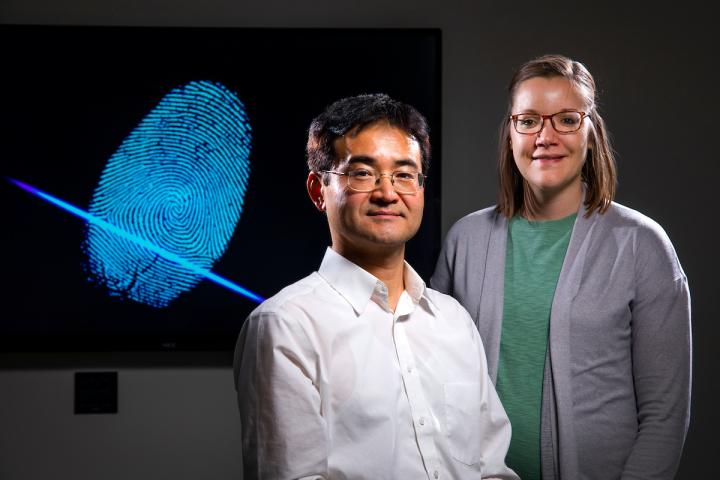
Credit: Photo by Christopher Gannon/Iowa State University
AMES, Iowa – Fingerprints are telling us more and more about the people that left them behind.
Sure, we all know the unique whorls, loops and arches in a print can identify a person. But now researchers are studying how the natural and environmental compounds within them can also offer clues about a person’s lifestyle, gender and ethnicity.
But even as researchers discover new information in fingerprints, they still hadn’t found a way to determine a basic fact about a print: How old is it?
That’s information that could potentially tie a suspect to a crime scene.
And that’s information chemists at Iowa State University are beginning to provide.
What happened to the unsaturated oils?
Paige Hinners was using a computer algorithm to objectively analyze the degradation and spread of fingerprint ridges over time – potentially a way to determine the age of a fingerprint – when she noticed something else in her data. The unsaturated fatty oils in a fingerprint were disappearing from her measurements.
“If we’re losing them, where are they going?” asked Hinners, who in December completed her doctorate in analytical chemistry at Iowa State and now works as a senior chemist for Ames-based Renewable Energy Group Inc. She worked on the fingerprint project while she was a graduate student in the research group of Young-Jin Lee, a professor of chemistry at Iowa State. Madison Thomas, a former Iowa State undergraduate student, also assisted with the project.
Eventually the research group found answers: As the unsaturated fats – triacylglycerols, to be exact – disappeared from the data, other compounds resulting from reactions with ozone – or ozonolysis – started showing up.
That led to numerous trials and steps to confirm that ozone was causing the degradation of the unsaturated fats in fingerprints. And that led to the conclusion that, with more study, this could turn into a useful tool to determine the age of a fingerprint.
The Iowa State chemists’ discovery was recently published online by the research journal Analytical Chemistry and is featured on a supplementary cover of the current print edition.
The paper describes how the chemists used a tool called matrix-assisted laser desorption/ionization mass spectrometry imaging. It’s technology that uses a laser to analyze compounds left on a surface then records the mass and electrical charge of each component within a sample, such as the various oils in a fingerprint. The imaging tool allowed the chemists to track the degradation of unsaturated oils due to reaction with ozone in the air.
How precise is the technique?
“Right now, we can measure the number of days (since a print was left),” Hinners said. “It’s easy to tell one-day old from fresh. There’s no doubt about that.”
The chemists also tested whether the powder used to make fingerprints visible would affect the ability of mass spectrometry to analyze fingerprint degradation and aging. It turned out the powder did not affect the researchers’ ability to collect data and determine fingerprint aging.
‘This might be the way’
Lee described the study – which was supported by a $362,000 grant from the National Institute of Justice – as a proof-of-concept project. And so the testing was limited to fingerprints from three people.
The data did show individual differences in the amount of unsaturated oils in fingerprints and the rate of reaction with ozone and resulting degradation, he said. So more study is needed to understand the different levels of fatty oils individuals have and how that would affect degradation. The researchers are also looking at how environmental factors such as humidity could affect reactions with ozone.
A new $516,800 grant from the National Institute of Justice will keep the fingerprint-aging study going. The grant will also allow the researchers to study how fatty oils in fingerprints could offer clues about a person’s health and other characteristics.
Though the technique for determining fingerprint aging needs more study, Lee said the concept has been proven:
“We can measure decomposition of unsaturated triacylglycerols as a function of time,” he said. “We’ve studied the mechanisms and proved what’s happening. By measuring how fast it’s decaying, we can come up with an idea of how old it is.”
The most exciting part of the project, which began by looking in a different direction?
“When we reproduced this with each person, it was fairly consistent,” said Hinners, who still serves as a resource for Lee’s research group. “And so we learned this might actually tell us how old a fingerprint actually is. This might be the way – that’s exciting.”
###
Media Contact
Young-Jin Lee
[email protected]
515-294-1235
Original Source
https:/
Related Journal Article
http://dx.