• HOME
  • NEWS
  • EXPLORE
    • CAREER
      • Companies
      • Jobs
    • EVENTS
    • iGEM
      • News
      • Team
    • PHOTOS
    • VIDEO
    • WIKI
  • BLOG
  • COMMUNITY
    • FACEBOOK
    • INSTAGRAM
    • TWITTER
Monday, May 11, 2026
BIOENGINEER.ORG
No Result
View All Result
  • Login
  • HOME
  • NEWS
  • EXPLORE
    • CAREER
      • Companies
      • Jobs
        • Lecturer
        • PhD Studentship
        • Postdoc
        • Research Assistant
    • EVENTS
    • iGEM
      • News
      • Team
    • PHOTOS
    • VIDEO
    • WIKI
  • BLOG
  • COMMUNITY
    • FACEBOOK
    • INSTAGRAM
    • TWITTER
  • HOME
  • NEWS
  • EXPLORE
    • CAREER
      • Companies
      • Jobs
        • Lecturer
        • PhD Studentship
        • Postdoc
        • Research Assistant
    • EVENTS
    • iGEM
      • News
      • Team
    • PHOTOS
    • VIDEO
    • WIKI
  • BLOG
  • COMMUNITY
    • FACEBOOK
    • INSTAGRAM
    • TWITTER
No Result
View All Result
Bioengineer.org
No Result
View All Result
Home NEWS Science News Chemistry

Chemists use light to build biologically active compounds

Bioengineer by Bioengineer
November 14, 2019
in Chemistry
Reading Time: 2 mins read
0
IMAGE
Share on FacebookShare on TwitterShare on LinkedinShare on RedditShare on Telegram

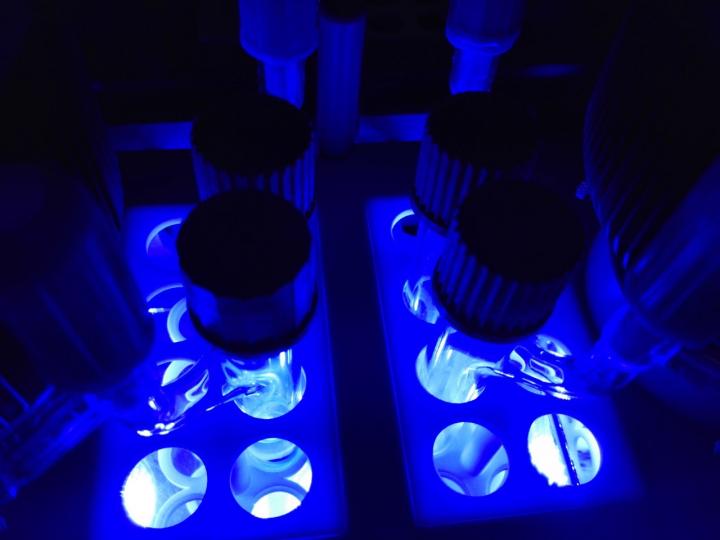
Photocatalyst builds 3D scaffolds from flat aromatics/Study published in Chem
IMAGE

Credit: Jiajia Ma


Some of the most biologically active molecules, including synthetic drugs, contain a central, nitrogen-containing chemical structure called an isoquinuclidine. This core has a three-dimensional shape which means it has the potential to interact more favourably with enzymes and proteins than flat, two-dimensional molecules. Unfortunately methods to make isoquinuclidines and the related dehyrdoisoquinuclidines suffer from a number of drawbacks which make it more difficult for scientists to discover new medicinal compounds. A team of researchers led by Prof. Frank Glorius at the University of Münster (Germany) have now published a new method of enabling this reaction. The study was published in the journal Chem.

Background and method:

Several methods for the preparation of three-dimensional core structures involve the addition of another molecule across a flat structure. The internal bonds of both molecules are reorganised to create new bonds between them in a transformation called a cycloaddition. In the case of isoquinuclidines, there is a high energy barrier to this chemical reaction since the flat starting molecule, a so-called pyridine, is very stable. This means that simple heating of the reaction is not enough to allow it to occur.

In the newly developed method, a special “photocatalyst” is able to transfer light energy from blue LEDs to excite a carbon-carbon double bond containing starting material to a high energy state. The excited molecule is then capable of addition into a nearby pyridine to give a dehydroisoquinuclidine. The scientists disclosed 44 examples of these compounds, which could afterwards be transformed into isoquinuclidines and other useful structures.

A highlight of the research is the recyclability of the photocatalyst, which can be used more than ten times without any decrease in its activity. The scientists also carried out experiments to understand the mechanistic details of how the reaction works, supported by computational calculations.

“We hope that the work will inspire other chemists to explore the area of so-called ‘energy-transfer catalysis’ and that easier access to these valuable molecules will accelerate the development of new drug molecules,” says Dr. Jiajia Ma, first author of the study.

###

Original publication:

J. Ma et al. (2019): Direct Dearomatization of Pyridines via an Energy-Transfer-Catalyzed Intramolecular [4+2] Cycloaddition. Chem; DOI: 10.1016/j.chempr.2019.10.016

Media Contact
Frank Glorius
[email protected]
49-251-833-3248

Original Source

https://www.uni-muenster.de/news/view.php?cmdid=10635

Related Journal Article

http://dx.doi.org/10.1016/j.chempr.2019.10.016

Tags: Chemistry/Physics/Materials SciencesPolymer Chemistry
Share12Tweet8Share2ShareShareShare2

Related Posts

Miniature Sensor Uses Light to Detect Touch — Chemistry

Miniature Sensor Uses Light to Detect Touch

May 8, 2026
Iron Minerals Determine Whether Dissolved Organic Matter Fuels Microbes or Becomes Long-Term Carbon Storage — Chemistry

Iron Minerals Determine Whether Dissolved Organic Matter Fuels Microbes or Becomes Long-Term Carbon Storage

May 8, 2026

Kate Evans Appointed Associate Lab Director for Biological and Environmental Systems Science at ORNL

May 8, 2026

Advancing Multiscale Modeling and Overcoming Operational Challenges in Autothermal CO₂-to-Methanol Reactors

May 8, 2026
Please login to join discussion

POPULAR NEWS

  • Research Indicates Potential Connection Between Prenatal Medication Exposure and Elevated Autism Risk

    840 shares
    Share 336 Tweet 210
  • New Study Reveals Plants Can Detect the Sound of Rain

    727 shares
    Share 290 Tweet 181
  • Salmonella Haem Blocks Macrophages, Boosts Infection

    61 shares
    Share 24 Tweet 15
  • Breastmilk Balances E. coli and Beneficial Bacteria in Infant Gut Microbiomes

    57 shares
    Share 23 Tweet 14

About

We bring you the latest biotechnology news from best research centers and universities around the world. Check our website.

Follow us

Recent News

New Post-Hoc Analysis Explores Daily Oral Orforglipron Use in Adults Over 65 with Obesity, Regardless of Diabetes Status

Evaluating Digoxin Use in Patients with Symptomatic Rheumatic Heart Disease

Evaluating the Effectiveness and Safety of Digitalis Glycosides in Treating Heart Failure

Subscribe to Blog via Email

Enter your email address to subscribe to this blog and receive notifications of new posts by email.

Join 82 other subscribers
  • Contact Us

Bioengineer.org © Copyright 2023 All Rights Reserved.

Welcome Back!

Login to your account below

Forgotten Password?

Retrieve your password

Please enter your username or email address to reset your password.

Log In
No Result
View All Result
  • Homepages
    • Home Page 1
    • Home Page 2
  • News
  • National
  • Business
  • Health
  • Lifestyle
  • Science

Bioengineer.org © Copyright 2023 All Rights Reserved.