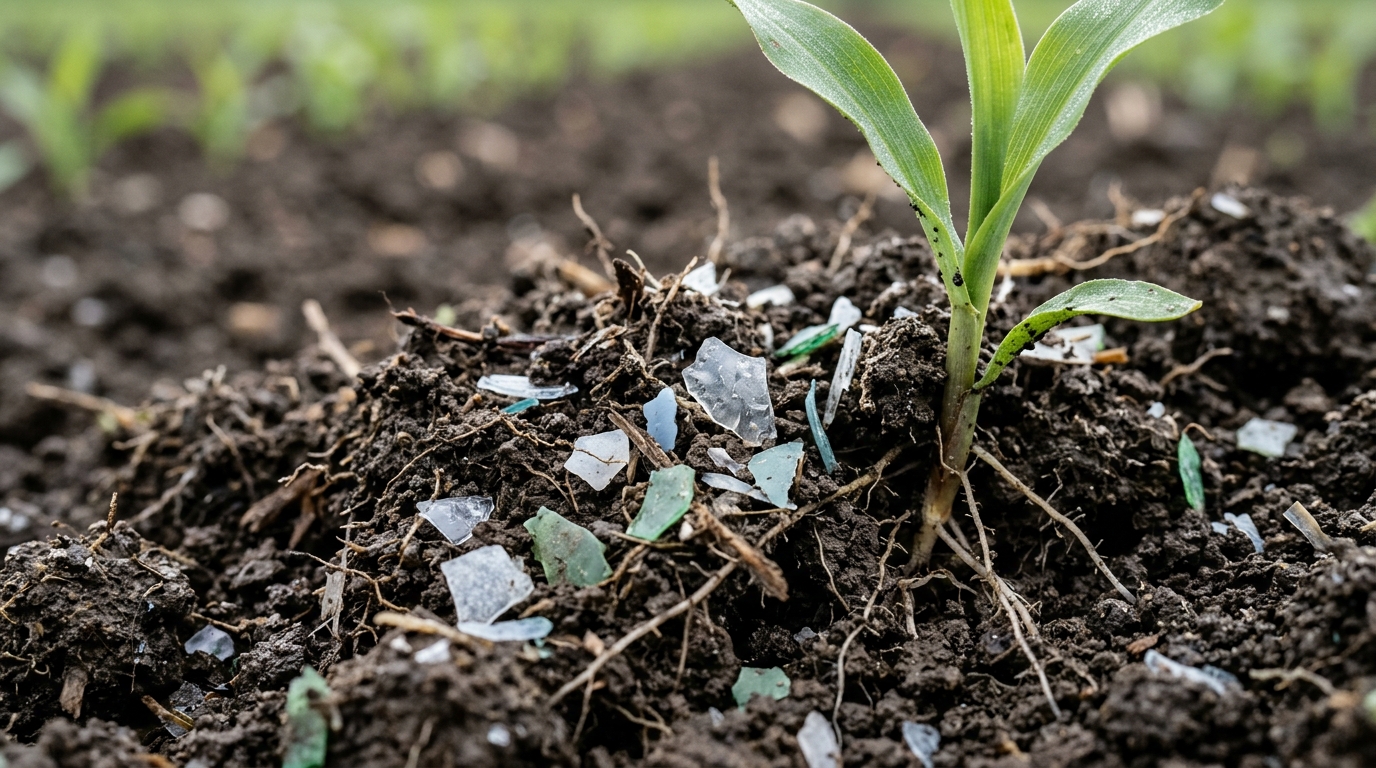
Polyethylene terephthalate microplastics prepared through chemical dissolution and precipitation trigger stronger biological responses in soil and crop systems than mechanically fragmented particles, according to a ninety-day maize pot experiment. Researchers found that dissolving the polymer in trifluoroacetic acid altered its physical and chemical properties, resulting in notable shifts in soil biological indicators and reduced maize growth. However, the study emphasized that these observed outcomes cannot be attributed exclusively to structural changes in the plastic, because differences in particle size, morphology, and potential solvent carryover also influenced the experimental system.
The investigation compared three distinct plastic preparations to evaluate how production methods influence microplastic behavior in agricultural soil. Two fractions, designated as PET-S and PET-L, were prepared through mechanical fragmentation, representing conventional physical breakdown. The third preparation, designated as PET-TFA, was generated through a dissolution and precipitation process utilizing trifluoroacetic acid. To establish baseline physical characteristics, the team analyzed all three fractions using Fourier-transform infrared spectroscopy, differential scanning calorimetry, and particle-size analysis before introducing them into the soil.
Laboratory characterization revealed marked physical distinctions between the chemical and mechanical preparations. PET-TFA exhibited different spectral and thermal properties compared to both PET-S and PET-L, alongside a smaller median particle size. The particles also differed slightly in morphology across the tested groups. These materials were subsequently mixed into soil across an experimental concentration gradient spanning 0.05 percent, 0.1 percent, 0.2 percent, and 0.4 percent weight by weight, allowing the researchers to track both plant and soil endpoints across a ninety-day cultivation period with maize.
Throughout the exposure period, the mechanically fragmented fractions PET-S and PET-L induced comparatively limited changes across the measured soil and crop endpoints. In contrast, soil amended with the chemically prepared PET-TFA displayed substantial biological and biochemical alterations. Soil microbial communities responded across multiple endpoints, with PET-TFA altering both bacterial 16S and fungal 18S ribosomal DNA gene-copy abundance, as well as influencing the enzymatic activity of arylsulfatase within the soil matrix.
The microbial shifts exhibited distinct concentration-dependent patterns under PET-TFA exposure. Bacterial 16S ribosomal DNA gene-copy abundance was higher than the control at lower exposure levels between 0.05 percent and 0.2 percent, but it declined below control levels at the maximum concentration of 0.4 percent. Soil enzyme responses varied depending on the specific endpoint evaluated. Furthermore, while the calculated carbon-balance indicator, designated as C_loss, increased with rising PET-TFA concentrations and significantly exceeded the control at 0.2 percent and 0.4 percent, basal soil respiration showed no significant differences from the control in individual treatment comparisons.
Plant development also demonstrated clear sensitivity to the presence of chemically modified microplastics. Maize aboveground biomass was lower than the untreated control across all tested PET-TFA concentrations, spanning from 0.05 percent to 0.4 percent weight by weight. When compared directly against the control and the mechanically fragmented PET treatments, aboveground maize biomass was reduced at concentrations from 0.1 percent to 0.4 percent. The mechanical fractions did not produce equivalent growth reductions under the same pot conditions.
Although the increased carbon-balance indicator and biological shifts provided indirect indications of higher biological reactivity and susceptibility to biodegradation in PET-TFA, the researchers stressed that the findings do not directly confirm plastic degradation. Because the calculated carbon-balance metric could not differentiate carbon derived from polyethylene terephthalate from native soil organic matter, carbon loss cannot verify breakdown. Moreover, because the fractions differed in median size and shape, and chemical carryover from dissolution remains possible, preparation techniques fundamentally complicate the interpretation of microplastic ecotoxicity studies.
Subject of Research: Ecotoxicological effects of chemically modified PET microplastics in soil-plant systems
Article Title: Structural modification of polyethylene terephthalate microplastics induced by dissolution–precipitation is associated with apparent biodegradability and ecotoxicological responses in soil–plant systems
Article References: Kučerík, J., Holátko, J., Kalčíková, G., Klofáč, D., Malyugina, S., Škarpa, P., Cajthaml, T., Kintl, A., Pěnčík, O., Kameníková, E., & Brtnický, M. (2026). Structural modification of polyethylene terephthalate microplastics induced by dissolution–precipitation is associated with apparent biodegradability and ecotoxicological responses in soil–plant systems. Microplastics and Nanoplastics. https://doi.org/10.1186/s43591-026-00263-9
Image Credits: AI Generated
DOI: 10.1186/s43591-026-00263-9
Keywords: polyethylene terephthalate, microplastics, dissolution-precipitation, trifluoroacetic acid, PET-TFA, soil ecotoxicology, maize biomass, pot experiment, bacterial 16S rDNA, fungal 18S rDNA, arylsulfatase activity, basal respiration, carbon-balance indicator, differential scanning calorimetry, FTIR spectroscopy, particle size analysis
News Source: Alan Morgan. (November 28, 2026). Chemically Treated PET Microplastics Alter Soil Responses and Reduce Maize Biomass. Scienmag.