• HOME
  • NEWS
  • EXPLORE
    • CAREER
      • Companies
      • Jobs
    • EVENTS
    • iGEM
      • News
      • Team
    • PHOTOS
    • VIDEO
    • WIKI
  • BLOG
  • COMMUNITY
    • FACEBOOK
    • INSTAGRAM
    • TWITTER
Monday, May 18, 2026
BIOENGINEER.ORG
No Result
View All Result
  • Login
  • HOME
  • NEWS
  • EXPLORE
    • CAREER
      • Companies
      • Jobs
        • Lecturer
        • PhD Studentship
        • Postdoc
        • Research Assistant
    • EVENTS
    • iGEM
      • News
      • Team
    • PHOTOS
    • VIDEO
    • WIKI
  • BLOG
  • COMMUNITY
    • FACEBOOK
    • INSTAGRAM
    • TWITTER
  • HOME
  • NEWS
  • EXPLORE
    • CAREER
      • Companies
      • Jobs
        • Lecturer
        • PhD Studentship
        • Postdoc
        • Research Assistant
    • EVENTS
    • iGEM
      • News
      • Team
    • PHOTOS
    • VIDEO
    • WIKI
  • BLOG
  • COMMUNITY
    • FACEBOOK
    • INSTAGRAM
    • TWITTER
No Result
View All Result
Bioengineer.org
No Result
View All Result
Home NEWS Science News Biology

Checking DNA base editor’s mistakes and tricks to reduce them

Bioengineer by Bioengineer
March 4, 2019
in Biology
Reading Time: 2 mins read
0
IMAGE
Share on FacebookShare on TwitterShare on LinkedinShare on RedditShare on Telegram

IBS-developed Digenome-seq technique reveals the accuracy of CRISPR-based editing tool that changes DNA letter A to G
IMAGE

Credit: IBS

Researchers at the Center for Genome Engineering, within the Institute for Basic Science (IBS, South Korea) have identified the mistake-rate of DNA editing tools, based on CRISPR and known as adenine base editors. Assessing the genome-wide target specificity of these innovative techniques is essential to harness their applications in clinics and biotechnology. Their findings were published in Nature Biotechnology.

DNA’s four letters, or bases, are the alphabet used by our cells: adenines (A) pairs with thymines (T), cytosines (C) with guanines (G), making a unique combination of 3.2 billion letters, that makes us who we are. Since some genetic diseases are caused by a mutation of just one letter, some of the applications of CRISPR – a very successful and powerful gene engineering tool – deal with the correction of this single-letter difference. Examples of proteins that can be added to the CRISPR system to promote letter conversions are: cytosine base editors (CBEs) for C-to-T conversions, and adenine base editors (ABEs) for A-to-G changes. The IBS team has been interested in studying ABEs’ specificity, as it has not been known so far.

The team, led by Jin-Soo Kim, studied the error-rate of recently developed ABE proteins, ABE7.10, in human cells. They pinpointed the positions on the human genome affected by ABE7.10 and scanned for errors beyond the target. To do that, they used an adapted version of Digenome-seq, a sequencing technique developed by the same Research Center, that had already successfully determined the accuracy of CBE, CRISPR/Cas9 and CRISPR/Cpf1, among others. They tested ABE7.10 with seven guide RNAs, corresponding to seven DNA target letters, and also compared the results with a common CBE, and a Cas9 nuclease. The modified Digenome-seq could detect an average of 60 off-target mistakes in the entire human genome. And interestingly, although the three proteins were engineered to target the same site, they recognized different off-target points.

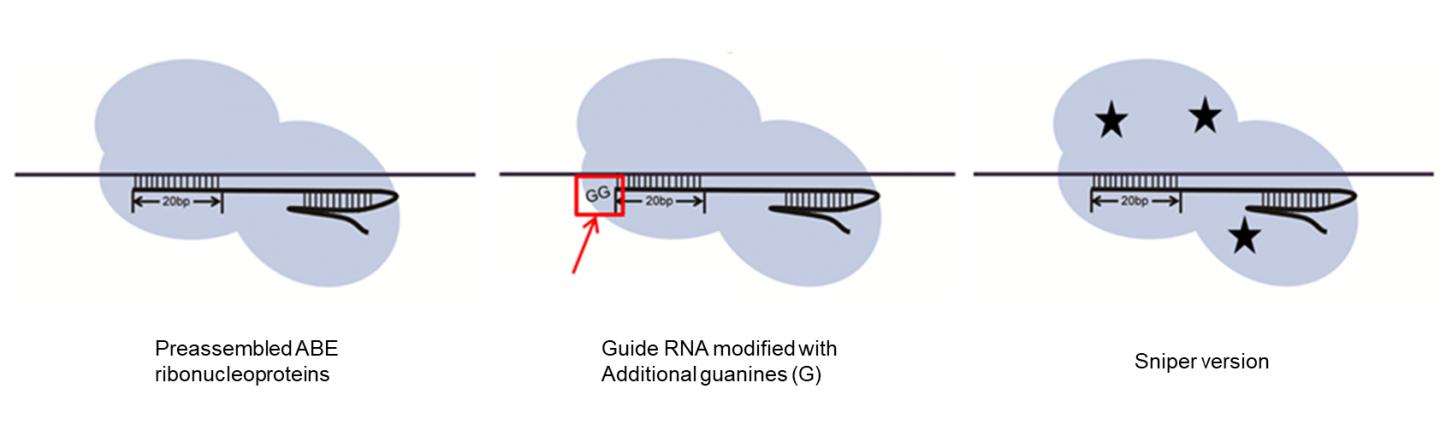
IBS biologists also showed some strategies to curb the number of off-target modifications. Adding a couple of Gs at the end of the guide RNA reduced the off-target mistakes, as well as the use of a different type of Cas9 (Sniper-Cas9, developed by the same team in 2018) and the delivery of ABE7.10 via preassembled ribonucleoproteins, rather than via plasmids.

The team aims to contribute to the development of ABEs, to introduce the desired single-letter changes in a more precise and efficient way. “As the accuracy of the base editor is proven, we expect that it will find wide application in the future in medical and agricultural realms,” says Jin-Soo Kim.

###

Media Contact
Dahee Carol Kim
[email protected]

Related Journal Article

http://dx.doi.org/10.1038/s41587-019-0050-1

Tags: Biology
Share12Tweet8Share2ShareShareShare2

Related Posts

Uncovering C. elegans Immunity via Genetic Screens — Biology

Uncovering C. elegans Immunity via Genetic Screens

May 16, 2026
Single mother must adapt swiftly — the survival of her colony depends on it — Biology

Single mother must adapt swiftly — the survival of her colony depends on it

May 15, 2026

Why Are Nearly Everyone Right-Handed? It Might Be Linked to How We Learned to Walk

May 15, 2026

Excessive Neuronal Activity Initiates Severe Autoimmune Brain Disorder

May 15, 2026
Please login to join discussion

POPULAR NEWS

  • Research Indicates Potential Connection Between Prenatal Medication Exposure and Elevated Autism Risk

    844 shares
    Share 338 Tweet 211
  • New Study Reveals Plants Can Detect the Sound of Rain

    730 shares
    Share 291 Tweet 182
  • Salmonella Haem Blocks Macrophages, Boosts Infection

    62 shares
    Share 25 Tweet 16
  • Breastmilk Balances E. coli and Beneficial Bacteria in Infant Gut Microbiomes

    58 shares
    Share 23 Tweet 15

About

We bring you the latest biotechnology news from best research centers and universities around the world. Check our website.

Follow us

Recent News

AI Tool in Radiotherapy Advances Global Fight to Eradicate Cervical Cancer

Detecting Illicit Bitcoin Transactions with Temporal Graph Learning

New Study Reveals the Massive Economic Impact of Tuberculosis

Subscribe to Blog via Email

Enter your email address to subscribe to this blog and receive notifications of new posts by email.

Join 82 other subscribers
  • Contact Us

Bioengineer.org © Copyright 2023 All Rights Reserved.

Welcome Back!

Login to your account below

Forgotten Password?

Retrieve your password

Please enter your username or email address to reset your password.

Log In
No Result
View All Result
  • Homepages
    • Home Page 1
    • Home Page 2
  • News
  • National
  • Business
  • Health
  • Lifestyle
  • Science

Bioengineer.org © Copyright 2023 All Rights Reserved.