A blueprint for measuring calcium carbonate on the ocean floor could help marine scientists monitor coral reef health around the globe.
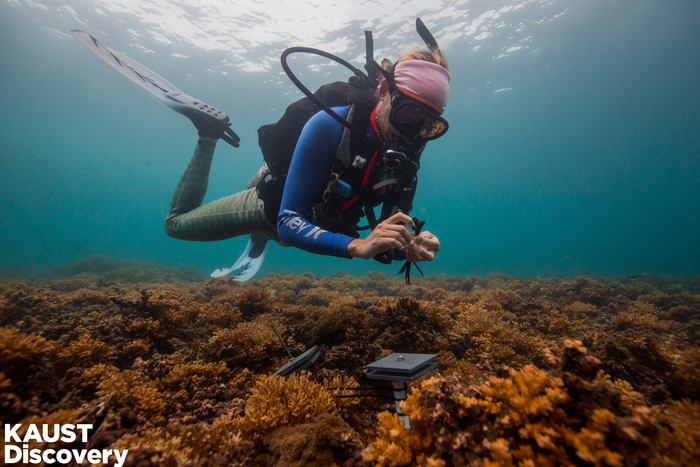
Credit: © 2022 KAUST; Sean Mattson
A blueprint for measuring calcium carbonate on the ocean floor could help marine scientists monitor coral reef health around the globe.
Climate change and pollution from human activities are irreversibly changing many marine habitats, particularly coral reefs. To assess and mitigate future impacts, ecologists must understand how these ecosystems are functioning right now.
One indicator of coral reef health is how much calcium carbonate is produced over time as shells and skeletons of marine animals accumulate on the ocean floor. Researchers often use special tiles on the seabed, which gradually become home to settling pioneering plants and animals. After a year, the researchers retrieve the tiles to see how much calcium carbonate has accumulated on them and which living species are present.
“To understand how marine ecosystems are changing over space and time we need to be able to compare data collected from different habitats,” says marine scientist Maggie Johnson. “But researchers employ a range of approaches or measure different variables, meaning that the data might not be directly comparable,” she adds. This makes it tricky to create a global picture of marine ecosystem health.
Johnson and her colleagues have developed a standardized method for making and deploying calcification accretion units (CAUs), which are similar to settlement tiles but more specifically are used for measuring calcium carbonate. The comprehensive “how to” guide provides detailed instructions for tile construction and CAU assembly, from material suppliers to measurements, as well as how to place them and retrieve them, all of which will enable researchers to collect comparable data from coral and oyster reefs worldwide.
“Coral reefs cover less than one percent of the seafloor, yet provide more than 25 percent of the ocean’s biodiversity,” says Johnson. “Much of this diversity comes from tiny critters living in the unseen cracks and crevices,” she adds. These hidden species, or “cryptic taxa,” cannot be captured by visual surveys, but the CAUs include a small space for these tiny taxa to occupy. “During collection, the tiles must be placed in zipped bags to keep the community of cryptic critters intact all the way to the lab,” says Johnson.
The guide advises immediate processing of the samples, while the animals and plants are still alive. This involves taking high resolution photographs that are later used for spotting species and microscope observations to count baby coral. The calcium carbonate is then removed by a weak acid.
“By weighing the tiles before and after decalcifying them, researchers can calculate how much calcium carbonate was deposited on that tile over a year,” says Johnson. “This figure can help compare reef conditions in different parts of the world or how the health of one reef is changing over time.”
Understanding the impacts of human activities on marine habitats will help researchers and governments find ways to mitigate the negative impacts. “This standardized and accessible approach will help promote collaboration and informed decision-making even when using data from all over the world,” concludes Johnson.
Journal
Methods in Ecology and Evolution
DOI
10.1111/2041-210X.13867
Article Title
Calcification accretion units (CAUs): A standardized approach for quantifying recruitment and calcium carbonate accretion in marine habitats
Article Publication Date
11-Apr-2022