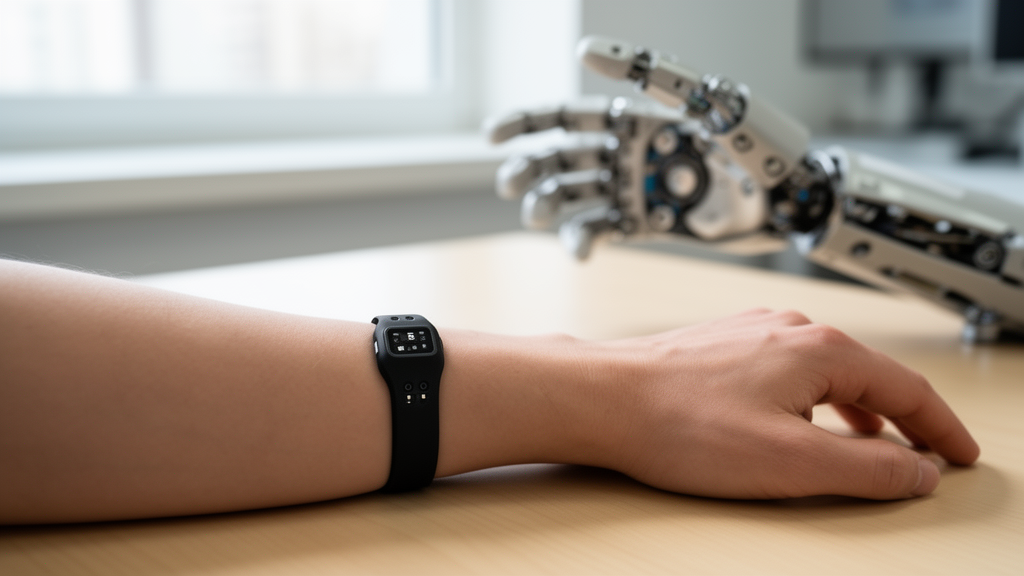
A team of engineers in India has built a remarkably simple device that may change how people control prosthetic hands, robotic arms, and rehabilitation equipment. The system is a wearable armband that reads the tiny forces produced by forearm muscles as they bulge during hand gestures, then translates those signals into commands that a machine can follow. Developed at the National Institute of Technology Rourkela, the platform pairs a four-channel force-sensing armband with a lightweight machine learning model running on a microcontroller that costs only a few dollars. In tests, the system recognized five everyday hand gestures with about 92 percent accuracy offline and 80 percent in real time, and it was able to drive a small robotic arm through a complete pick-and-place task using nothing more than the movements of a wearer’s hand.
The technology belongs to a field called force myography, or FMG, which measures the mechanical deformation of muscles rather than their electrical activity. When a hand closes into a fist or a wrist bends, the muscles of the forearm contract and harden, pressing outward against the skin. Sensors positioned over these muscles can detect that pressure and convert it into electrical signals. Because FMG relies on mechanical force instead of the faint voltages that muscles emit, the signals are larger, less noisy, and far less sensitive to sweat, skin preparation, and electrode placement than the more familiar technique of surface electromyography. That robustness matters enormously for wearable devices that must work reliably outside the laboratory, on real people, all day long.
Existing gesture-recognition interfaces often demand elaborate hardware. Some research systems stitch together a dozen or more sensors, combine multiple sensing modalities such as electromyography, accelerometry, and optical pulse readings, or depend on computationally heavy deep neural networks that cannot run on inexpensive embedded processors. The Rourkela team, led by Laxmi Gupta, Naveeta Kharendra, and Alok Prakash, deliberately went the other way. They asked how few sensors they could use while still capturing the distinct patterns of muscle activity that separate one gesture from another. Their answer was four force-sensing resistors, arranged over the Flexor Carpi, Extensor Digitorum, and Extensor Carpi muscle groups that drive wrist and finger movement.
Sensor placement turned out to be the crucial engineering problem. A force-sensing resistor pressed flat against bare skin does not reliably pick up the force of a contracting muscle, because the sensitive area may be misaligned with the muscle bulge or bend unpredictably under load. The researchers solved this with custom sensor housings designed in Autodesk Fusion 360 and fabricated by 3D printing. Each housing consists of a rigid base with a circular cavity that seats the sensor precisely, a cylindrical coupler whose underside rests on the sensor’s sensitive region, and a top enclosure. One face of the coupler is slightly convex so it conforms to the skin and collects the muscle’s contractile force, while the other face is flat and delivers that force squarely onto the sensor. Four such units were mounted on a Velcro band with adjustable plastic strings so each sensor could be tuned to sit over the right muscle on any wearer’s arm.
Calibration established how much force the sensors could meaningfully measure. Applying loads from 0.1 to 6 kilograms to each sensing unit revealed the nonlinear voltage-to-force relationship typical of piezoresistive sensors. When human volunteers performed their strongest voluntary forearm contractions, the muscles pressed the sensors with about two kilograms of force, producing an output near 2.8 volts. That defined the useful operating window: below saturation, with plenty of headroom for everyday gestures. A voltage-divider circuit with a buffer stage converted each sensor’s resistance change into a clean voltage signal for recording.
Ten healthy participants, six men and four women, wore the armband while performing five gestures: a fist, fist flexion, an open hand, wrist extension, and wrist flexion. Each gesture was held for roughly five seconds, repeated ten times, with rest periods built in to prevent muscle fatigue. A data acquisition device sampled all four channels at 1,000 hertz. Before any classification could happen, the raw signals passed through a Savitzky-Golay smoothing filter to strip out random noise and motion artefacts while preserving the shape of the muscle deformation waveform. The filtered signals were then chopped into overlapping windows of 250 milliseconds with a 50 millisecond step, a framing choice that keeps latency low enough for real-time use.
From each window the team extracted ten time-domain features per channel, including the mean, median, variance, standard deviation, minimum, maximum, root mean square, integral absolute value, mean absolute value, and slope sign change, for a total of forty numbers describing every gesture sample. Not all of those features carry useful information, so the researchers pruned them using a two-stage procedure: an ANOVA F-test to rank each feature’s statistical power for separating gesture classes, followed by recursive feature elimination, which iteratively removes the weakest features. A subset of twenty features proved optimal, delivering the best accuracy while keeping the eventual model small enough for a microcontroller to handle.
Five machine learning classifiers competed on the prepared data: Random Forest, Support Vector Machine, Extreme Gradient Boosting, K-Nearest Neighbours, and a Multi-Layer Perceptron neural network. Evaluated with ten-fold cross-validation, the Random Forest ensemble of decision trees won with 91.81 percent accuracy, edging out the neural network at 90.10 percent, K-Nearest Neighbours at 90.00 percent, XGBoost at 89.36 percent, and the Support Vector Machine at 89.32 percent. Random Forest’s advantage lies in its tolerance for noisy, high-dimensional feature spaces and its resistance to overfitting, since it aggregates many slightly different decision trees by majority vote. Just as importantly for embedded use, its structure converts cleanly to compact code.
The winning model was exported as an Arduino-compatible header file and loaded onto an ESP32 microcontroller, a cheap Wi-Fi-capable chip with limited memory. In live testing with five subjects across 250 trials, the embedded system recognized 200 gestures correctly within three seconds of initiation, an 80 percent real-time success rate. Each predicted gesture activated a distinct LED, proving the full chain from muscle force to microcontroller decision in under a heartbeat of computation. The accuracy drop from 92 to 80 percent reflects familiar realities: subjects differ in forearm anatomy, sensor position shifts slightly between wearers, and real muscles do not contract as consistently as laboratory recordings. The team compensated with adjustable sensor straps and by compressing the deployment algorithm to fit the chip’s storage.
The final demonstration tied the whole system to hardware that matters. Five gesture classes were mapped to the servomotors of a four-degree-of-freedom robotic arm, which executed a full pick-and-place sequence: a fist command lowered the arm to grasp an object, fist flexion lifted it back, wrist flexion rotated it, wrist extension released the object, and an open hand returned the arm to rest. Compared with rival systems that reach 92 to 96 percent accuracy using sixteen channels or hybrid sensor arrays, this four-channel design trades a few points of accuracy for dramatic gains in cost, wearability, and embeddability. For upper-limb amputees and rehabilitation patients, who need intuitive, dependable control rather than laboratory perfection, that trade-off could prove decisive. The researchers see clear next steps: improving generalization across users, expanding the gesture vocabulary, and mating the armband to prosthetic and assistive devices outside the lab. If those efforts succeed, the simple act of tensing a forearm muscle may become a universal remote control for the machines that restore human capability.
Subject of Research: Force myography-based wearable gesture recognition for controlling assistive and robotic devices
Article Title: Classification of forearm muscle forces for controlling assistive devices
Article References: Gupta, L., Kharendra, N., & Prakash, A. (2026). Classification of forearm muscle forces for controlling assistive devices. Frontiers in Medical Engineering, 4, Article 1942273. https://doi.org/10.3389/fmede.2026.1942273
Image Credits: AI Generated
DOI: 10.3389/fmede.2026.1942273
Keywords: force myography, gesture recognition, wearable sensors, machine learning, Random Forest, assistive devices, prosthetics, robotic arm control, microcontroller, human-machine interface, rehabilitation, forearm muscles
News Source: Denise Maddox. (October 15, 2026). Cheap Armband Reads Forearm Muscle Forces to Drive Robots and Prosthetics. Scienmag.