• HOME
  • NEWS
  • EXPLORE
    • CAREER
      • Companies
      • Jobs
    • EVENTS
    • iGEM
      • News
      • Team
    • PHOTOS
    • VIDEO
    • WIKI
  • BLOG
  • COMMUNITY
    • FACEBOOK
    • INSTAGRAM
    • TWITTER
Monday, May 11, 2026
BIOENGINEER.ORG
No Result
View All Result
  • Login
  • HOME
  • NEWS
  • EXPLORE
    • CAREER
      • Companies
      • Jobs
        • Lecturer
        • PhD Studentship
        • Postdoc
        • Research Assistant
    • EVENTS
    • iGEM
      • News
      • Team
    • PHOTOS
    • VIDEO
    • WIKI
  • BLOG
  • COMMUNITY
    • FACEBOOK
    • INSTAGRAM
    • TWITTER
  • HOME
  • NEWS
  • EXPLORE
    • CAREER
      • Companies
      • Jobs
        • Lecturer
        • PhD Studentship
        • Postdoc
        • Research Assistant
    • EVENTS
    • iGEM
      • News
      • Team
    • PHOTOS
    • VIDEO
    • WIKI
  • BLOG
  • COMMUNITY
    • FACEBOOK
    • INSTAGRAM
    • TWITTER
No Result
View All Result
Bioengineer.org
No Result
View All Result
Home NEWS Science News Biology

Characterisation of the structure of a member of the L-Amino acid Transporter (LAT) family

Bioengineer by Bioengineer
April 24, 2019
in Biology
Reading Time: 2 mins read
0
IMAGE
Share on FacebookShare on TwitterShare on LinkedinShare on RedditShare on Telegram

IMAGE

Credit: Manuel Paladín, IRB Barcelona

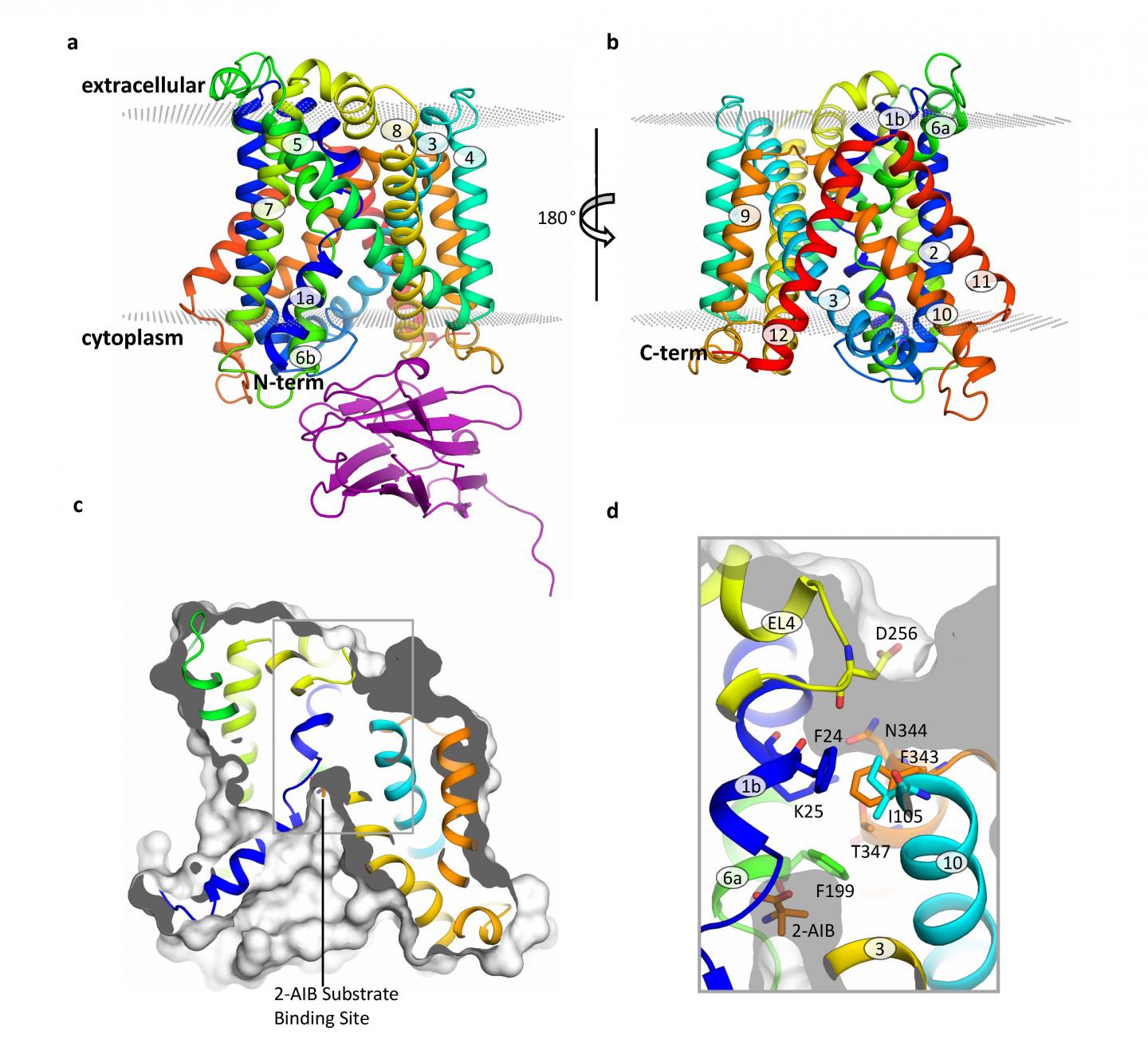
In humans, there are more than 50 types of amino acid transporters, which are responsible for the cellular uptake of amino acids and for regulating the intra- and extra-cellular balance of these molecules. Mutations in these transporters are associated with a variety of diseases. However, in spite of the importance of these molecules, little is known about how they work. Scientists at the Institute for Research in Biomedicine (IRB Barcelona) have now characterised the structure of a member of the LAT family.

LATs form a family that includes various kinds of amino acid transporter and even even members in bacteria. Mutated LATs are associated with conditions as diverse as autism, age-related hearing loss, cystinuria and lysinuric protein intolerance.

Published in the journal Nature Communications, this study has focused on BasC, a LAT present in bacteria. “We have used BasC as a model because it shows structural and functional similarity to LATs in humans,” explains Manuel Palacín, head of the Amino Acid Transporters and Disease Lab at IRB Barcelona.

By analysing the structure and function of BasC, the first authors of this work, Ekaitz Errasti-Murugarren, Joana Fort and Paola Bartoccioni, postdoctoral fellows at IRB Barcelona, have identified the site at which amino acids bind to LATs and the mechanism underlying the interaction at both sides of the cell membrane.

“Knowing how LATs recognise the amino acids to be transported into the cell allows us to better understand their function and to decipher the molecular defects associated with various conditions. This knowledge will then help us to develop potential treatments,” comments Palacín, full professor at the Faculty of Biology at the University of Barcelona, and head of unit U731 of the Centro de Investigación Biomédica en Red de Enfermedades Raras (CIBERER).

In this collaboration between IRB Barcelona, CIBERER, IBMB-CSIC and the Barcelona Supercomputing Center, the researchers have characterised the structure of BasC by means of X-ray crystallography and using an antibody against this transporter. “The BasC antibodies that we developed provide an excellent tool through which to study the function of this transporter,” adds Palacín.

###

The study has been supported by the Ministry of Science, Innovation and Universities, La Fundació La Marató TV3, SIDRA Medicine (Qatar), CIBERER, the Catalan Government, INSTRUCT-ERIC (European Strategy Forum on Research Infrastructures, ESFRI) and the Research Foundation – Flanders (FWO).

Reference article:

Ekaitz Errasti-Murugarren, Joana Fort, Paola Bartoccioni, Lucía Díaz, Els Pardon, Xavier Carpena, Meritxell Espino-Guarch, Antonio Zorzano, Christine Ziegler, Jan Steyaert, Juan Fernández-Recio, Ignacio Fita and Manuel Palacín.

L-Amino acid Transporter structure and molecular bases for the asymmetry of substrate interaction

Nature Communications (2019) doi: 10.1038/s41467-019-09837-z

Media Contact
Communications IRB Barcelona
[email protected]

Original Source

https://www.irbbarcelona.org/en/news/characterisation-of-the-structure-and-function-of-a-member-of-the-l-amino-acid-transporter-lat

Related Journal Article

http://dx.doi.org/10.1038/s41467-019-09837-z

Tags: BiochemistryBiologyBiomechanics/BiophysicsCell BiologyMolecular Biology
Share12Tweet8Share2ShareShareShare2

Related Posts

Ancient Plant Populations Reveal Fresh Insights into Climate Resilience — Biology

Ancient Plant Populations Reveal Fresh Insights into Climate Resilience

May 8, 2026
Rare Brain Disorders in Children Linked to Mutations in Lesser-Known Protein Complex — Biology

Rare Brain Disorders in Children Linked to Mutations in Lesser-Known Protein Complex

May 8, 2026

From Odd Insect to Underwater Predator: The Remarkable Evolution of a Bloodthirsty Fruit Fly

May 8, 2026

SNU Professor Sangwoo Seo’s Team Develops Next-Generation CRISPR Biocontainment Technology to Control Microbial Survival Without DNA Cleavage

May 8, 2026
Please login to join discussion

POPULAR NEWS

  • Research Indicates Potential Connection Between Prenatal Medication Exposure and Elevated Autism Risk

    840 shares
    Share 336 Tweet 210
  • New Study Reveals Plants Can Detect the Sound of Rain

    727 shares
    Share 290 Tweet 181
  • Salmonella Haem Blocks Macrophages, Boosts Infection

    61 shares
    Share 24 Tweet 15
  • Breastmilk Balances E. coli and Beneficial Bacteria in Infant Gut Microbiomes

    57 shares
    Share 23 Tweet 14

About

We bring you the latest biotechnology news from best research centers and universities around the world. Check our website.

Follow us

Recent News

New Post-Hoc Analysis Explores Daily Oral Orforglipron Use in Adults Over 65 with Obesity, Regardless of Diabetes Status

Evaluating Digoxin Use in Patients with Symptomatic Rheumatic Heart Disease

Evaluating the Effectiveness and Safety of Digitalis Glycosides in Treating Heart Failure

Subscribe to Blog via Email

Enter your email address to subscribe to this blog and receive notifications of new posts by email.

Join 82 other subscribers
  • Contact Us

Bioengineer.org © Copyright 2023 All Rights Reserved.

Welcome Back!

Login to your account below

Forgotten Password?

Retrieve your password

Please enter your username or email address to reset your password.

Log In
No Result
View All Result
  • Homepages
    • Home Page 1
    • Home Page 2
  • News
  • National
  • Business
  • Health
  • Lifestyle
  • Science

Bioengineer.org © Copyright 2023 All Rights Reserved.