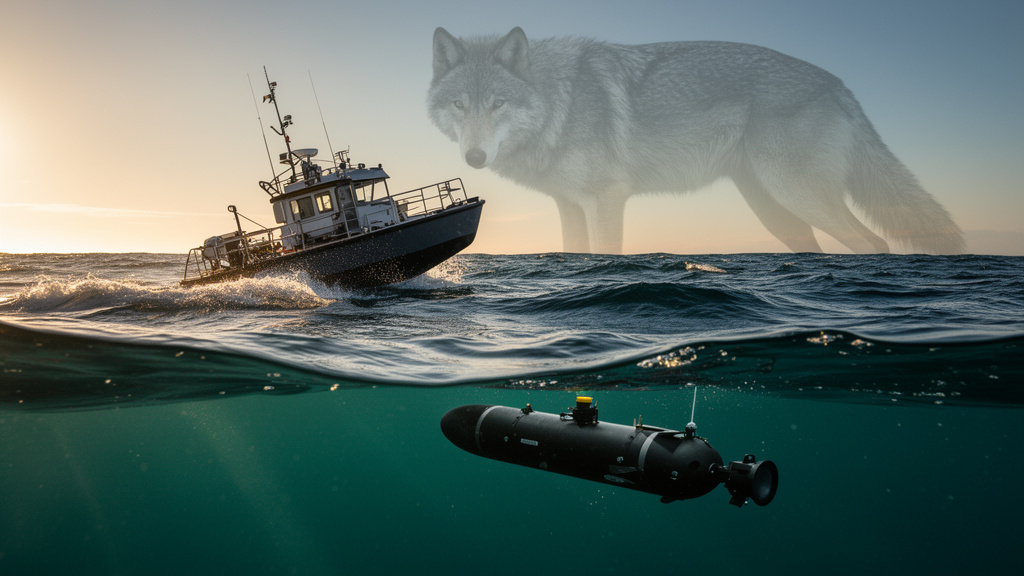
Marine robots working together on the ocean surface and below it face a brutal combination of problems: nonlinear vehicle dynamics, uncertain hydrodynamics, wind and wave loads, underwater currents, and obstacles scattered across the search area. A new study proposes a single control framework designed to handle all of these at once for a collaborative team of one autonomous surface vehicle and two underwater robotic vehicles on a simulated search-and-rescue mission.
The framework, called disturbance-observer-based adaptive neuro-fuzzy sliding mode control, or DO-ANFSMC, was developed by Mustafa Wassef Hasan and Nizar Hadi Abbas and published in Discover Vehicles. It layers three techniques on top of a sliding-mode control law: an adaptive neuro-fuzzy system that approximates the unknown nonlinear dynamics of the vehicles, a nonlinear disturbance observer that estimates lumped environmental disturbances together with residual uncertainties, and an improved grey wolf optimizer with chaotic theory, abbreviated IGWO-CT, that tunes the controller parameters online.
The mathematical foundation is a reduced three-degree-of-freedom model of marine-craft motion covering surge, sway, and yaw, based on the generalized formulation of Fossen. Heave, roll, and pitch are neglected because the mission relies on horizontal maneuvering, and the ballast restoring-force term is omitted accordingly. The ASV and the two URVs share the same dynamic structure, with their physical differences captured through inertia, hydrodynamic damping, and disturbance parameters. The controller is built on a transformed control-affine form in which the unknown nonlinear dynamics and the lumped disturbance vector appear explicitly, so the tracking error and sliding surface can be driven to convergence.
The adaptive neuro-fuzzy approximator uses twelve input variables drawn from the tracking errors, the desired trajectory, and its first and second derivatives. These are normalized and split into four linguistic groups, each assigned two or three fuzzy terms, producing sixty fuzzy rules in total across a network with two hidden layers. The scaling parameters of the four output channels are optimized by the IGWO-CT algorithm, which modifies the standard grey wolf optimizer using a Rossler dynamical system whose chaotic vectors reshape both the adaptive search coefficient and the position update mechanism. The authors report that the chaotic modification was chosen after testing several chaotic maps with the optimizer.
Because the neuro-fuzzy system cannot eliminate approximation error entirely, the disturbance observer estimates what remains. It constructs an innovation signal from the measurable residual dynamics and tracks the equivalent lumped disturbance composed of external disturbances and the residual approximation error. A Lyapunov analysis establishes that the observer estimation error is uniformly ultimately bounded, and a second Lyapunov argument shows that all closed-loop signals remain bounded, with the sliding surface, disturbance estimation error, and trajectory tracking error uniformly ultimately bounded under the proposed control law.
Before the optimizer was entrusted with controller tuning, it was benchmarked against eight population-based algorithms, including the original grey wolf optimizer, particle swarm optimization, the genetic algorithm, the whale optimization algorithm, the salp swarm algorithm, the moth-flame optimizer, the multi-verse optimizer, and the sine cosine algorithm. Each algorithm ran thirty independent times on five standard functions: Sphere, Rosenbrock, Rastrigin, Ackley, and Griewank, with a population of thirty and five hundred iterations. On Rastrigin and Griewank, IGWO-CT converged to the known global optimum in every run, yielding zero best, mean, worst, and standard deviation values. On Ackley, the whale optimization algorithm achieved the smallest average objective value, while IGWO-CT remained competitive with a very small numerical error. The chaotic variant cost moderately more computation than the original grey wolf optimizer but less than particle swarm optimization, and it achieved the highest overall success rate among the compared algorithms.
The mission simulations were run in MATLAB R2018b for one ASV and two URVs under identical conditions, with eight static obstacles distributed through a geographically referenced marine environment derived from bathymetric data covering longitudes 42 to 46 degrees and latitudes 32 to 35 degrees. The ASV experienced near-surface wind-induced forces, while the URVs operated under deep-water current variations. No hardware experiments were conducted; the authors state explicitly that the results should be interpreted as simulation-based validation, with experimental validation on real platforms reserved for future work.
The quantitative results are specific. Yaw-rate tracking root-mean-square errors were 0.00956 rad/s for the ASV, 0.01915 rad/s for URV1, and 0.00185 rad/s for URV2. Tracking errors converged within approximately 0.10 seconds for all vehicles, with the maximum error occurring during the initial transient. The travelled path lengths were 68.781 meters for the ASV, 68.171 meters for URV1, and 79.399 meters for URV2. Compared with the ANNFOPID baseline controller, the proposed method reduced the ASV path from 85.856 meters to 68.781 meters, the URV1 path from 87.135 meters to 68.171 meters, and the URV2 path from 121.953 meters to 79.399 meters. All vehicles maintained positive obstacle-clearance distances and reached their targets with negligible final error.
Ablation tests isolated the contribution of each component. Removing either the disturbance observer or the adaptive neuro-fuzzy estimator increased trajectory deviation and produced less efficient navigation paths, while the original grey wolf optimizer configuration converged more slowly than the chaotic version. The disturbance observer compensates for environmental disturbances before large tracking errors develop, the neuro-fuzzy layer absorbs the remaining modeling uncertainties without excessive control activity, and the online parameter tuning shortens the transient response while keeping control energy low. The authors attribute the balanced performance to the coordinated action of all four elements rather than any single mechanism.
Several practical caveats accompany the results. The study assumes accurate measurement of vehicle states, does not model communication delays between the ASV and the URVs, and treats actuators as ideal without saturation or rate constraints. Sensor noise, acoustic latency, packet losses, and actuator limits could all degrade performance in real deployments, and the authors identify state filtering, delay compensation, and anti-windup strategies as necessary next steps. Model uncertainties from payload changes and unmodeled hydrodynamic interactions remain, though the observer and neuro-fuzzy approximation absorb a significant portion of them. Within those limits, the study demonstrates that combining disturbance estimation, adaptive approximation, sliding-mode robustness, and chaotic optimization can improve tracking accuracy, disturbance rejection, and navigation efficiency for cooperative marine robots in simulation, while leaving physical trials as the decisive test still to come.
Subject of Research: Disturbance-observer-based adaptive neuro-fuzzy sliding mode control for collaborative autonomous surface and underwater robotic vehicles
Article Title: Disturbance-observer-based adaptive neuro-fuzzy sliding mode control for collaborative ASV and URV systems
Article References: Hasan, M. W., & Abbas, N. H. (2026). Disturbance-observer-based adaptive neuro-fuzzy sliding mode control for collaborative ASV and URV systems. Discover Vehicles, 2(1), Article 29. https://doi.org/10.1007/s44465-026-00032-1
Image Credits: AI Generated
DOI: 10.1007/s44465-026-00032-1
Keywords: autonomous surface vehicle, underwater robotic vehicle, sliding mode control, disturbance observer, neuro-fuzzy control, grey wolf optimizer, chaos theory, trajectory tracking, obstacle avoidance, search and rescue, marine robotics, Lyapunov stability
News Source: Denise Maddox. (October 30, 2026). Chaotic Grey Wolf Optimizer Steers Robot Boats and Underwater Vehicles Through Disturbances. Scienmag.