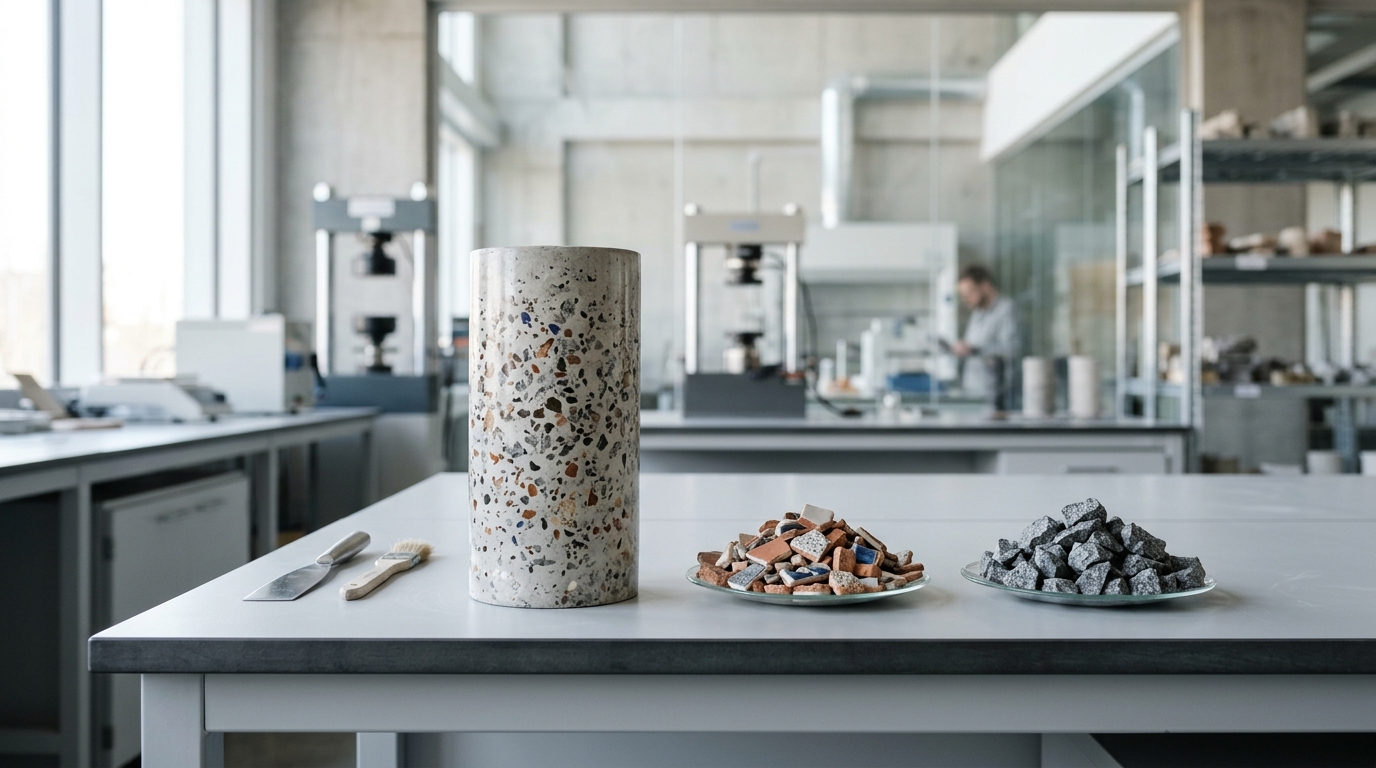
Crushed ceramic tiles from demolished buildings can replace up to 10% of the granite coarse aggregate in structural concrete without falling below the minimum strength requirement, according to a laboratory study published in Discover Concrete and Cement.
The control mix, containing no ceramic tile waste, recorded the highest slump at 61 mm, while the mix with 40% replacement recorded the lowest at 45 mm. The authors suggest the trend may be due to the greater quantity of ceramic aggregate requiring more water to lubricate material surfaces, making the blended concrete less workable. Density followed a more complicated pattern, rising with ceramic content up to 20% replacement before falling at 30% and 40%, a shift the researchers link to the weight difference between granite and ceramic aggregates.
At 10% replacement, water absorption was 51% higher than in the control mix, an increase the authors suggest was probably due to the relatively porous unpolished side of the ceramic tile waste compared with granite. Absorption continued rising up to 30% replacement before dropping at 40%.
Compressive strength fell gradually at every curing age as ceramic content increased, with the control mix performing best. One-way ANOVA at a 5% significance level found that the differences in compressive strength across replacement levels were statistically significant at all three curing ages. One-way ANOVA at a 5% significance level found ceramic tile waste replacement had a significant effect on compressive strength at 7 days, F(4, 10) = 4.152, p = 0.031, and at 14 days, F(4, 10) = 7.088, p = 0.006, and at 28 days, F(4, 10) = 5.576, p = 0.013. Post-hoc testing identified a significant difference between the control mix and the 40% replacement mix at all three curing ages. Quadratic regression models provided the best fit for the compressive strength data, with R² values of 0.99, 0.9787 and 0.9817 for 7, 14 and 28 days respectively, indicating a nonlinear relationship between replacement level and strength.
Flexural strength, which measures resistance to failure in bending, was highest in the control concrete and decreased across the 10, 20, 30 and 40% replacement levels at 28 days. ANOVA on the 28-day flexural results returned F(4, 14) = 8.618, p = 0.003, and post-hoc testing showed the control mix differed significantly from both the 30% and 40% mixes, while no significant difference emerged among the 0, 10 and 20% mixes. A quadratic model again provided the best fit, with an R² of 0.9752.
The authors suggest the split tensile strength reduction may be due to the brittleness of the ceramic material, a poorer cement bond and increased porosity.
Subject of Research: Use of crushed ceramic tile waste as a partial replacement for granite coarse aggregate in structural concrete
Article Title: Evaluation of mechanical properties of concrete produced with partial replacement of granite with ceramic tile waste
Article References: Umasabor, R., Ikponmwosa, O., & Olalekan, T. (2026). Evaluation of mechanical properties of concrete produced with partial replacement of granite with ceramic tile waste. Discover Concrete and Cement, 2(1), Article 93. https://doi.org/10.1007/s44416-026-00137-6
Image Credits: AI Generated
DOI: 10.1007/s44416-026-00137-6
Keywords: ceramic tile waste, concrete, coarse aggregate, compressive strength, flexural strength, split tensile strength, water absorption, workability, recycled construction waste, grade 20 concrete, ANOVA, regression analysis
News Source: Denise Maddox. (November 5, 2026). Ceramic Tile Waste Can Replace 10% of Granite in Structural Concrete. Scienmag.