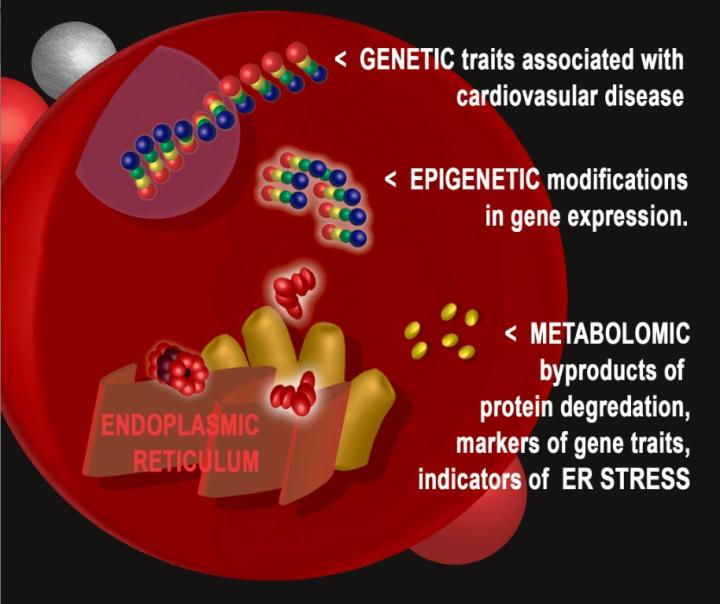
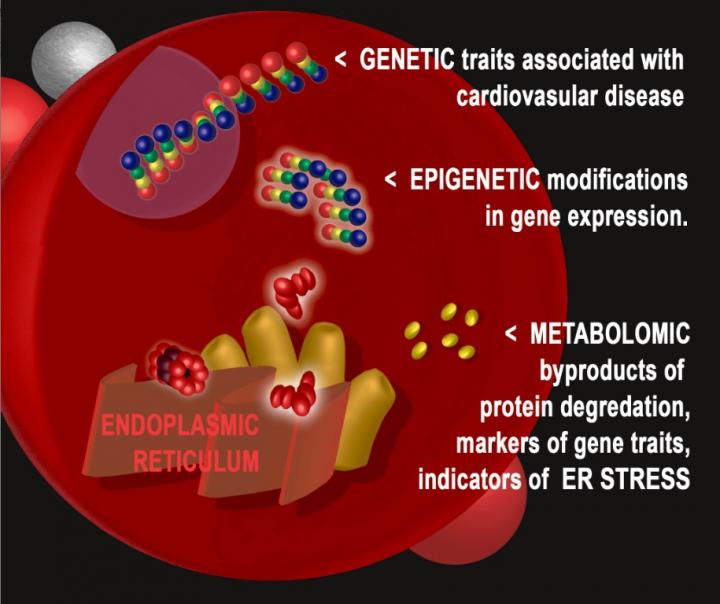
Combining the investigative tools of genetics, transcriptomics, epigenetics and metabolomics, a Duke Medicine research team has identified a new molecular pathway involved in heart attacks and death from heart disease.
The researchers, publishing in the journal PLOS Genetics, found that stress on a component of cells called the endoplasmic reticulum (ER) is associated with risk of future heart events, and it can be detected in bits of molecular detritus circulating in the blood.
"ER stress has long been linked to Type 1 diabetes and Parkinson's disease, among others, but this is the first indication that it is also playing a role in common heart attacks and death from heart disease," said senior author Svati H. Shah, M.D., associate professor of medicine and faculty at the Molecular Physiology Institute at Duke. "It's also exciting that we are able to measure this ER stress in a small drop of blood, providing a potential way to intercede and lower the risk of a major cardiovascular event."
Even after mapping the human genome and finding genetic traits associated with cardiovascular disease, the mechanisms underlying the inherited susceptibility to this disease have not been fully understood. Shah said the Duke team's research approach — using a variety of analytical methods measuring over a million data points in 3,700 patients — enabled them to fill in some of the missing steps leading to cardiovascular disease, which is often inherited.
"With genetics, everyone is lumped together if they share a trait," Shah said. "But everyone knows if you have two people with the same trait, but one is overweight, smokes and has a bad lifestyle, that person has a different pathway that led to heart disease than someone who is normal weight, doesn't smoke, eats right and exercises."
The Duke team focused on the intermediates between the genes and the disease pathway. This involved metabolomics — an analysis of the metabolites, or trace chemicals, left behind as the byproducts from cellular processes.
Among a group of about 3,700 patients referred for cardiac catheterization in the CATHGEN study, Shah and colleagues performed a genome-wide analysis of specific metabolite levels that had previously been identified as predictors of cardiovascular disease.
In their earlier work, the researchers had flagged these metabolites as markers for cardiovascular disease, but had not known how they were generated or what the underlying biological pathways were. The current study resolved that question, finding that these genes were directly linked to ER stress, which occurs when the endoplasmic reticulum organelle becomes overworked in its job managing excess and damaged cellular proteins.
Shah and colleagues then took an epigenetics and transcriptomics approach to determine what the differences were between patients with high or low levels of metabolites. Once again, the ER stress pathway came up as a key component.
"Using this multi-platform 'omics' approach, we identified these novel genetic variants associated with metabolite levels and with cardiovascular disease itself," Shah said. "We don't believe that the metabolites themselves are causing heart attacks — they might just be byproducts of a dysregulated process that people are genetically susceptible to — but that's something we need to study further."
###
In addition to Shah, study authors include William E. Kraus; Deborah M. Muoio; Robert Stevens; Damian Craig; James R. Bain; Elizabeth Grass; Carol Haynes; Lydia Kwee; Xuejun Qin; Dorothy H. Slentz; Deidre Krupp; Michael Muehlbauer; Elizabeth R. Hauser; Simon G. Gregory; and Christopher B. Newgard.
The study received funding from the National Heart, Lung and Blood Institute (HL095987, HL101621).