Credit: Darleny Lizardo/Alan Siegel/University at Buffalo North Campus Confocal Imaging Facility
BUFFALO, N.Y. — Scientists seeking to unlock the secrets of cellular aging have identified a gene that triggers senescence, a phenomenon in which cells stop dividing.
Senescence is a natural occurrence in the life of a cell, and researchers have sought to learn about it for a couple of reasons. First, it's connected to old age: Senescent cells are thought to contribute to heart disease, arthritis, cataracts and a bevy of other age-linked conditions. Second, a lack of senescence is a hallmark of cancer cells, which bypass this process to replicate in an uncontrolled manner.
The new study — published online on June 20 in Molecular Omics, a journal of the Royal Society of Chemistry — illuminates genes involved in cellular senescence, and highlights one in particular that seems tightly associated with this crucial biological process.
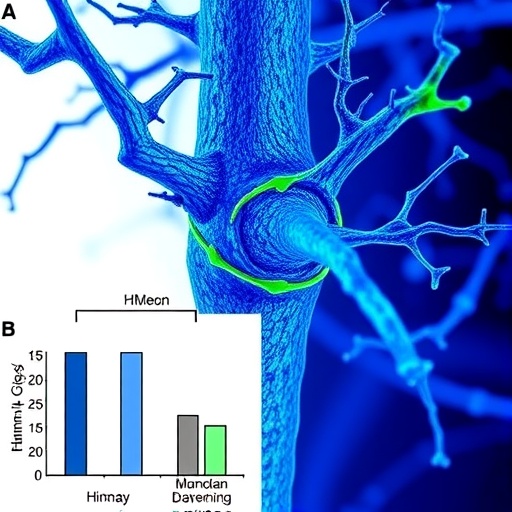
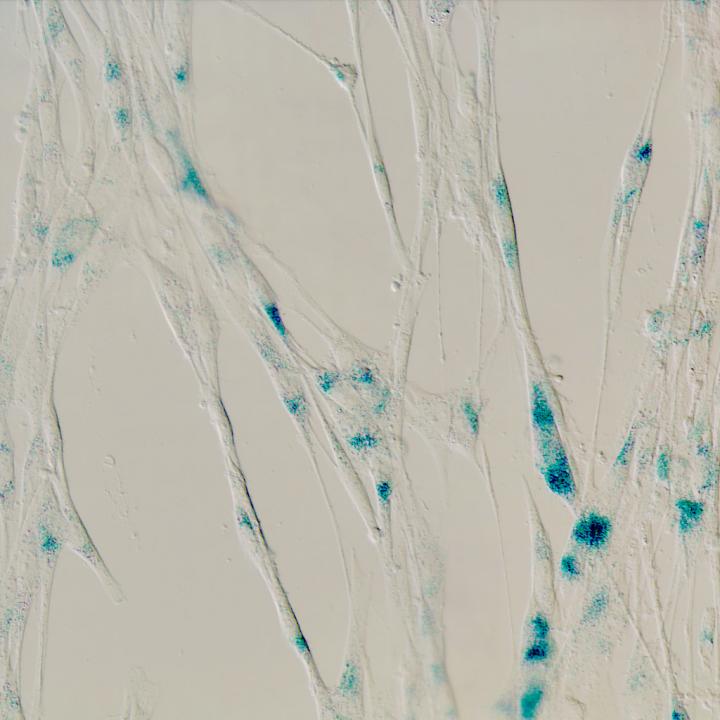
In experiments, University at Buffalo researchers discovered that a gene called CD36 is unusually active in older, senescent cells.
What's more, scientists were able to cause young, healthy cells to stop dividing by heightening CD36 activity within those cells. The effect spread to nearby cells, with almost all of the cells in a petri dish showing signs of senescence when only a small fraction of those cells — about 10 to 15 percent — were overexpressing CD36. New cells placed in the growth medium (a soupy substance) that previously housed the senescent cells also stopped replicating.
"What we found was very surprising," says Ekin Atilla-Gokcumen, PhD, an assistant professor of chemistry in the UB College of Arts and Sciences. "Senescence is a very complex process, and we didn't expect that altering expression of one gene could spark it, or cause the same effect in surrounding cells."
The results point to CD36 as an exciting topic of future research. The gene's exact role in senescence remains a mystery: Scientists know that the gene guides the body in building a protein of the same name that sits on the surface of cells, but this protein's functions are still being studied. Proposed activities include helping cells import lipids, and influencing how these lipids are used within cells.
"Our research identifies CD36 as a candidate for further study. Senescence is a fundamental aspect of being a cell, but there is still a lot that we don't know about it," says Omer Gokcumen, PhD, an assistant professor of biological sciences in the UB College of Arts and Sciences. "Senescence seems to have implications for old age and cancer, so understanding it is very important."
Atilla-Gokcumen and Gokcumen led the study. The first authors were UB chemistry PhD student Darleny Lizardo and UB biological sciences postdoctoral researcher Marie Saitou, who won an award for a talk on this work during the UB Postdoctoral Research Symposium in June.
Zeroing in on an important gene
The scientists did not set out to investigate CD36.
Instead, they began with a pair of broad goals: They wanted to catalogue all genes related to senescence, and they wanted to gain a better understanding, in particular, of lipid-related genes involved in this process. (Past studies have shown that lipids play a role in cellular aging.)
CD36 emerged as a gene of interest in experiments designed to address these questions.
First, through a technique called transcriptomics, scientists identified CD36 as one of the two lipid-related genes that ramp up their activity the most in senescent cells. (This part of the study was done on two kinds of cells — human skin and lung fibroblasts — and the findings held true for both cell types.)
CD36 popped up again in a second test, this one a genetic analysis of all lipid-related genes that kicked into high gear during senescence. Within this group of genes, CD36 stood out as one of the most variable in humans, meaning that the gene's DNA sequence is highly likely to vary from person to person. Such diversity may be an indicator of functional variation, in which different environmental and evolutionary pressures give rise to a range of useful mutations in a highly expressed gene that serves an important purpose, Gokcumen says.
"We did not set out to look for CD36," Gokcumen says. "We took a broad approach to our study, using transcriptomics and an evolutionary framework to identify genes and proteins that are fundamental to the senescence process. In the end, CD36 stood out as an outlier in both cases. That's kind of beautiful — a compelling way to do biological research."
###
Media Contact
Charlotte Hsu
[email protected]
716-645-4655
@UBNewsSource
http://www.buffalo.edu
Original Source
http://www.buffalo.edu/news/releases/2018/06/011.html http://dx.doi.org/10.1039/C8MO00099A