• HOME
  • NEWS
  • EXPLORE
    • CAREER
      • Companies
      • Jobs
    • EVENTS
    • iGEM
      • News
      • Team
    • PHOTOS
    • VIDEO
    • WIKI
  • BLOG
  • COMMUNITY
    • FACEBOOK
    • INSTAGRAM
    • TWITTER
Sunday, October 4, 2026
BIOENGINEER.ORG
No Result
View All Result
  • Login
  • HOME
  • NEWS
  • EXPLORE
    • CAREER
      • Companies
      • Jobs
        • Lecturer
        • PhD Studentship
        • Postdoc
        • Research Assistant
    • EVENTS
    • iGEM
      • News
      • Team
    • PHOTOS
    • VIDEO
    • WIKI
  • BLOG
  • COMMUNITY
    • FACEBOOK
    • INSTAGRAM
    • TWITTER
No Result
View All Result
Bioengineer.org
No Result
View All Result
Home NEWS Science News Health

Cells pumping iron to prevent anemia

Bioengineer by Bioengineer
February 11, 2018
in Health
Reading Time: 2 mins read
0
Share on FacebookShare on TwitterShare on LinkedinShare on RedditShare on Telegram
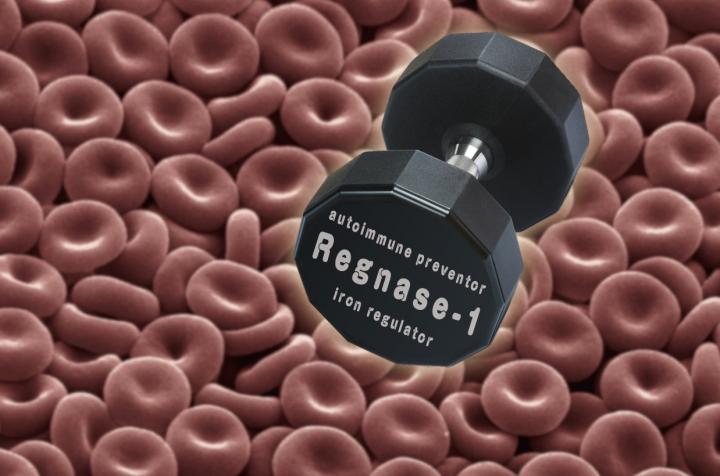
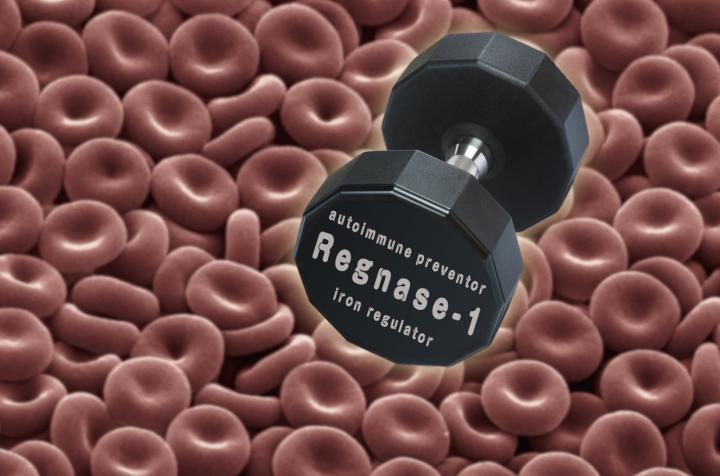
IMAGE

Credit: Kyoto University

Kyoto, Japan — Maintaining a good balance of iron in the body is necessary for health: too little can lead to anemia, but too much can cause debilitating disorders such as hemochromatosis.

The uptake and metabolism of iron in the body is one of the most tightly-controlled systems in mammals. Iron 'regulation' occurs at multiple levels, from controlling gene expression to degrees of protein synthesis, but some key factors have yet to be uncovered.

As described recently in Cell Reports, Kyoto University researchers have now identified a specific gene — initially known to prevent autoimmune diseases — as a key regulator in iron uptake.

"We found previously that when mice lack the gene Regnase-1 they suffer from severe autoimmune diseases and anemia," explains first author Masanori Yoshinaga.

"At first, we assumed that anemia was a secondary effect, but after detailed analysis we found that the two symptoms develop independently."

Continued study of mice with a Regnase-1 mutation revealed a functional defect in the principle site for iron absorption in the body, the duodenum, which is the first section of the small intestine, coming directly after the stomach.

"The next step was to find the role of Regnase-1 in iron-uptake maintenance. We started by looking at the most important iron-uptake gene, Transferrin Receptor 1, or TfR1," continues Yoshinaga.

"Our results showed that Regnase-1 degrades the mRNA of TfR1, thereby inhibiting the synthesis of the TfR1 protein, and additionally that it likely regulates other important iron-controlling genes."

"Further analysis of Regnase-1 in iron-related homeostasis," concludes team leader Osamu Takeuchi, "may provide insight into the mechanisms causing anemia and other iron-related disorders, perhaps eventually leading to new methods of treatment."

###

The paper "Regnase-1 maintains iron homeostasis via the degradation of transferrin receptor 1 and prolyl hydroxylase domain-containing protein 3 mRNAs" appeared in Cell Reports on 24 May 2017, with doi: 10.1016/j.celrep.2017.05.009

Kyoto University is one of Japan and Asia's premier research institutions, founded in 1897 and responsible for producing numerous Nobel laureates and winners of other prestigious international prizes. A broad curriculum across the arts and sciences at both undergraduate and graduate levels is complemented by numerous research centers, as well as facilities and offices around Japan and the world. For more information please see: http://www.kyoto-u.ac.jp/en

Media Contact

Raymond Kunikane Terhune
[email protected]
81-757-535-728
@KyotoU_News

http://www.kyoto-u.ac.jp/en

Related Journal Article

http://dx.doi.org/10.1016/j.celrep.2017.05.009

Share13Tweet8Share2ShareShareShare2

Related Posts

How Well Do Patients Really Know Their Own Skin Cancer History?

How Well Do Patients Really Know Their Own Skin Cancer History?

October 4, 2026
Smartphone Dependence in the Hospital Ward: Nurses' Nomophobia Tested Against Job Performance

Smartphone Dependence in the Hospital Ward: Nurses’ Nomophobia Tested Against Job Performance

October 4, 2026

Toddler’s Sip of Printer Fluid Reveals Hidden Danger of Hydrocarbon Poisoning

October 4, 2026

Gene Silencing of Complement C3 Shields Nerve-Muscle Junctions in Myasthenia Gravis Rats

October 4, 2026
Please login to join discussion

POPULAR NEWS

  • Alloys That Shrink Their Own Grains: New PIX Mechanism Refines Metals With Heat Alone

    Alloys That Shrink Their Own Grains: New PIX Mechanism Refines Metals With Heat Alone

    29 shares
    Share 12 Tweet 7
  • Endurance Exercise Reshapes the Liver in Males and Females Through Distinct Molecular Routes

    29 shares
    Share 12 Tweet 7
  • Single Transcription Factor PU.1 Rapidly Converts Fibroblasts into Macrophage-Lineage Cells

    29 shares
    Share 12 Tweet 7
  • New Scale Measures How Ready Nurse Educators Really Are for the AI Era

    29 shares
    Share 12 Tweet 7

About

We bring you the latest biotechnology news from best research centers and universities around the world. Check our website.

Follow us

Recent News

Alloys That Shrink Their Own Grains: New PIX Mechanism Refines Metals With Heat Alone

Endurance Exercise Reshapes the Liver in Males and Females Through Distinct Molecular Routes

Single Transcription Factor PU.1 Rapidly Converts Fibroblasts into Macrophage-Lineage Cells

Subscribe to Blog via Email

Enter your email address to subscribe to this blog and receive notifications of new posts by email.

Join 85 other subscribers
  • Contact Us

Bioengineer.org © Copyright 2023 All Rights Reserved.

Welcome Back!

Login to your account below

Forgotten Password?

Retrieve your password

Please enter your username or email address to reset your password.

Log In
No Result
View All Result
  • Homepages
    • Home Page 1
    • Home Page 2
  • News
  • National
  • Business
  • Health
  • Lifestyle
  • Science

Bioengineer.org © Copyright 2023 All Rights Reserved.