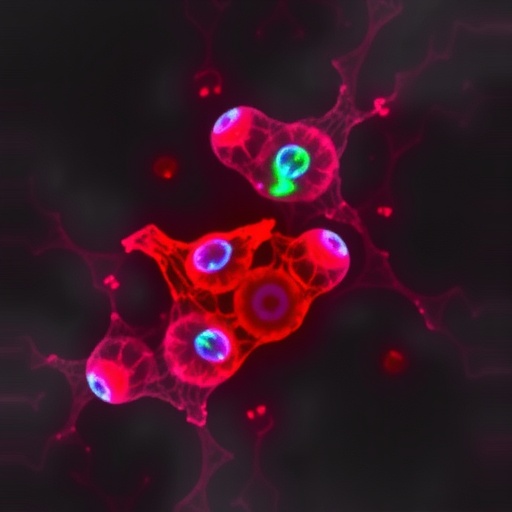
A pioneering research team at La Trobe University has harnessed biological inspiration to usher in a revolutionary advance in blood sensing technology. This breakthrough enables real-time monitoring of molecular changes within unprocessed whole blood—a feat long sought but rarely achieved due to inherent challenges posed by the complex nature of blood. Such capacity for immediate, ultra-sensitive detection marks a transformative step toward personalized medical care, wherein treatments and drug dosages can be precisely tailored in response to a patient’s dynamic physiological state.
Traditional molecular sensing techniques face a severe limitation when applied to blood samples: blood naturally clogs sensor surfaces, greatly impeding accuracy and reliability over time. Overcoming this obstacle required biomimicry—replicating natural cellular defense mechanisms to shield the sensor while allowing critical molecules to be detected. The research team succeeded by integrating a sophisticated mimic of the glycocalyx, a protective, sugar-rich cellular layer, with an advanced optical sensing method known as Surface-Enhanced Raman Scattering (SERS).
SERS is an exceptionally sensitive optical detection technology that leverages the scattering of light to identify and quantify individual molecules based on their unique vibrational signatures. While highly sensitive, conventional SERS sensors struggle with fouling—when blood components adhere to sensor surfaces, diminishing signal clarity and response speed. To address this, the researchers applied a coating consisting of lubricin, a naturally occurring glycoprotein that functions as a lubricating and anti-fouling agent on cell surfaces. This biomimetic layer effectively acts as a microscopic shield, mitigating sensor fouling without compromising molecular access.
Strategically embedded within this lubricin shield are DNA-based aptamers, synthetic oligonucleotide sequences that function as highly selective and rapid molecular receptors. These aptamers act as molecular “traps,” selectively binding target molecules of interest amidst the multifaceted blood milieu. The coupling of this selective binding mechanism with the signal amplification capability of SERS yields a sensor exhibiting both remarkable sensitivity and rapid response—an elusive combination in the field of molecular diagnostics.
The research team demonstrated their sensor’s unparalleled capabilities by detecting vancomycin, a critical antibiotic, directly in whole blood samples without any prior processing or dilution. Notably, this detection was sustained continuously for over ten hours, displaying no degradation in signal sensitivity. Compared to prior methods, which often required extensive sample preparation and suffered from short operational lifespans, this represents a compelling leap forward in both practicality and performance.
Associate Professor Wren Greene from La Trobe University, lead researcher on the project, emphasized the innovation’s core: “Our sensor’s cell-like architecture filters out interfering blood constituents while enabling ultra-sensitive SERS detection, overcoming a fundamental barrier that has long hindered blood-based molecular sensing.” Dr. Mingyu Han of CSIRO, co-leader of the study, underscored the scale of advancement, describing the sensor as 100 million times more sensitive than existing vancomycin detectors, marking it as the first truly practical real-time SERS sensor functioning robustly in whole blood.
The transformative potential of this technology extends well beyond antibiotic monitoring. Its expanded detection range promises new opportunities in tracking hormones, toxins, and various biomarkers that exist in blood at ultralow concentrations—parameters critical for early disease diagnostics and real-time treatment monitoring. Precision medicine, where therapeutic regimens adapt responsively to patient biomarker fluctuations, stands to benefit profoundly from the implementation of such sensitive and continuous molecular surveillance.
Technologically, the device’s operation is rooted in a fine balance between molecular selectivity, antifouling durability, and optical sensitivity. The lubricin-inspired coating creates a dynamic but protective interface, preventing nonspecific adsorption while permitting target molecules to promptly reach the aptamer receptors. This biomimetic stratagem cleverly circumvents the traditional trade-off in sensor design: high sensitivity sensors are usually slow and easily fouled, whereas faster sensors often lack sufficient sensitivity. The work thus not only advances practical medical tools but also meaningfully contributes to the fundamental science of biosensor engineering.
The sensor itself is constructed on AlleSense’s NanoMslide platform, which provides a scalable and integrable basis for device fabrication. La Trobe University spinout company AlleSense is progressing toward clinical-scale manufacturing, with ambitions to produce accessible, mass-producible test strips analogous to blood glucose monitors. Such strips could revolutionize point-of-care diagnostics—allowing patients and clinicians alike to gain near-instant insights into critical molecular markers at the bedside or beyond traditional laboratory settings.
In addition to immediate applications, the technique promises to accelerate research across biomedical fields by enabling uncompromised molecular detection in complex biological fluids. The collaboration between La Trobe University, CSIRO, Lubris Biopharma, and AlleSense exemplifies interdisciplinary synergy, coupling molecular biology, materials science, and optical physics to tackle a long-standing bottleneck in diagnostics.
This research was supported by the ARC Research Hub for Molecular Biosensors at Point-of-Use (MOBIUS) and has been published in the reputable journal ACS Sensors. The findings set a new benchmark for real-time blood sensing technologies and herald a future in which comprehensive molecular health monitoring can be seamlessly integrated into routine clinical practice and personalized therapeutic strategies.
As Professor Brian Abbey from La Trobe University notes, “The evolution from laboratory prototypes to mass-produced biosensors will democratize advanced diagnostics, enabling earlier detection, better disease management, and ultimately improved patient outcomes.” The team’s innovation is positioned to redefine the landscape of molecular diagnostics and personalized medicine, rendering invisible physiological processes suddenly visible with unprecedented clarity and immediacy.
Subject of Research: Cells
Article Title: Ultrasensitive, Real-Time Molecular Sensing in Unprocessed Whole Blood Using Surface-Enhanced Raman Scattering Combined with Glycocalyx-Mimicking Structures
News Publication Date: 9-Mar-2026
Web References: http://dx.doi.org/10.1021/acssensors.6c00192
References: DOI: 10.1021/acssensors.6c00192
Keywords: biosensors, Surface-Enhanced Raman Scattering (SERS), molecular sensing, blood diagnostics, lubricin, aptamers, personalized medicine, vancomycin detection, biomimicry, antifouling, real-time monitoring, AlleSense NanoMslide
Tags: advanced molecular sensing techniquesbiomimicry in medical devicescell-inspired blood sensordynamic physiological state detectionglycocalyx mimicry in sensorsLa Trobe University blood researchmolecular detection in whole bloodovercoming blood sensor foulingpersonalized medicine blood monitoringreal-time blood monitoring technologySurface-Enhanced Raman Scattering (SERS) applicationsultra-sensitive optical blood sensors