Credit: Weizmann Institute of Science
Every time we swallow food, cells that line the intestines must step up their activity in a sudden and dramatic manner. According to a new study by Weizmann Institute of Science researchers, reported in Science, they rise to the challenge in the most economic fashion.
In business or engineering, when one has to get production underway quickly, instant decisions are made. These might involve instantly throwing all ones resources into boosting production with existing equipment, or else first spending all those resources to equip the plant with proper machinery. The latter might seem to be a less efficient production method but it can actually, in some cases speed things up considerably. Dr. Shalev Itzkovitz and his team in Weizmann's Molecular Cell Biology Department discovered that this is just the method adopted in the lining of the intestinal wall.
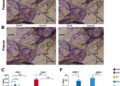
This lining is a single layer of elongated cells that come into contact with food on one narrow side, and with the bloodstream on the other. Thus they absorb nutrients on one side and release them into the blood on the other. The scientists discovered that the two sides of the cell differ in the composition of messenger RNA, or mRNA: About 30 percent of the genes expressed in the intestines produced mRNAs that appeared either on one side of the cell or on the other. The two sides were also found to differ in the content of protein-making machines called ribosomes: The number of ribosomes on the food-facing side was double that of the bloodstream-facing side; as a result, the production of proteins on that side was much more efficient.
The scientists further discovered that whenever food enters the bowels, cells in the intestinal lining immediately respond by increasing the production of ribosomes, particularly in the food-facing part of the cell. To this end, the cell dispatches to the food-facing area large numbers of mRNAs that carry the genetic code for making ribosomes. This part of the cell then becomes an intensive production shop of sorts, generating the proteins needed for processing the food.
Itzkovitz explains: "For most of the night and day, cells in the lining of the intestines just loll around, but once food appears, they must instantly step into action. Generating new mRNA molecules from DNA in order to make new proteins would have taken the cells about half an hour. Instead, they can increase production of certain proteins within minutes by moving the mRNA molecules encoding the relevant proteins into the side of the cell that is rich with ribosomes. This strategy enables them to deal with the arrival of food in a fast and efficient manner. "
In addition to opening the door to new studies in the "economics" of cells, the findings may have medical implications, as intestinal lining plays an important role in the both absorption of nutrients and protecting the body. It may now be possible to investigate whether the failure of mRNAs to move to the proper part of the cell – or a lack of balance between mRNAs in the high- and low-production areas of the cell – may play a role in such diseases as colitis and Crohn's disease, and possibly also in bowel cancer.
###
The research team included Dr. Andreas E. Moor, Matan Golan, Efi E. Massasa, Dr. Doron Lemze, Tomer Weizman, Rom Shenhav and Shaked Baydatch of the Molecular Cell Biology Department; Orel Mizrahi , Roni Winkler and Dr. Noam Stern-Ginossar of the Molecular Genetics Department; and Ofra Golani of the Life Sciences Core Facilities Department.
Dr. Shalev Itzkovitz's research is supported by the Henry Chanoch Krenter Institute for Biomedical Imaging and Genomics; the Rothschild Caesarea Foundation; the Cymerman – Jakubskind Prize; and the European Research Council. Dr. Itzkovitz is the incumbent of the Philip Harris and Gerald Ronson Career Development Chair.
The Weizmann Institute of Science in Rehovot, Israel, is one of the world's top-ranking multidisciplinary research institutions. Noted for its wide-ranging exploration of the natural and exact sciences, the Institute is home to scientists, students, technicians and supporting staff. Institute research efforts include the search for new ways of fighting disease and hunger, examining leading questions in mathematics and computer science, probing the physics of matter and the universe, creating novel materials and developing new strategies for protecting the environment.
Media Contact
Gizel Maimon
[email protected]
972-893-43856
@WeizmannScience
http://www.weizmann.ac.il
Original Source
https://wis-wander.weizmann.ac.il/life-sciences/cell-economics-101