• HOME
  • NEWS
  • EXPLORE
    • CAREER
      • Companies
      • Jobs
    • EVENTS
    • iGEM
      • News
      • Team
    • PHOTOS
    • VIDEO
    • WIKI
  • BLOG
  • COMMUNITY
    • FACEBOOK
    • INSTAGRAM
    • TWITTER
Monday, April 20, 2026
BIOENGINEER.ORG
No Result
View All Result
  • Login
  • HOME
  • NEWS
  • EXPLORE
    • CAREER
      • Companies
      • Jobs
        • Lecturer
        • PhD Studentship
        • Postdoc
        • Research Assistant
    • EVENTS
    • iGEM
      • News
      • Team
    • PHOTOS
    • VIDEO
    • WIKI
  • BLOG
  • COMMUNITY
    • FACEBOOK
    • INSTAGRAM
    • TWITTER
  • HOME
  • NEWS
  • EXPLORE
    • CAREER
      • Companies
      • Jobs
        • Lecturer
        • PhD Studentship
        • Postdoc
        • Research Assistant
    • EVENTS
    • iGEM
      • News
      • Team
    • PHOTOS
    • VIDEO
    • WIKI
  • BLOG
  • COMMUNITY
    • FACEBOOK
    • INSTAGRAM
    • TWITTER
No Result
View All Result
Bioengineer.org
No Result
View All Result
Home NEWS Science News

CCNY-led team develops cancer imaging aid from horse chestnuts

Bioengineer by Bioengineer
December 12, 2017
in Science News
Reading Time: 2 mins read
0
Share on FacebookShare on TwitterShare on LinkedinShare on RedditShare on Telegram
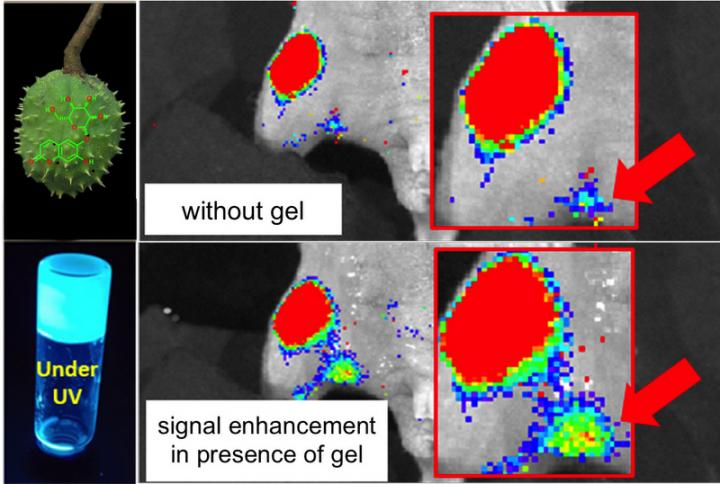
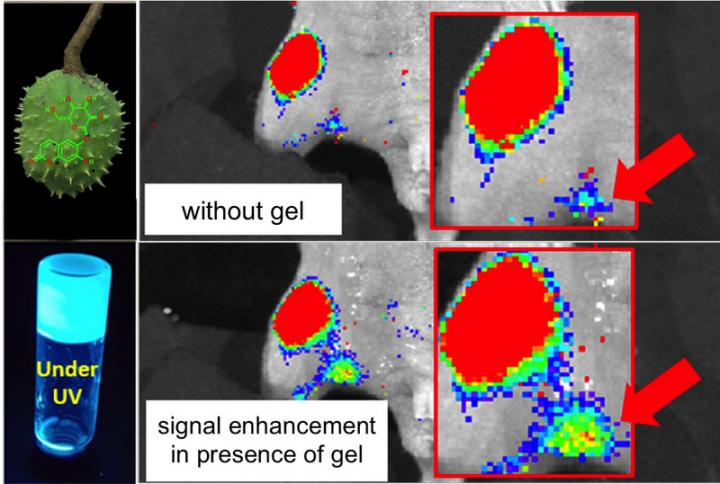
IMAGE

Credit: City College of New York

Research at The City College of New York shows that cancer imaging can be simplified by a photonic process utilizing molecules derived from horse chestnuts. The study with potential to better detect the presence of cancer is led by George John, professor in City College's Division of Science, in collaboration with Jan Grimm, a physician scientist at Sloan Kettering Institute who is also affiliated with Memorial Sloan Kettering Cancer Center and Weill Cornell Medical College.

The team has developed a radiation responsive esculin-derived molecular gel, that is both scintillating and fluorescent, to enhance the optical photon output in image mapping for cancer imaging.

Esculin, or Æsculin, is a coumarin glucoside that naturally occurs in the horse chestnut, a plant extract. It is beneficial to circulatory health.

A challenge currently in cancer imaging is that optical imaging of radiotracers through Cerenkov light (the Grimm lab is one of the leading labs in this field) often produces light that is typically low in intensity and blue-weighted (greatly scattered and absorbed in vivo). It is therefore imperative to increase or shift the photon flux for improved detection.

The gel has been developed to address this challenge.

"Tailoring biobased materials to synthesize thixotropic thermo-reversible hydrogels offers image-aiding systems which are not only functional but also potentially economical, safe, and environmentally friendly," said John.

"The possibility of developing a topical application from the gel makes this innovation an attractive potential improvement to current techniques of cancer imaging with Cerenkov light," added Grimm.

A Fellow of Britain's Royal Society of Chemistry, John's research is rooted in the idea that innovation can be inspired by nature to develop economical and green technologies for a sustainable future.

###

Also involved in the research at CCNY's Center for Discovery and Innovation and scientists from Memorial Sloan Kettering Cancer Center, Weill Cornell Medical College, the Graduate Center, CUNY and Hunter College. The team includes Julian Silverman, Nabendu B. Pramanik, Malick Samateh and Sai Sateesh Sagiri from City College; Travis Shaffer and Qize Zhang from MSKCC.

The study appears in the journal ACS Appl Mater Interfaces.

Media Contact

Jay Mwamba
[email protected]
212-650-7580

http://www2.ccny.cuny.edu

Original Source

https://www.ccny.cuny.edu/news/ccny-led-team-develops-cancer-imaging-aid-horse-chestnuts
Share12Tweet8Share2ShareShareShare2

Related Posts

Smartphone Video Enhances Parkinson’s DBS Programming

April 20, 2026

Lab-Grown Mini Brain Models Offer New Hope for Diagnosing and Treating Alzheimer’s Disease

April 20, 2026

NCQA and West Health Collaborate to Enhance Integration of Behavioral Health within Primary Care Systems

April 20, 2026

Rapid 3D-Printed Coils Enhance 0.55T Wrist, Heart MRI

April 20, 2026
Please login to join discussion

POPULAR NEWS

  • Research Indicates Potential Connection Between Prenatal Medication Exposure and Elevated Autism Risk

    442 shares
    Share 177 Tweet 111
  • Scientists Investigate Possible Connection Between COVID-19 and Increased Lung Cancer Risk

    64 shares
    Share 26 Tweet 16
  • NSF funds machine-learning research at UNO and UNL to study energy requirements of walking in older adults

    101 shares
    Share 40 Tweet 25
  • Boosting Breast Cancer Risk Prediction with Genetics

    48 shares
    Share 19 Tweet 12

About

We bring you the latest biotechnology news from best research centers and universities around the world. Check our website.

Follow us

Recent News

Smartphone Video Enhances Parkinson’s DBS Programming

Lab-Grown Mini Brain Models Offer New Hope for Diagnosing and Treating Alzheimer’s Disease

NCQA and West Health Collaborate to Enhance Integration of Behavioral Health within Primary Care Systems

Subscribe to Blog via Email

Enter your email address to subscribe to this blog and receive notifications of new posts by email.

Join 79 other subscribers
  • Contact Us

Bioengineer.org © Copyright 2023 All Rights Reserved.

Welcome Back!

Login to your account below

Forgotten Password?

Retrieve your password

Please enter your username or email address to reset your password.

Log In
No Result
View All Result
  • Homepages
    • Home Page 1
    • Home Page 2
  • News
  • National
  • Business
  • Health
  • Lifestyle
  • Science

Bioengineer.org © Copyright 2023 All Rights Reserved.