• HOME
  • NEWS
  • EXPLORE
    • CAREER
      • Companies
      • Jobs
    • EVENTS
    • iGEM
      • News
      • Team
    • PHOTOS
    • VIDEO
    • WIKI
  • BLOG
  • COMMUNITY
    • FACEBOOK
    • INSTAGRAM
    • TWITTER
Thursday, May 21, 2026
BIOENGINEER.ORG
No Result
View All Result
  • Login
  • HOME
  • NEWS
  • EXPLORE
    • CAREER
      • Companies
      • Jobs
        • Lecturer
        • PhD Studentship
        • Postdoc
        • Research Assistant
    • EVENTS
    • iGEM
      • News
      • Team
    • PHOTOS
    • VIDEO
    • WIKI
  • BLOG
  • COMMUNITY
    • FACEBOOK
    • INSTAGRAM
    • TWITTER
  • HOME
  • NEWS
  • EXPLORE
    • CAREER
      • Companies
      • Jobs
        • Lecturer
        • PhD Studentship
        • Postdoc
        • Research Assistant
    • EVENTS
    • iGEM
      • News
      • Team
    • PHOTOS
    • VIDEO
    • WIKI
  • BLOG
  • COMMUNITY
    • FACEBOOK
    • INSTAGRAM
    • TWITTER
No Result
View All Result
Bioengineer.org
No Result
View All Result
Home NEWS Science News Chemistry

Catalyticity of molybdenum-dinitrogen complexes in organic reactions

Bioengineer by Bioengineer
January 14, 2021
in Chemistry
Reading Time: 3 mins read
0
IMAGE
Share on FacebookShare on TwitterShare on LinkedinShare on RedditShare on Telegram

IMAGE

Credit: ©Science China Press

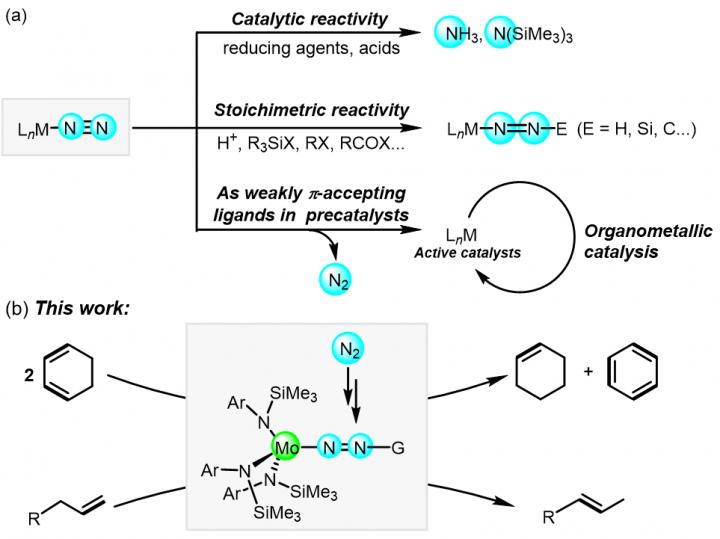
Dinitrogen (N2) fixation is considered as one of the most essential tasks in basic science, providing straightforward methods to produce ammonia and nitrogen-containing molecules. Exploring the reactivity of N2 units of transition metal-nitrogen complexes is of great significance and challenging in the chemistry. Since the first Ru-N2 complex was prepared in 1965, important progress has been made in the synthesis and reactivity of transition metal nitrogen complexes. In many cases, terminal end-on M-N2 complexes as the most prevalent bonding mode were proved to be effective to catalyze reductive reactions of N2 to afford ammonia or silylamines; moreover, due to the nucleophilicity of dinitrogen moiety, the activated dinitrogen ligands in M-N2 (M = Mo, W, Fe, Co) complexes were transformed into N-containing organic compounds with carbon-based electrophiles. On the other hand, late-transition metal-N2 complexes (M = Co, Ru, Ir, Fe) have also been reported as precatalysts for organometallic transformations including cycloaddition and hydrofunctionalization of olefins, semihydrogenation of alkynes, transfer hydrogenation of ketones and acceptorless dehydrogenation of alcohols. In these systems, dinitrogen (N2) as weakly π-accepting ligand to stabilize highly reactive and low valence-electron species, was proved not to be involved in the catalytic processes. The status quo urges exploration on the potential reactivity of coordinated N2 units in organometallic catalysis, which will inspire new strategies for catalytic conversions of N2.

More recently, the research group of Professor Zhang-Jie Shi from Fudan University reported the synthesis, structural characterization and catalytic reactivity exploration of molybdenum-nitrogen complexes supported by monodentate arylsilylamino ligand in the National Science Review (NSR). The results showed that complexes [Ar(TMS)N]3MoN2Mg(THF)2[N(TMS)Ar] (A) and [Ar(TMS)N]3MoN2TMS (B) could be used as effective catalysts for the disproportionation of cyclohexadienes to generate cyclohexene and benzene. It was noteworthy that those catalysts remained intact after complete conversion of the substrate, suggesting that the activated -N2 units were retained during catalysis. Other complexes such as Mo[N(TMS)Ar]3, ClMo[N(TMS)Ar]3, Mg[N(TMS)Ar]2 or Li[N(TMS)Ar] failed for promoting such a disproportionation efficiently. Kinetic studies showed that the initial rate of disproportionation depend on the concentration of catalyst A was the first order, providing the evidence of A not as a precatalyst in the transformation; the authors proposed that the Mo-N=N unit in the molybdenum-nitrogen complex played a key role in the reaction through the LLHT process. In addition, applying the LLHT-reverse LLHT reaction process to terminal olefins such as allylbenzene or 1-hexene the isomerization indeed took place in high efficiency. Kinetic studies indicated the C-H cleavage was not involved in the rate-determining step.

The research results showed that molybdenum-nitrogen complexes possessed high catalytic activity in organometallic catalytic conversion, which may suggest new approaches to participate in catalytic systems for nitrogen ligands, and afforded new perspectives to examine coordination modes between metal centers and nitrogen ligands.

###

See the article:

Silylamido supported dinitrogen heterobimetallic complexes: Syntheses and their catalytic ability

https://doi.org/10.1093/nsr/nwaa290

Media Contact
Zhang-jie Shi
[email protected]

Related Journal Article

http://dx.doi.org/10.1093/nsr/nwaa290

Tags: Chemistry/Physics/Materials Sciences
Share12Tweet8Share2ShareShareShare2

Related Posts

Scientists Achieve Breakthrough in Molecular ‘Sandwich’ Assembly — Chemistry

Scientists Achieve Breakthrough in Molecular ‘Sandwich’ Assembly

May 21, 2026
Advancing In Vivo and In Situ Monitoring: Science Bulletin Highlights Host-Based Antifouling Gold Nanotube Sensor for Selective Detection of Mechanically Sensitive Serotonin Release in Intestinal Mucosa — Chemistry

Advancing In Vivo and In Situ Monitoring: Science Bulletin Highlights Host-Based Antifouling Gold Nanotube Sensor for Selective Detection of Mechanically Sensitive Serotonin Release in Intestinal Mucosa

May 20, 2026

How Magnetic Orientation Could Influence the Building Blocks of Life

May 20, 2026

Breaking a 200-Year-Old Belief: Novel Surface Design Achieves Two Distinct Wetting States on One Substrate

May 20, 2026
Please login to join discussion

POPULAR NEWS

  • blank

    New Study Reveals Plants Can Detect the Sound of Rain

    733 shares
    Share 292 Tweet 183
  • ESMO 2025: mRNA COVID Vaccines Enhance Efficacy of Cancer Immunotherapy

    304 shares
    Share 122 Tweet 76
  • Research Indicates Potential Connection Between Prenatal Medication Exposure and Elevated Autism Risk

    846 shares
    Share 338 Tweet 212
  • Breastmilk Balances E. coli and Beneficial Bacteria in Infant Gut Microbiomes

    58 shares
    Share 23 Tweet 15

About

We bring you the latest biotechnology news from best research centers and universities around the world. Check our website.

Follow us

Recent News

Innovative Reusable Brick Walls Revolutionize Construction Industry

Nonlinear Atomic Tunneling Enhanced by Bright Squeezed Vacuum

Label-Free Super-Resolution Imaging of Live Cells

Subscribe to Blog via Email

Enter your email address to subscribe to this blog and receive notifications of new posts by email.

Join 82 other subscribers
  • Contact Us

Bioengineer.org © Copyright 2023 All Rights Reserved.

Welcome Back!

Login to your account below

Forgotten Password?

Retrieve your password

Please enter your username or email address to reset your password.

Log In
No Result
View All Result
  • Homepages
    • Home Page 1
    • Home Page 2
  • News
  • National
  • Business
  • Health
  • Lifestyle
  • Science

Bioengineer.org © Copyright 2023 All Rights Reserved.