• HOME
  • NEWS
  • EXPLORE
    • CAREER
      • Companies
      • Jobs
    • EVENTS
    • iGEM
      • News
      • Team
    • PHOTOS
    • VIDEO
    • WIKI
  • BLOG
  • COMMUNITY
    • FACEBOOK
    • INSTAGRAM
    • TWITTER
Monday, March 30, 2026
BIOENGINEER.ORG
No Result
View All Result
  • Login
  • HOME
  • NEWS
  • EXPLORE
    • CAREER
      • Companies
      • Jobs
        • Lecturer
        • PhD Studentship
        • Postdoc
        • Research Assistant
    • EVENTS
    • iGEM
      • News
      • Team
    • PHOTOS
    • VIDEO
    • WIKI
  • BLOG
  • COMMUNITY
    • FACEBOOK
    • INSTAGRAM
    • TWITTER
  • HOME
  • NEWS
  • EXPLORE
    • CAREER
      • Companies
      • Jobs
        • Lecturer
        • PhD Studentship
        • Postdoc
        • Research Assistant
    • EVENTS
    • iGEM
      • News
      • Team
    • PHOTOS
    • VIDEO
    • WIKI
  • BLOG
  • COMMUNITY
    • FACEBOOK
    • INSTAGRAM
    • TWITTER
No Result
View All Result
Bioengineer.org
No Result
View All Result
Home NEWS Science News Chemistry

Catalyst deposition on fragile chips

Bioengineer by Bioengineer
February 14, 2020
in Chemistry
Reading Time: 2 mins read
0
IMAGE
Share on FacebookShare on TwitterShare on LinkedinShare on RedditShare on Telegram

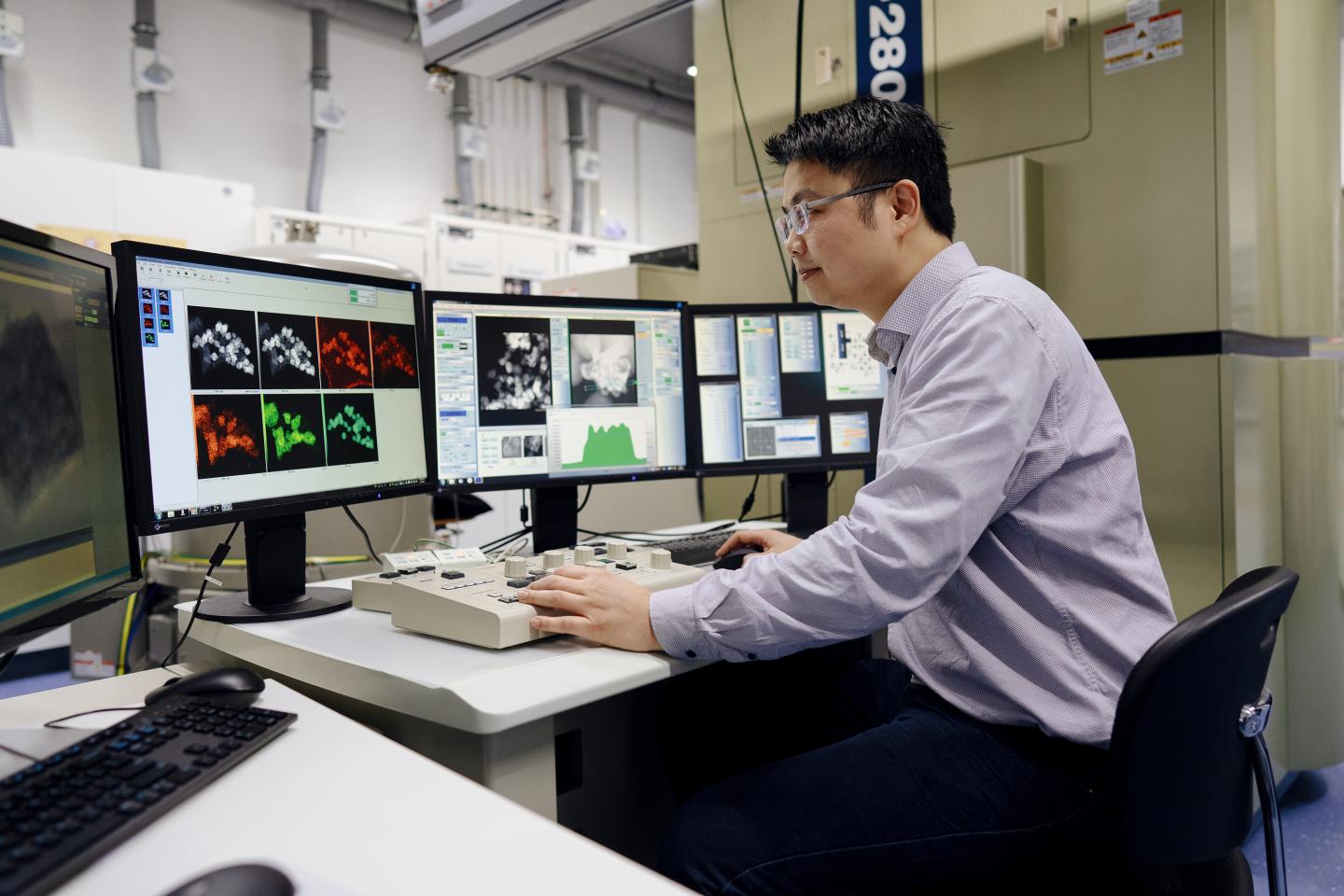
Electrocatalysts can help to obtain chemicals from renewable raw materials or to use alternative energy sources. But testing new catalysts brings challenges
IMAGE

Credit: RUB, Kramer

Researchers at the Ruhr-Universität Bochum (RUB) and the University of Duisburg-Essen have developed a new method of depositing catalyst particles to tiny electrodes. It is inexpensive, simple and quick to perform. In order to characterize catalysts and test their potential for various applications, researchers have to fix the particles to electrodes so that they can then be examined, for example, with transmission electron microscopy.

The new method is described by Dr. Tsvetan Tarnev and Professor Wolfgang Schuhmann from the Center for Electrochemistry at RUB with Steffen Cychy and Professor Martin Muhler, RUB Chair of Technical Chemistry, as well as Professor Corina Andronescu, University of Duisburg-Essen, and Dr. Yen-Ting Chen from the Bochum Center for Solvation Science in the journal Angewandte Chemie, published online on 20 January 2020.

Wafer-thin electrodes

In transmission electron microscopy, TEM for short, a thin electron beam is sent through the sample to observe the electrochemical processes taking place at an electrode. In order for the beam to penetrate the structures, all sample components must be very thin. The diameter of the electrode to which the catalyst is applied is therefore only ten micrometers.

Depositing catalyst particles drop by drop

With earlier methods, the catalyst particles were either distributed evenly throughout the sample, i.e. even where they were not needed, or methods were used that could damage the material. Both disadvantages are eliminated with the new method, which is based on scanning electrochemical cell microscopy. The researchers fill a glass capillary with a liquid containing the catalyst particles. They then approach the capillary to the electrode onto which the particles are to be deposited. A tiny drop of the particle liquid hangs at the lower opening of the capillary.

The researchers approach the capillary to the electrode until the drop of liquid comes into contact with the electrode and closes an electrical circuit. This automatically stops the approach, preventing damage to the material. The scientists then retract the capillary, but the drop of liquid remains on the electrode. This step can be repeated as often as required. Finally, the researchers evaporate the solvent so that only the catalyst particles remain, which are now fixed to the electrode.

Suitable for many catalyst materials

“Once the methodology is established, it offers a clean, easy-to-use and variable way of applying and measuring a large number of different catalyst materials stably and reproducibly on liquid cell TEM chips,” says Wolfgang Schuhmann.

###

Media Contact
Wolfgang Schuhmann
[email protected]
49-234-322-6200

Original Source

https://news.rub.de/english/press-releases/2020-02-14-chemistry-catalyst-deposition-fragile-chips

Related Journal Article

http://dx.doi.org/10.1002/anie.201916419

Tags: Chemistry/Physics/Materials SciencesIndustrial Engineering/Chemistry
Share12Tweet8Share2ShareShareShare2

Related Posts

Enhancing Weather Resistance in Perovskite Solar Cells

Enhancing Weather Resistance in Perovskite Solar Cells

March 29, 2026
Innovative Approach Achieves 29.76% Efficiency in All-Perovskite Tandem Solar Cells

Innovative Approach Achieves 29.76% Efficiency in All-Perovskite Tandem Solar Cells

March 29, 2026

Molecular Umbrella Shields Solar Cells for Enhanced Protection

March 29, 2026

Microwave Technology Transforms Moon Dust into Building Materials Without Earth Supplies

March 29, 2026
Please login to join discussion

POPULAR NEWS

  • blank

    Revolutionary AI Model Enhances Precision in Detecting Food Contamination

    96 shares
    Share 38 Tweet 24
  • Imagine a Social Media Feed That Challenges Your Views Instead of Reinforcing Them

    1005 shares
    Share 397 Tweet 248
  • Promising Outcomes from First Clinical Trials of Gene Regulation in Epilepsy

    51 shares
    Share 20 Tweet 13
  • Advancements in EV Battery Technology to Surpass Climate Change-Induced Degradation

    45 shares
    Share 18 Tweet 11

About

We bring you the latest biotechnology news from best research centers and universities around the world. Check our website.

Follow us

Recent News

Life Satisfaction and Cognitive Reserve Shape Aging Brains

Gut Microbiome Drives Metabolic Response to Raspberries

Prioritize Intensity Over Duration: How Harder Exercise Lowers Disease and Mortality Risks

Subscribe to Blog via Email

Enter your email address to subscribe to this blog and receive notifications of new posts by email.

Join 78 other subscribers
  • Contact Us

Bioengineer.org © Copyright 2023 All Rights Reserved.

Welcome Back!

Login to your account below

Forgotten Password?

Retrieve your password

Please enter your username or email address to reset your password.

Log In
No Result
View All Result
  • Homepages
    • Home Page 1
    • Home Page 2
  • News
  • National
  • Business
  • Health
  • Lifestyle
  • Science

Bioengineer.org © Copyright 2023 All Rights Reserved.