


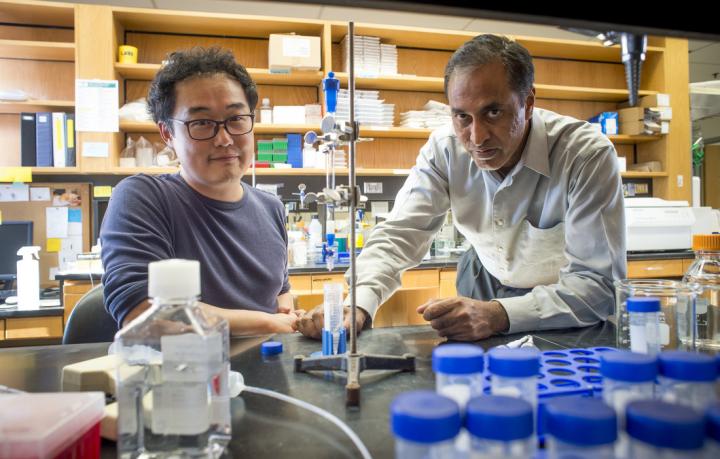
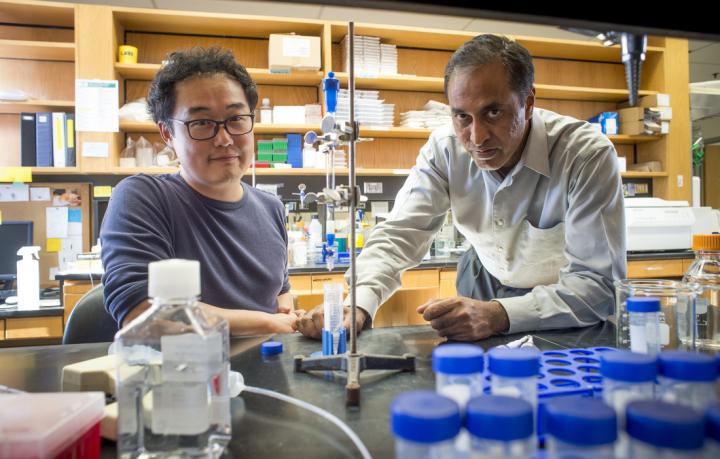
Credit: UAB
BIRMINGHAM, Ala. – Failure of hormone deprivation therapy, which is used to slow prostate cancer in patients, leads to castration-resistant prostate cancer, a lethal form of advanced disease with limited treatment options.
University of Alabama at Birmingham researchers have discovered that endostatin, a naturally occurring protein in humans, can significantly decrease proliferation of castration-resistant prostate cells in culture, and in a recent paper in The FASEB Journal, they describe the physiological pathways and signaling evoked by endostatin. This endostatin effect is now being tested in a preclinical xenograft animal model of castration-resistant prostate cancer.
"We hope we can delay the onset of castration-resistant disease," said Selvarangan Ponnazhagen, Ph.D., a UAB professor in the UAB Department of Pathology who holds an Endowed Professorship in Experimental Cancer Therapeutics at UAB.
The medical treatment that deprives prostate cancer cells of androgen hormones through anti-hormone therapy creates oxidative stress in those cancer cells. This oxidative stress is associated with reactivated signaling by the androgen receptor in the cells, causing resistance to the anti-hormone therapy.
The UAB researchers, led by Ponnazhagen and first author Joo Hyoung Lee, Ph.D., hypothesized that the oxidative stress might be triggered upstream of the androgen receptor, with the glucocorticoid receptor as the stress-inducer. If so, endostatin might interact with the glucocorticoid receptor to remove the oxidative stress and reduce that pro-tumorigenic function in the cancer cells, thereby preventing or delaying the onset of castration-resistant disease.
They found that endostatin did target the androgen and glucocorticoid receptors through reciprocal regulation that affected downstream pro-oxidant signaling mechanisms. The effect of endostatin treatment, possibly mediated through direct interaction of endostatin with both androgen receptor and glucocorticoid receptor, downregulated both the steroid hormone receptor levels and led to physiological changes that removed oxidative stress from the cancer cells.
Treatment with endostatin resulted in a significant up-regulation of the major cellular machinery to scavenge destructive reactive-oxygen-species, including manganese superoxide dismutase, the glutathione system and the biliverdin/bilirubin redox cycle. Increased levels of reduced glutathione, a major internal antioxidant molecule, was accompanied by increased glucose uptake as the endostatin-treated cancer cells appeared to shift their metabolism to the pentose phosphate pathway. This pathway uses glucose to maintain the antioxidant system, which includes NAD/NADP production and glutathione.
"Our study suggests that the potential therapeutic application of endostatin may include combination with the frontline androgen-deprivation therapy that targets prostate cancer at early stages," the researchers wrote. "Based on the known anti-angiogenic properties of endostatin and on more interesting evidence that human prostate endothelial cells also express androgen receptor, the application of endostatin in combination therapies could synergize tumoristatic and tumoricidal effects with minimal resistance."
###
Besides Ponnazhagen and Lee, authors of the paper, "Endostatin inhibits androgen-independent prostate cancer growth by suppressing nuclear receptor-mediated oxidative stress," are Minsung Kang and W. Timothy Garvey, UAB Department of Nutrition Sciences; Hong Wang and Victor M. Darley-Usmar, UAB Department of Pathology; Gurudatta Naik and Guru Sonpavde, UAB Comprehensive Cancer Center; and James A. Mobley, UAB Department of Surgery. Garvey also serves in the Birmingham Veterans Affairs Medical Center, and Lee is a research associate in pathology.
Media Contact
Jeff Hansen
[email protected]
205-209-2355
http://www.uab.edu
############
Story Source: Materials provided by Scienmag


