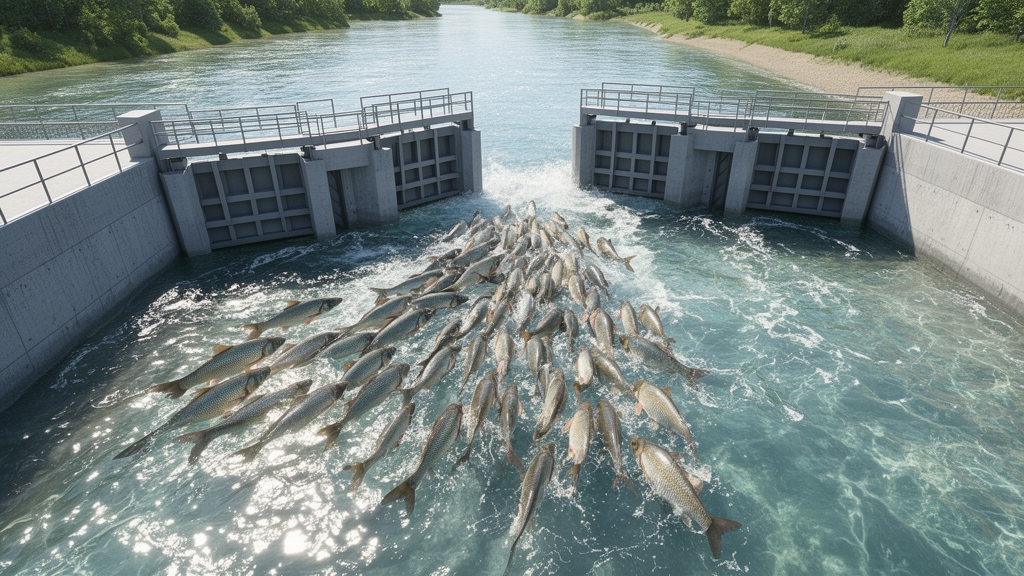
Biological invasions in highly engineered waterways advance along directional pathways dictated by network structure rather than unchecked open water dispersal, according to an extensive modeling investigation of silver carp spread across the southeastern United States. Researchers evaluating decades of biological records across the Tennessee River and Cumberland River basins found that the timing of first detection for invasive silver carp (Hypophthalmichthys molitrix) was primarily explained by distance from downstream invasion sources, while lock-mediated passage opportunity provided modest supplementary explanatory power. The investigation, conducted using accelerated failure time survival models adapted for interval- and right-censored ecological records, demonstrates that reservoir cascades function as directional corridors where physical position along the impounded chain largely determines colonization sequences. Rather than spreading haphazardly across basin networks, nonnative fish populations advanced sequentially from reservoir to reservoir without skipping downstream segments, providing resource managers with an empirical framework to forecast invasion fronts and implement targeted containment measures.
River impoundment has become the dominant global standard for major lotic ecosystems, with more than half of the world’s large rivers and over sixty percent of long river corridors fragmented by dams, reservoirs, and navigational infrastructure. In these heavily modified fluvial systems, ecological conditions and movement corridors do not follow continuous natural longitudinal river gradients, but are instead partitioned by repeated physical discontinuities created by engineered impoundments and associated navigation locks. In the interconnected Tennessee and Cumberland river systems, invasion sources are situated downstream near confluences with the lower Ohio River and connected waterways, creating a distinct spatial configuration where invasive progression must advance upstream against the prevailing downstream flow through a linear chain of artificial impoundments.
Unlike navigation dams on other large North American rivers such as the Mississippi, Ohio, and Illinois rivers, where fishes can periodically pass upstream through open gates during specific high-water hydraulic conditions, upstream passage across the mainstem dams of the Tennessee and Cumberland systems is effectively restricted to commercial navigation lock chambers. The gated spillways and powerhouse structures at these hydroelectric and flood control dams do not permit upstream biological passage, meaning that upstream fish movement between adjacent impoundments depends entirely on traversing lock chambers during lockage cycles. The Tennessee River navigation corridor spans nearly one thousand kilometers, comprising a contiguous series of lock-and-dam reservoirs extending upstream from Kentucky Lake through Pickwick, Wilson, Wheeler, Guntersville, Nickajack, Chickamauga, Watts Bar, and Fort Loudoun reservoirs, before continuing into the Clinch River tributary to Melton Hill Reservoir. The Cumberland River navigation corridor extends approximately six hundred and fifty kilometers, encompassing Barkley, Cheatham, Old Hickory, and Cordell Hull reservoirs linked along a shared navigational channel.
To evaluate the spatial and temporal mechanics governing silver carp progression through these lock-connected networks, the research team assembled first-detection records across all lock-connected reservoirs in both basins. Invasion timing was characterized using the earliest documented agency reports, official records from the United States Geological Survey Nonindigenous Aquatic Species Database, regional coordination inventories, and direct communications with state and federal field biologists. First-detection metrics represent a widely accepted standard proxy in invasion biology for establishing chronological benchmarks when standardized, long-term monitoring across entire river networks is logistically unavailable or unevenly distributed. While first-detection years may lag actual biological arrival by varying intervals due to surveillance intensity, researchers treated these dates as conservative markers of documented presence rather than absolute colonization timestamps, focusing their mathematical analysis on broad system-wide dynamics and directional trends rather than fine-scale local colonization dates.
The scientists formulated three explicit candidate hypotheses to evaluate what factors determine arrival timing in impounded river networks: first, that arrival timing is primarily structured by network position within the cascade; second, that arrival timing is associated with lock-mediated passage opportunity; and third, that arrival timing reflects accumulated exposure to downstream source populations over time. Network position was indexed as distance from the downstream invasion source at the Ohio River confluence, scaled to units of one hundred kilometers. Lock-mediated passage opportunity was estimated through annual water locked, calculated as the physical volume of the navigation lock chamber multiplied by the mean annual number of lockages recorded by navigation authorities between 2015 and 2020. Cumulative exposure was evaluated through metrics tracking the elapsed years since the initial downstream invasion and the cumulative volume of water transferred through all downstream locks up to the focal reservoir.
Lock chamber dimensions across the study basins exhibited substantial physical variation that directly influenced the volume of water transferred during navigation operations. Assuming an effective water filling depth of three meters, lock chamber volumes ranged from six thousand to eight thousand five hundred cubic meters at smaller upstream locks including Watts Bar, Fort Loudoun, and Melton Hill, up to eighteen thousand seven hundred cubic meters across standard-sized chambers including Kentucky, Wilson, Wheeler, Guntersville, Nickajack, Chickamauga, Old Hickory, and Cordell Hull dams. The largest downstream lock chambers, located at Pickwick, Barkley, and Cheatham dams, encompassed volumes reaching twenty-five thousand to thirty-one thousand cubic meters per cycle. Despite these structural disparities, because the vast majority of locks along the corridors fall within the standard size class, spatial differences in annual water exchange were driven primarily by variations in lockage frequency rather than chamber geometry, providing an operational metric of physical connectivity.
To rigorously accommodate uncertainty and unobserved colonization events across the cascades, the research team applied parametric Weibull accelerated failure time survival models capable of handling both interval-censored and right-censored data using the LIFEREG procedure. Interval censoring was assigned to three reservoirs where historical first detections were documented as multi-year date ranges rather than specific single-year records, establishing defined bounds on initial presence. Right censoring was applied to all upstream reservoirs where silver carp had not yet been detected by the conclusion of the study period, properly accounting for the fact that invasion could occur at an unspecified future date. In this survival analysis framework, covariate coefficients reflect multiplicative acceleration or deceleration factors directly influencing the expected time elapsed before initial detection occurs across the reservoir cascade.
Initial screening models demonstrated that including river basin identity as an explanatory covariate did not meaningfully improve model performance compared to distance alone, producing an Akaike Information Criterion difference of 3.4 units. Consequently, data from both the Tennessee and Cumberland river basins were pooled into a unified analytical framework. The observed spatial patterns revealed an orderly, monotonic progression of silver carp upstream along both river channels, with reservoirs becoming invaded strictly in order of their position along the network. Across the multi-decade monitoring record, there were zero occurrences where an upstream reservoir was colonized prior to confirmed establishment in the downstream reservoir immediately preceding it, demonstrating a strictly directional invasion corridor.
By 2026, biological monitoring confirmed that silver carp had successfully invaded all four lock-connected reservoirs within the Cumberland River cascade, terminating at Cordell Hull Reservoir where the species was documented in 2024. In contrast, upstream spread along the longer Tennessee River cascade had progressed only approximately halfway through the system, reaching Guntersville Lake where first detection occurred in 2021. The subsequent upstream reservoir, Nickajack, is situated approximately one hundred and twenty kilometers upstream of Guntersville Dam and roughly one hundred and seventy-seven kilometers farther from the Ohio River source than Cordell Hull. Because upstream reservoirs such as Nickajack remain uninvaded despite continuous lock-mediated connectivity, the researchers noted that pathway structure alone does not guarantee rapid colonization, while emphasizing that the lack of detection does not indicate that upstream progression has permanently halted.
Statistical evaluation of candidate time-to-event models demonstrated that cascade position was the dominant factor governing silver carp arrival times across both river networks. The top-supported model incorporated both upstream distance and annual water locked, capturing sixty-six percent of the total model weight, whereas the distance-only model received secondary support with a weight of sixteen percent and an Akaike difference of 2.8 units. In the top-ranked model, distance upstream was associated with a statistically significant delay in arrival timing, exhibiting a positive coefficient of 0.00168 per one hundred kilometers, while annual water locked exhibited a negative coefficient of minus 0.00053, indicating that greater lock-mediated passage opportunity modestly accelerates upstream arrival. In contrast, models relying on cumulative exposure or cumulative locked water failed to receive statistical support, displaying Akaike differences exceeding 3.9 units when paired with distance and exceeding 10 units when evaluated independently.
The lack of independent support for cumulative exposure metrics indicates that cumulative passage history and exposure duration are largely collinear with physical distance in linear reservoir systems, meaning spatial network position inherently encapsulates exposure gradients. Descriptive calculations of stepwise colonization lags between consecutive reservoirs revealed substantial variation rather than a constant apparent rate of advance, with intervals fluctuating across different segments of the cascade. The authors noted that silver carp reproduction appears largely absent or strictly limited to the lowermost reaches of the study cascades, suggesting that the river networks function primarily as recipient corridors sustained by downstream immigrants rather than self-seeding relays. In such source-fed configurations, upstream movement depends heavily on immigration pressure, where fluctuations in downstream source population recruitment and lock passage frequency dictate how rapidly individuals reach uninvaded territory.
These empirical findings outline practical implications for regional fisheries management and invasive species mitigation across regulated river networks. Because invasion trajectories are tightly constrained by directional network position, management authorities can prioritize interventions at identifiable leverage points along the corridor rather than deploying diffuse basin-wide measures. Recommended strategies include intensive early detection monitoring and containment at uninvaded barrier reservoirs, aggressive population suppression in downstream source waters to reduce propagule pressure, and targeted deterrent installations or modified lock operations at critical connectivity nodes to restrict upstream passage. By viewing reservoir cascades as directional, source-limited corridors, natural resource agencies can strategically deploy deterrent technologies and suppression harvesting to stall invasion fronts before nonnative species access vulnerable upstream aquatic habitats.
Subject of Research: Spread dynamics and arrival timing of invasive silver carp in lock-connected reservoir cascades
Article Title: Reservoir cascades as directional invasion corridors
Article References: Miranda, L. E., Angulo-Valencia, M. A., & Aldridge, C. A. (2026). Reservoir cascades as directional invasion corridors. Biological Invasions, 28(10), Article 217. https://doi.org/10.1007/s10530-026-03934-z
Image Credits: AI Generated
DOI: 10.1007/s10530-026-03934-z
Keywords: silver carp, Hypophthalmichthys molitrix, reservoir cascades, Tennessee River, Cumberland River, biological invasions, navigation locks, directional dispersal, time-to-event models, accelerated failure time, propagule pressure, invasive species management, river impoundment, first detection, Guntersville Lake, Cordell Hull Reservoir, water locked
News Source: Drew Townsend. (November 24, 2026). Cascade Position and Navigation Locks Predict Directional Silver Carp Spread Across River Basins. Scienmag.