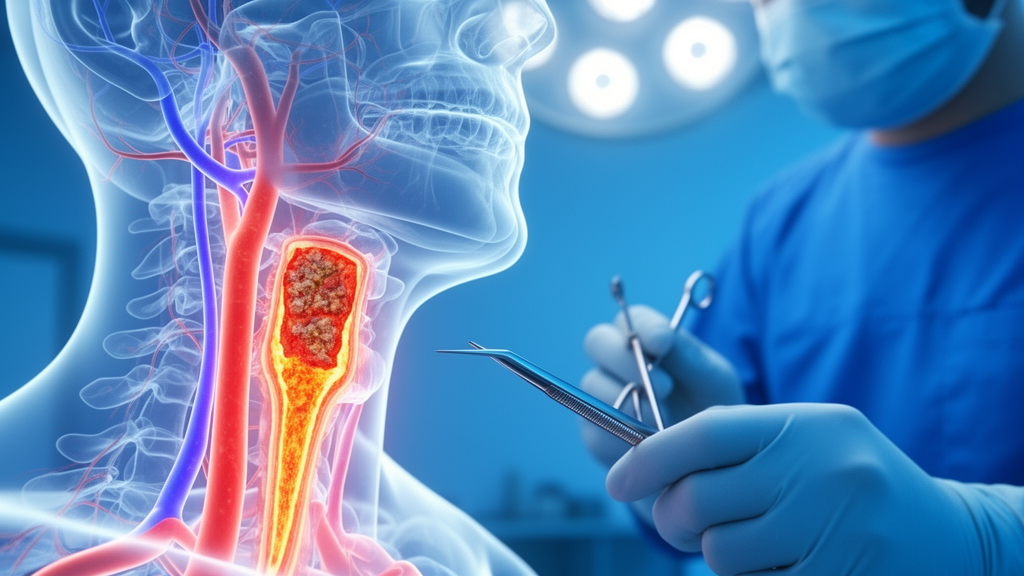
When a severely narrowed carotid artery chokes off blood flow so badly that the vessel beyond the blockage itself collapses, surgeons and neurologists face one of the most contested questions in stroke medicine: does operating on this fragile artery help, or does it expose the patient to needless risk? A new prospective study from Helsinki University Hospital, published in the Journal of Neurology, delivers a technically detailed answer that challenges decades of assumptions about carotid near occlusion, a condition that turns out to be far more common on modern imaging than the landmark trials ever captured.
Carotid near occlusion, abbreviated NO, refers to a severe stenosis of the internal carotid artery that reduces the diameter of the vessel distal to the blockage. Unlike conventional stenosis, which can be expressed as a percentage reduction in luminal diameter using the NASCET criteria, the severity of near occlusion cannot be reliably quantified this way. The distal artery has already been squeezed by the inability of blood flow to sustain adequate pressure past the critical narrowing, so the usual yardstick breaks down. This complicates both diagnosis and clinical decision-making, and it explains why the condition has remained controversial since the era of the North American Symptomatic Carotid Endarterectomy Trial and the European Carotid Surgery Trial, which together included only 262 patients with near occlusion, a mere 4.4 percent of their combined cohorts.
The Finnish team, led by Henrietta Törmänen and Petra Ijäs, reanalyzed preoperative CT angiograms from 443 consecutive carotid stenosis patients scheduled for carotid endarterectomy between October 2012 and September 2015 as part of the Helsinki Carotid Endarterectomy Study 2. The cohort drew from a catchment area of approximately 1.6 million people, and the decision to operate was made according to institutional guidelines aligned with European Society for Vascular Surgery recommendations. Crucially, the study cohort was established based on the decision to perform surgery, not the operation itself, so patients who suffered adverse events while waiting were retained in the analysis.
The researchers applied precise, reproducible measurement-based definitions. Subtle near occlusion, or s-NO, was defined as a difference of at least 1.0 millimeter in distal luminal diameter between the ipsilateral and contralateral internal carotid artery, a threshold derived from the normal variation of the healthy internal carotid artery using a 2.5 times standard deviation cut-off. Near occlusion with full collapse, or fc-NO, was defined as an ipsilateral distal internal carotid artery diameter of 2.0 millimeters or less, and/or an ipsilateral-to-contralateral diameter ratio of 0.42 or less. All measurements were conducted by two experienced neuroradiologists and a trained radiology resident, ensuring diagnostic consistency across the entire cohort.
The headline finding is striking: near occlusion was detected in 143 patients, or 32 percent of the cohort, with 124 cases, or 87 percent, being the subtle form and only 19 cases, or 13 percent, showing full collapse. This prevalence vastly exceeds what was seen in the NASCET and ECST study cohorts, a difference the authors attribute to the superior sensitivity of CT angiography compared with digital subtraction angiography, which was typically performed unilaterally in the early trials and likely underestimated the prevalence of subtle collapse. The mean age of patients was 70 years, 68 percent were male, and the most prevalent index symptom was hemispheric stroke at 27 percent, followed by amaurosis fugax at 18 percent and transient ischemic attack at 17 percent.
Contrary to expectations, patients with near occlusion did not carry a higher risk of preoperative recurrent stroke or procedural stroke or death within 30 days of surgery compared with those with conventional stenosis. The age-adjusted odds ratio for preoperative ischemic cerebrovascular events was 1.82 with a 95 percent confidence interval of 0.96 to 3.47, which did not reach statistical significance. For procedural stroke or death, the odds ratio was 1.73 with a confidence interval of 0.67 to 4.50, again not significant. The 30-day stroke or death rate in near occlusion patients was 5.6 percent, with 5.6 percent in the subtle group and 5.3 percent in the full collapse group. These figures contrast sharply with some earlier reports, including one study that documented a 43 percent risk of recurrent ipsilateral ischemic stroke within 90 days for patients with full collapse treated with best medical therapy alone, and another that found a 6 percent stroke or death rate after revascularization.
However, the study uncovered a genuinely important procedural risk that has been underappreciated: hyperperfusion syndrome after carotid endarterectomy was nearly three times more frequent in near occlusion patients, occurring in 7.0 percent versus 2.7 percent of conventional stenosis patients, with an age-adjusted odds ratio of 2.78 and a confidence interval of 1.06 to 7.12. Hyperperfusion syndrome was diagnosed when typical symptoms such as hypertension, headache, confusion, focal neurological deficits, or seizures occurred in association with elevated flow velocity in the middle cerebral artery territory ipsilateral to the surgery, as measured by transcranial doppler. One patient with subtle near occlusion suffered a fatal intracranial hemorrhage due to hyperperfusion. The predominance of the subtle form among affected patients, with 55 percent of hyperperfusion cases having s-NO, suggests that impaired cerebrovascular reserve and autoregulation may promote post-revascularization hyperperfusion even in milder forms of collapse.
The study also revealed a curious pattern in symptom distribution. Amaurosis fugax, the transient loss of vision in one eye, was significantly more common as an index symptom in near occlusion patients, occurring in 26 percent versus 14 percent of conventional stenosis patients, and it tended to be repetitive in nature, with a median of three attacks per patient before hospital admission. The authors interpret this finding as partly a consequence of patient selection, since near occlusion patients are typically managed with best medical therapy after their first symptom, with invasive treatments reserved for recurrent symptoms. Yet they cannot rule out a true biological association, because high-grade carotid stenosis reduces arterial flow, increasing embolic risk and predisposing to ocular hypoperfusion, which can lead to repetitive transient visual symptoms through both frank hemodynamic failure and microemboli.
The clinical implications are substantial. Because optimal treatment strategies for near occlusion remain uncertain, with the 2023 European Society for Vascular Surgery guidelines providing only a Class IIb recommendation for revascularization in symptomatic full collapse patients with recurrent events despite best medical therapy, this study contributes to an evolving understanding of the condition. The finding that near occlusion patients face a higher risk of hyperperfusion syndrome, which can predispose to intracerebral hemorrhage if left untreated, makes strict perioperative blood pressure control essential. The authors call for further observational studies comparing near occlusion patients with and without collapse to better guide clinical decisions, and their precise measurement-based criteria offer a reproducible tool for future research into this common yet enigmatic variant of carotid artery disease.
Subject of Research: Neurology
Article Title: Risk of early stroke recurrence and procedural stroke or death in carotid near occlusion patients scheduled for carotid endarterectomy
Article References: Törmänen, H., Koskinen, S., Nuotio, K., Tulamo, R., Vikatmaa, P., Soinne, L., Lindsberg, P. J., & Ijäs, P. (2026). Risk of early stroke recurrence and procedural stroke or death in carotid near occlusion patients scheduled for carotid endarterectomy. Journal of Neurology, 273(11), Article 667. https://doi.org/10.1007/s00415-026-14198-x
Image Credits: AI Generated
DOI: 10.1007/s00415-026-14198-x
Keywords: stroke, carotid near occlusion, carotid endarterectomy, hyperperfusion syndrome, CT angiography, Journal of Neurology, Risk, early, recurrence, procedural, death, carotid
News Source: Ophelia Keating. (October 17, 2026). Carotid near occlusion is common on CTA and linked to hyperperfusion risk after carotid surgery. Scienmag.