• HOME
  • NEWS
  • EXPLORE
    • CAREER
      • Companies
      • Jobs
    • EVENTS
    • iGEM
      • News
      • Team
    • PHOTOS
    • VIDEO
    • WIKI
  • BLOG
  • COMMUNITY
    • FACEBOOK
    • INSTAGRAM
    • TWITTER
Friday, December 19, 2025
BIOENGINEER.ORG
No Result
View All Result
  • Login
  • HOME
  • NEWS
  • EXPLORE
    • CAREER
      • Companies
      • Jobs
        • Lecturer
        • PhD Studentship
        • Postdoc
        • Research Assistant
    • EVENTS
    • iGEM
      • News
      • Team
    • PHOTOS
    • VIDEO
    • WIKI
  • BLOG
  • COMMUNITY
    • FACEBOOK
    • INSTAGRAM
    • TWITTER
  • HOME
  • NEWS
  • EXPLORE
    • CAREER
      • Companies
      • Jobs
        • Lecturer
        • PhD Studentship
        • Postdoc
        • Research Assistant
    • EVENTS
    • iGEM
      • News
      • Team
    • PHOTOS
    • VIDEO
    • WIKI
  • BLOG
  • COMMUNITY
    • FACEBOOK
    • INSTAGRAM
    • TWITTER
No Result
View All Result
Bioengineer.org
No Result
View All Result
Home NEWS Science News Chemistry

Carnegie Mellon physicist Rachel Mandelbaum named 2019 Simons Investigator

Bioengineer by Bioengineer
June 24, 2019
in Chemistry
Reading Time: 2 mins read
0
IMAGE
Share on FacebookShare on TwitterShare on LinkedinShare on RedditShare on Telegram

IMAGE

Credit: Carnegie Mellon University

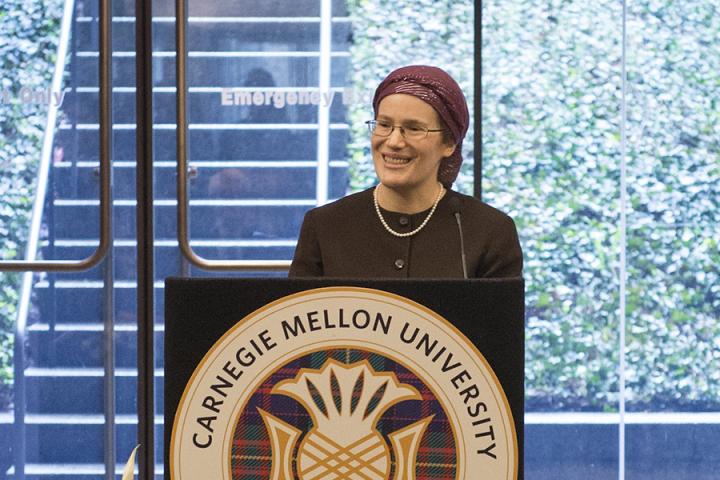
Carnegie Mellon University physicist Rachel Mandelbaum has been named a 2019 Simons Investigator by the Simons Foundation.

The Simons Investigator program provides research support to outstanding scientists, enabling them to undertake the long-term study of fundamental questions. Mandelbaum is the first Carnegie Mellon researcher to be selected for this prestigious program.

“I am honored to have been named a Simons Investigator. This source of support will be of great value to my research group during the next five years, which will be particularly exciting times as we explore many questions in cosmology with new datasets,” Mandelbaum said.

Mandelbaum, a professor in the Department of Physics and a member of the McWilliams Center for Cosmology, seeks to better understand the universe – how it started and how it came to be as it is today. Specifically, Mandelbaum studies weak gravitational lensing, which looks at distortions in images of distant galaxies obtained by telescopes.

When light from far-away galaxies travels towards Earth – and the lenses of terrestrial telescopes – it passes other objects in the universe. The masses of these objects bend the path taken by light as it travels past, resulting in distorted images. Mandelbaum studies the slightest of these distortions, which contain valuable information about how matter was distributed in the early universe and how matter evolved to the large-scale structure we see today. It also holds clues to the nature of dark matter and dark energy.

“Rachel is a leader in the field of gravitational lensing, and her work is paving the paving for exciting discoveries over the coming decade. We are thrilled that the Simons Foundation has acknowledged the importance of her work,” said Scott Dodelson, professor and head of the Department of Physics at Carnegie Mellon.

Mandelbaum is particularly known for her work that pairs cosmological observations with computer science, statistics and data science. To accurately measure the tiny weak lensing distortions, researchers must collect data from tens of millions of galaxies. They also need to correct for other causes of blurring caused by telescopes or the atmosphere. Mandelbaum creates algorithms that take sources of observational and theoretical uncertainty into account to learn about how galaxies relate to their dark matter halos and to measure cosmological parameters from large telescope datasets.

These algorithms are used by leading astronomical surveys, including the Hyper Suprime-Cam Survey and the upcoming Large Synoptic Survey Telescope (LSST), Euclid and WFIRST projects.

Mandelbaum has held a number of leadership roles and won numerous awards in physics and cosmology. She was recently elected the spokesperson for the LSST’s Dark Energy Science Collaboration (DESC) and previously served as the DESC analysis coordinator and co-leader of the weak lensing working group. She received the Annie Jump Cannon Prize from the American Astronomical Society, a Department of Energy Early Career Award and an Alfred P. Sloan Fellowship.

###

Media Contact
Jocelyn Duffy
[email protected]

Original Source

https://www.cmu.edu/mcs/news-events/2019/0624_mandelbaum-simons-investigator.html

Tags: Algorithms/ModelsAstrophysicsChemistry/Physics/Materials SciencesMathematics/StatisticsSpace/Planetary ScienceTechnology/Engineering/Computer Science
Share12Tweet8Share2ShareShareShare2

Related Posts

Microenvironment Shapes Gold-Catalysed CO2 Electroreduction

Microenvironment Shapes Gold-Catalysed CO2 Electroreduction

December 11, 2025
Photoswitchable Olefins Enable Controlled Polymerization

Photoswitchable Olefins Enable Controlled Polymerization

December 11, 2025

Cation Hydration Entropy Controls Chloride Ion Diffusion

December 10, 2025

Iridium Catalysis Enables Piperidine Synthesis from Pyridines

December 3, 2025
Please login to join discussion

POPULAR NEWS

  • Nurses’ Views on Online Learning: Effects on Performance

    Nurses’ Views on Online Learning: Effects on Performance

    70 shares
    Share 28 Tweet 18
  • NSF funds machine-learning research at UNO and UNL to study energy requirements of walking in older adults

    70 shares
    Share 28 Tweet 18
  • Unraveling Levofloxacin’s Impact on Brain Function

    53 shares
    Share 21 Tweet 13
  • MoCK2 Kinase Shapes Mitochondrial Dynamics in Rice Fungal Pathogen

    72 shares
    Share 29 Tweet 18

About

We bring you the latest biotechnology news from best research centers and universities around the world. Check our website.

Follow us

Recent News

Transforming Food Systems for Health and Climate Resilience

Linking Embryo Development and Neonatal Sex Ratios

Combining Therapies for Adolescent ARFID: A Case Study

Subscribe to Blog via Email

Enter your email address to subscribe to this blog and receive notifications of new posts by email.

Join 70 other subscribers
  • Contact Us

Bioengineer.org © Copyright 2023 All Rights Reserved.

Welcome Back!

Login to your account below

Forgotten Password?

Retrieve your password

Please enter your username or email address to reset your password.

Log In
No Result
View All Result
  • Homepages
    • Home Page 1
    • Home Page 2
  • News
  • National
  • Business
  • Health
  • Lifestyle
  • Science

Bioengineer.org © Copyright 2023 All Rights Reserved.