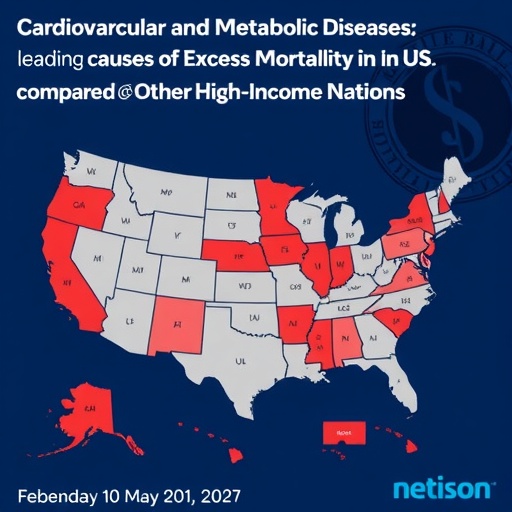
A groundbreaking study conducted by researchers at the Boston University School of Public Health (BUSPH) reveals a stark and troubling health disparity between the United States and other high-income countries (HICs). Spanning over two decades, from 1999 to 2022, the investigation uncovers that the U.S. exhibits significantly elevated mortality rates, with cardiovascular diseases identified as the predominant driver behind these excess deaths. This comprehensive analysis, recently published in the esteemed journal JAMA Network Open, delivers an unprecedented “population autopsy” detailing the multifaceted causes behind America’s escalating mortality disadvantage relative to its global peers.
Despite the apparent parity in access to cutting-edge medical technologies, the U.S. has experienced a progressively widening mortality gap with comparable affluent nations. The study meticulously quantifies what it terms “excess deaths”—fatalities that arguably could have been averted if American mortality rates aligned with those of other wealthy countries. Notably, by 2022, all-cause mortality rates in the U.S. were approximately 38 percent higher than those observed among other HICs, translating to an estimated 12.7 million avoidable deaths within this period. These excess deaths, evocatively labeled “missing Americans,” starkly illustrate systemic health failures embedded within the nation’s social and economic fabric.
Delving into the pathology of this mortality gap, the researchers highlight cardiovascular disease as the leading cause of excess deaths almost every year during the study period. Diseases including heart disease, hypertension, and stroke collectively accounted for a large fraction of these additional deaths, signifying a persistent vulnerability in managing cardiometabolic health within the U.S. population. Moreover, metabolic disorders, such as diabetes and chronic kidney disease, displayed a concerning upward trajectory post-2010, further exacerbating the causes behind excess mortality. Mental health disorders, notably Alzheimer’s disease and related dementias, rose sharply particularly in the elderly demographic aged 85 years and above, underscoring a growing crisis in neurological health outcomes.
This research expands significantly on prior studies by incorporating a detailed cause-specific evaluation, employing robust methodologies such as mortality rate ratios, years of life lost, and excess death counts. By harnessing data from the World Health Organization Mortality Database and comparing U.S. mortality patterns with those of 17 other high-income nations—including Canada, France, Japan, and the United Kingdom—the investigators provide a holistic view of the excess mortality phenomenon. Their analytical rigor accounts for stratifications by age, sex, temporal trends, and cause of death, affording a nuanced understanding of the factors driving the U.S. mortality disadvantage.
Intriguingly, deaths relating to substance abuse, especially drug poisonings and alcohol-related diseases, emerged as critical contributors to excess deaths, predominantly among younger Americans under 45 years of age. The study draws attention to the severe escalation of drug-related fatalities, associated notably with the influx of fentanyl in the U.S. illicit drug supply after 2013. While these causes manifested alarming relative risks—as high as 7.48 times in drug poisonings compared to peer countries—they paradoxically represented a smaller share of overall excess deaths due to their concentration in younger demographics. The social determinants fueling these trends, including economic disenfranchisement and behavioral health disparities, are underscored as key intervention points.
Contrasting with the high rates in many categories, the U.S. showed superior performance relative to its peers regarding certain cancer types (excluding lung cancer) and influenza mortality. This suggests that strides in American medical innovation, screening, and treatment protocols have yielded tangible improvements in specific domains, although these are insufficient to offset the broader mortality challenges. The researchers emphasize that elevated death rates from homicide and HIV/AIDS, while much higher in the U.S. than in other HICs, contribute to a relatively modest fraction of excess mortality numbers.
COVID-19’s devastating impact is prominently documented in the study, with the pandemic years (2020-2022) witnessing an acute surge in excess deaths. The virus accounted for roughly 20 percent of U.S. excess deaths during its initial waves, coinciding with exacerbations of underlying chronic conditions. The interplay between the pandemic and preexisting health disparities likely amplified the excess mortality burden, reflecting systemic vulnerabilities in public health infrastructure and social safety nets.
The study also illuminates the critical importance of social determinants of health in shaping mortality patterns. Death certificates typically attribute causality to proximate causes, but underlying social and economic factors—such as income inequality, health care access, educational disparities, and neighborhood environments—play a pivotal role in influencing behavioral risk factors and, consequently, mortality risk. Addressing these foundational determinants emerges as a central recommendation by study authors to reverse the rising tide of preventable deaths.
One of the most provocative conclusions relates to the relative emphasis within U.S. public health discourse on “deaths of despair” (drug overdoses, suicides, and alcohol-related mortality). While these certainly contribute to the mortality gap, the researchers stress that cardiometabolic diseases represent a substantially larger proportion of excess deaths on an absolute scale. This insight pivots policy focus toward broader preventive strategies tackling hypertension, obesity, diabetes, and cardiovascular risk factors through systemic reform in health promotion and disease prevention.
Federal policy reform is deemed essential to ameliorate the excess mortality burden. The authors advocate for a multipronged approach that integrates evidence-based interventions targeting chronic disease management, substance abuse prevention, mental health support, and social equity. They recommend exploring health policies from peer countries that demonstrate more effective mortality mitigation despite comparable access to medical advancements. A strategic realignment of public health priorities and resource allocation, informed by such international comparisons, might provide a roadmap to enhancing U.S. population health.
Innovative therapeutics, including novel agents like GLP-1 receptor agonists for cardiometabolic disease, hold promise for reducing mortality. However, the study underscores that technological solutions alone are insufficient without addressing structural and social dimensions of health. Embracing comprehensive public health reforms that encompass socioeconomic policy, healthcare delivery, and community support are essential for meaningful and sustainable reductions in excess death rates.
In conclusion, the Boston University study offers a clarion call to action: the burgeoning U.S. mortality disadvantage stems from a confluence of cardiovascular, metabolic, neurological, behavioral, and social determinants. Tackling this complex challenge requires an integrative approach that transcends simplistic clinical interventions, prioritizing systemic policy change and social determinants to mitigate the “missing Americans” phenomenon. The findings not only quantify the urgent mortality crisis but also chart a path forward toward improving health equity and longevity across the nation.
Subject of Research: People
Article Title: Causes of Excess Deaths in the US Compared with Other High-Income Countries
News Publication Date: 8-May-2026
Web References:
https://jamanetwork.com/journals/jamanetworkopen/fullarticle/10.1001/jamanetworkopen.2026.6147?guestAccessKey=1b34668e-afe8-4888-aa3d-dd05b3b83eff&utm_source=for_the_media&utm_medium=referral&utm_campaign=ftm_links&utm_content=tfl&utm_term=050826
References:
Boston University study in JAMA Network Open, DOI: 10.1001/jamanetworkopen.2026.6147
Keywords: mortality rates, cardiovascular disease, cardiometabolic diseases, excess deaths, drug poisoning, public health, COVID-19, Alzheimer’s disease, dementia, substance abuse, social determinants of health, health disparities
Tags: cardiovascular disease mortality ratescomparative health systems researchexcess deaths in the United Stateshealth disparities in high-income countriesmetabolic diseases and mortalitymortality gap analysis 1999-2022population autopsy studypreventable deaths in Americapublic health challenges in the USsocioeconomic factors in healthsystemic health failures in AmericaUS vs global health outcomes