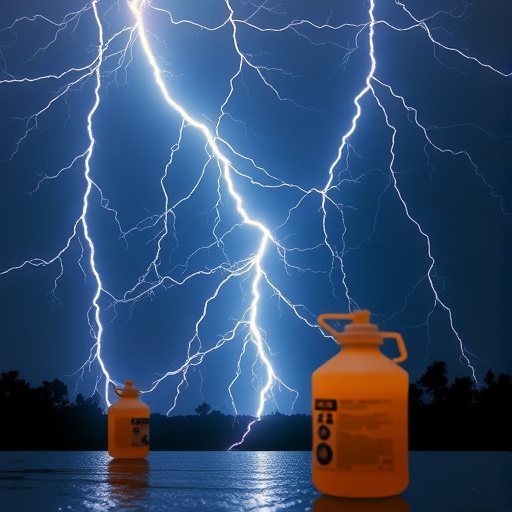
Northwestern University chemists have pioneered a remarkable advancement in the conversion of natural gas into liquid fuel by employing a technique evocative of capturing “lightning in a bottle.” This innovative process utilizes brief pulses of plasma—miniature lightning bolts generated inside glass tubes submerged in water—to convert methane, the primary component of natural gas, directly into methanol in a single, streamlined step. Methanol, an industrial chemical of vast significance, serves as a foundational building block in producing a wide array of everyday products, from plastics to adhesives, and its use as a cleaner-burning fuel alternative for maritime and industrial applications has attracted growing interest in recent years.
Traditional industrial practices for methanol production are hampered by their reliance on extreme temperatures and pressures. Typically, methane undergoes a steam reforming process at temperatures soaring above 800 degrees Celsius, where it is decomposed into carbon monoxide and hydrogen. These gases are subsequently subjected to high pressures—often two hundred to three hundred times atmospheric pressure—to synthesize methanol. While effective, this multi-stage methodology demands enormous energy input and results in substantial carbon dioxide emissions, exacerbating global climate concerns. The novel plasma-driven technique promises to circumvent these challenges by leveraging electric energy, water, and a copper-oxide catalyst to catalyze the conversion at ambient temperatures and pressures, exemplifying a cleaner, electrified chemical transformation route.
The core of this groundbreaking approach lies in the application of plasma, a highly energized state composed of ionized gas particles. Unlike conventional hot plasmas observed in stars and lightning, the researchers utilize cold plasmas—where the gas maintains near room temperature while electrons within are energized to tens of thousands of degrees. This selective elevation of electron energy facilitates the precise cleavage of methane’s notoriously stable carbon-hydrogen bonds without globally heating the entire system, thereby optimizing energy consumption and control. By generating these cold plasma bursts within the reactor, the team harnesses the unique chemistry elicited by the high-energy electrons to achieve methane activation and partial oxidation in a single reaction step.
The design of the plasma “bubble reactor” is a feat of chemical engineering ingenuity. It consists of a porous glass tube, its inner surface coated with a copper oxide catalyst. Methane gas is introduced and subjected to rapid electrical pulses, generating plasma within the confined space. This plasma dissociates methane molecules into highly reactive radicals, which then interact with water molecules to form methanol. An elegant aspect of the process is the immediate dissolution of methanol into the surrounding water, which acts to quench the reaction swiftly. This rapid quenching is paramount, as it prevents further oxidation of methanol into less desirable products, such as carbon dioxide, maintaining high selectivity toward the desired fuel.
To optimize the system’s efficacy, the research team discovered that incorporating argon, an inert noble gas, into the methane feedstock markedly enhances the reaction environment. Upon ionization in the plasma, argon becomes an active participant, increasing electron density and stabilizing plasma characteristics. This adjustment reduces the formation of unwanted byproducts while elevating methanol selectivity to an impressive 96.8% among liquid products. Overall, approximately 57% of all chemical products formed, encompassing both gaseous and liquid species, consisted of methanol. The mixture also included ethylene—a precursor in plastic manufacturing—and hydrogen gas, a versatile commodity and potential zero-carbon fuel, highlighting the synthetic versatility of the approach.
This plasma-mediated technique could revolutionize methane utilization across industries traditionally reliant on carbon-intensive processes. The method’s mild operational conditions and the potential scalability of compact reactors might enable decentralized conversion facilities situated near methane sources, including remote or stranded natural gas reserves. Particularly enticing is the prospect of mitigating methane emissions from leaky wellheads and natural gas infrastructure. Currently, methane leaks are often managed by flaring, which converts methane into carbon dioxide—a less potent climate forcer but nonetheless a greenhouse gas emission. The plasma reactor offers a superior alternative by transforming these fugitive emissions into a valuable liquid fuel on site, reducing environmental impact and creating economic value.
The chemistry underpinning this advance is as fascinating as its applications. Methane’s high chemical stability is chiefly due to the strength of its carbon-to-hydrogen bonds, which requires substantial energy to break. Traditional thermal methods necessitate heating entire reactors to extreme temperatures, a costly and inefficient approach. Instead, the plasma system focuses energy delivery into electron excitation, enabling the selective rupture of methane’s bonds without bulk heating. This targeted activation not only conserves energy but also provides finer control over reaction pathways, effectively “ripping and rebuilding” methane molecules into methanol and other valuable chemicals in a single step—a feat previously unattainable on an industrial scale.
In addition to the catalyst-mediated chemistry, the plasma environment introduces a dynamic landscape of reactive species including ions, radicals, and excited atoms. This rich milieu fosters novel reaction mechanisms distinct from classical thermal catalysis, expanding the frontier of chemical reactivity accessible under mild conditions. The immediate quenching of products by dissolution into water forms an integral part of this unique system design, capturing intermediates before they decompose. Such meticulous orchestration of reaction kinetics results in high yields and purity of methanol, substantially surpassing many earlier attempts at direct methane oxidation.
From an engineering standpoint, the stability and durability of the copper oxide catalyst in the plasma-liquid interface setting represent critical factors for future development. Operating under pulses of high voltage electricity within a confined aqueous environment poses challenges related to catalyst wear, reactor maintenance, and energy efficiency. The Northwestern team is actively exploring strategies to optimize catalyst formulations and reactor geometries, aiming to maximize throughput, operational lifespan, and product separation efficiencies. These efforts are essential steps toward translating this promising laboratory breakthrough into practical industrial technology.
Looking forward, the promise of this plasma-catalyst-liquid interface approach could extend beyond methanol synthesis. The fundamental insights into cold plasma-driven chemistry may unlock pathways to convert other stable hydrocarbons and greenhouse gases into useful chemicals and fuels with unprecedented selectivity and efficiency. Harnessing renewable electricity to power these processes could integrate seamlessly with sustainable energy grids, furthering the decarbonization of chemical manufacturing. As a testament to its potential, this research garnered substantial support from bodies including the U.S. Department of Energy, the U.S. Army DEVCOM ARL Army Research Office, and the David and Lucille Packard Foundation.
This pioneering study, scheduled for publication in the Journal of the American Chemical Society, stands at the intersection of physical chemistry, catalysis, and energy science, promising to redefine how society taps into methane resources. By replacing conventional thermal cracking and synthesis with a plasma-enabled, low-temperature alternative, this method offers an environmentally conscious, economically viable route to one of the world’s most critical industrial fuels. The implications for climate change mitigation, energy security, and chemical manufacturing innovation are profound, signaling a bright future for electrified catalysis and plasma chemistry.
Subject of Research: Direct partial oxidation of methane to methanol via plasma-catalyst-liquid interfaces
Article Title: Direct partial oxidation of methane at plasma-catalyst-liquid interfaces
News Publication Date: 15-Apr-2026
Image Credits: Alexander Davis with special thanks to Michelle Driscoll
Keywords
Lightning, Methane, Catalysis, Plasma, Industrial chemistry, Greenhouse gases
Tags: alternative marine fuel sourcesclean fuel production technologycopper-oxide catalyst in fuel conversiongreen methanol production methodslow-energy methanol synthesismethane to methanol processNorthwestern University fuel researchplasma technology for chemical synthesisplasma-assisted methane conversionreducing carbon emissions in fuel productionsingle-step methanol manufacturingsustainable industrial fuel innovation