Cannabis, also known as weed or marijuana, is used by hundreds of millions of people worldwide. Although restricted in most countries, the increasing legalisation of cannabis for recreational and medicinal consumption means that cannabis use is rising. Cannabis is also the most common illicit drug used by pregnant women, but the effects of cannabis on embryonic development are not well understood. It is also important to understand the effects of cannabis on individuals with a genetic predisposition, which means they carry genetic mutations that increase the risk of environmental conditions triggering a defect or disease.
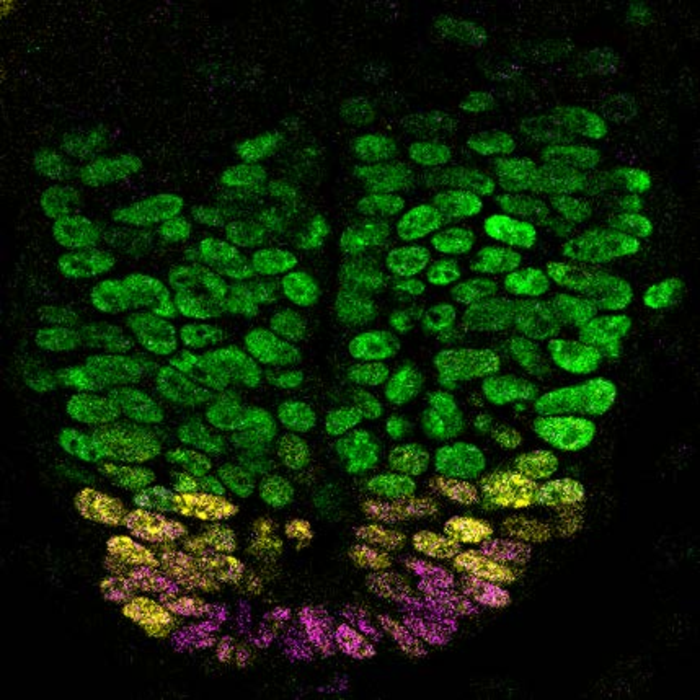
Credit: Lo, H.-F., Hong, M., Szutorisz, H., Hurd, Y.L., Krauss, R.S. (2021). Δ9-Tetrahydrocannabinol inhibits Hedgehog-dependent patterning during development. Development, 148, dev199585. doi:10.1242/dev.199585
Cannabis, also known as weed or marijuana, is used by hundreds of millions of people worldwide. Although restricted in most countries, the increasing legalisation of cannabis for recreational and medicinal consumption means that cannabis use is rising. Cannabis is also the most common illicit drug used by pregnant women, but the effects of cannabis on embryonic development are not well understood. It is also important to understand the effects of cannabis on individuals with a genetic predisposition, which means they carry genetic mutations that increase the risk of environmental conditions triggering a defect or disease.
A new study from scientists at the Icahn School of Medicine at Mount Sinai, USA, has now revealed that THC, the chemical in cannabis that causes the sensation of feeling ‘high’, can cause birth defects in genetically predisposed mice. In this case, the researchers investigated whether THC could exacerbate a mutation that affects a mechanism that cells use to communicate with each other, called Hedgehog signalling. “Several years ago, it was reported that THC could inhibit Hedgehog signalling in cells grown in a dish,” said the study’s lead author Robert Krauss, PhD, Professor of Cell, Developmental and Regenerative Biology at the Icahn School of Medicine at Mount Sinai. “We reasoned that THC might be an environmental risk factor for birth defects, but that it would require additional risk factors, such as specific mutations in the genes required for Hedgehog signalling, to induce these defects in mice.”
To address this hypothesis, Dr Krauss and colleagues administered a single dose of THC, equivalent to exposures achieved when humans smoke cannabis, to pregnant mice about a week after conception. They then studied the embryonic development of their pups, some of which carried a mutation that meant Hedgehog signalling was not functioning at full efficiency. The scientists found that pups without the mutation developed normally, even when exposed to THC, as did pups that carried the mutation but were not exposed to the drug. However, pups that were exposed to THC and carried the mutation developed a brain and face defect called holoprosencephaly, a common birth defect seen in 1 in 250 human conceptions that includes the failure of the forebrain to divide into two distinct segments.
The researchers showed that the defect occurs because THC can interfere with Hedgehog signalling in the embryo. THC alone is not sufficient to disrupt Hedgehog signalling and cause defects but, in animals where Hedgehog signalling is already weakened through genetic mutation, it has significant effects. “THC directly inhibits Hedgehog signalling in mice, but it is not a very powerful inhibitor; this is presumably why a genetic predisposition is required for it to cause holoprosencephaly in mice,” explained Dr Krauss.
These first studies in mice have important implications for human health, highlighting the need for more research into the effects of cannabis use during pregnancy in humans. “The THC concentration in cannabis is now very high, so it is important to perform epidemiology studies looking at whether cannabis consumption is associated with developmental defects. Women are already advised not to consume cannabis while pregnant, but our results show that embryos are sensitive at a very early period, before many women know they are pregnant. Cannabis consumption may therefore be inadvisable even when women are trying to get pregnant,” Dr Krauss warned.
Although this study focussed on one chemical in cannabis and one genetic mutation, further research could reveal other combinations that cause similar effects. “Many of the mutations found in human holoprosencephaly patients could conceivably synergise with THC,” said Dr Krauss. “We would also like to test the related chemical CBD in genetically predisposed mice. Like THC, CBD inhibits Hedgehog signalling in cells grown in a dish, but CBD appears to work differently. As CBD is widely available and often viewed as beneficial – or at least innocuous – it would be worth investigating this as well,” he added.
Journal
Development
DOI
10.1242/dev.199585
Method of Research
Experimental study
Subject of Research
Animals
Article Title
Δ9-Tetrahydrocannabinol inhibits Hedgehog-dependent patterning during development
Article Publication Date
5-Oct-2021
COI Statement
The authors declare no competing or financial interests.