• HOME
  • NEWS
  • EXPLORE
    • CAREER
      • Companies
      • Jobs
    • EVENTS
    • iGEM
      • News
      • Team
    • PHOTOS
    • VIDEO
    • WIKI
  • BLOG
  • COMMUNITY
    • FACEBOOK
    • INSTAGRAM
    • TWITTER
Tuesday, January 13, 2026
BIOENGINEER.ORG
No Result
View All Result
  • Login
  • HOME
  • NEWS
  • EXPLORE
    • CAREER
      • Companies
      • Jobs
        • Lecturer
        • PhD Studentship
        • Postdoc
        • Research Assistant
    • EVENTS
    • iGEM
      • News
      • Team
    • PHOTOS
    • VIDEO
    • WIKI
  • BLOG
  • COMMUNITY
    • FACEBOOK
    • INSTAGRAM
    • TWITTER
  • HOME
  • NEWS
  • EXPLORE
    • CAREER
      • Companies
      • Jobs
        • Lecturer
        • PhD Studentship
        • Postdoc
        • Research Assistant
    • EVENTS
    • iGEM
      • News
      • Team
    • PHOTOS
    • VIDEO
    • WIKI
  • BLOG
  • COMMUNITY
    • FACEBOOK
    • INSTAGRAM
    • TWITTER
No Result
View All Result
Bioengineer.org
No Result
View All Result
Home NEWS Science News Health

Cancer: Central role of cell ‘skeleton’ discovered

Bioengineer by Bioengineer
April 10, 2019
in Health
Reading Time: 1 min read
0
IMAGE
Share on FacebookShare on TwitterShare on LinkedinShare on RedditShare on Telegram

IMAGE

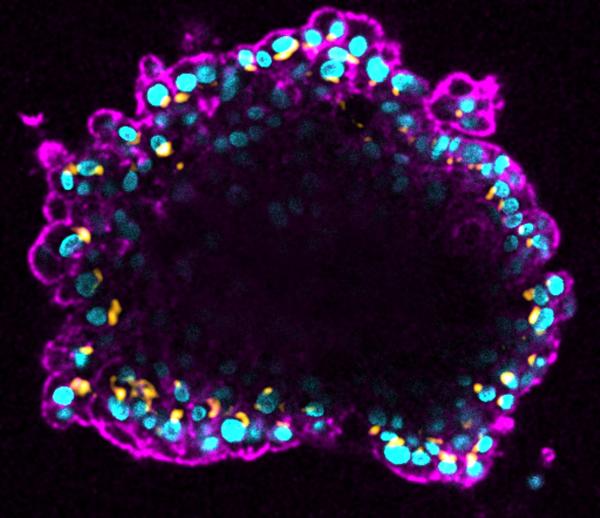
Credit: (CC) Molinie et al./Cell Res/DOI: 10.1038/s41422-019-0160-9

All cells possess a cytoskeleton which allows them to move and maintain their shape. However, scientists recently showed that a part of this cytoskeleton called branched actin is also essential to cell proliferation*: this actin transmits information to cells about the space around them, environmental chemical messages and therefore on whether they should proliferate. If the necessary conditions are not met, these actin fibres are not synthesised, and the cell does not divide – except in the case of cancerous cells, which can override this control mechanism and proliferate where they should not. This mechanism could nevertheless represent a therapeutic target to fight certain types of cancer. Inhibiting the formation of branched actin, for example, prevents the growth of a type of melanoma cells, against which no other specific treatment exists today. This research, carried out by an international team composed of scientists at the Laboratoire Bases moléculaires et régulation de la biosynthèse protéique (CNRS/École polytechnique) appear in the April 10th 2019 edition of Cell Research.

###

*- Proliferation is the rapid and abundant growth of either normal or pathogenic cells.

Media Contact
Francois Maginiot
[email protected]

Related Journal Article

http://dx.doi.org/10.1038/s41422-019-0160-9

Tags: BiologycancerCell BiologyMolecular Biology
Share12Tweet8Share2ShareShareShare2

Related Posts

Osimertinib ± Savolitinib in MET-EGFR NSCLC Trial

Osimertinib ± Savolitinib in MET-EGFR NSCLC Trial

January 13, 2026

Acute Mesenteric Ischemia in Elderly: Clinical Insights

January 13, 2026

Hydrolyzed Milk Formula Supports Infant Growth Safely

January 13, 2026

Assessing Nurses’ Self-Efficacy in Symptom Management

January 13, 2026
Please login to join discussion

POPULAR NEWS

  • Enhancing Spiritual Care Education in Nursing Programs

    154 shares
    Share 62 Tweet 39
  • PTSD, Depression, Anxiety in Childhood Cancer Survivors, Parents

    147 shares
    Share 59 Tweet 37
  • Robotic Ureteral Reconstruction: A Novel Approach

    72 shares
    Share 29 Tweet 18
  • Study Reveals Lipid Accumulation in ME/CFS Cells

    52 shares
    Share 21 Tweet 13

About

We bring you the latest biotechnology news from best research centers and universities around the world. Check our website.

Follow us

Recent News

New Primer Method Detects Liver Fluke Host

Global Autism: Risks, Burden, and Implications Uncovered

Optimizing Pleurotus djamor Polysaccharides for Health Benefits

Subscribe to Blog via Email

Enter your email address to subscribe to this blog and receive notifications of new posts by email.

Join 71 other subscribers
  • Contact Us

Bioengineer.org © Copyright 2023 All Rights Reserved.

Welcome Back!

Login to your account below

Forgotten Password?

Retrieve your password

Please enter your username or email address to reset your password.

Log In
No Result
View All Result
  • Homepages
    • Home Page 1
    • Home Page 2
  • News
  • National
  • Business
  • Health
  • Lifestyle
  • Science

Bioengineer.org © Copyright 2023 All Rights Reserved.