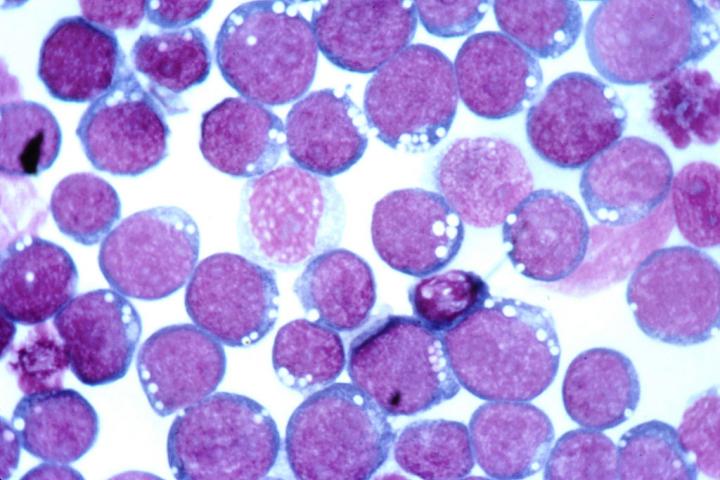
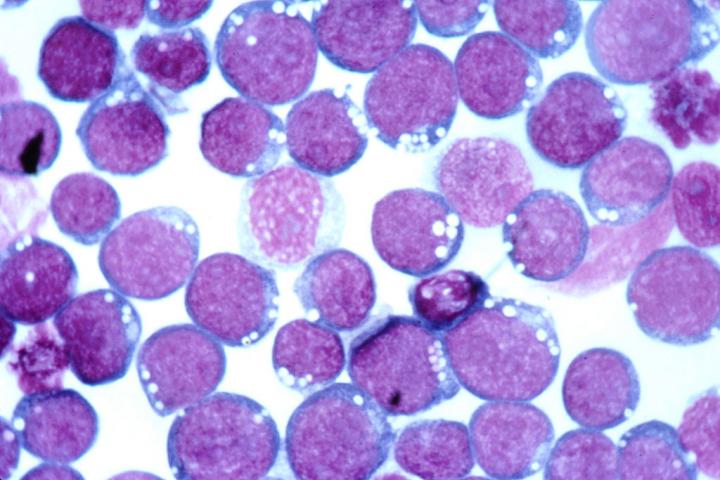
Credit: National Cancer Institute
DURHAM, NC — Viruses are notorious for taking over their host's operations and using them to their own advantage. But few human viruses make themselves quite as cozy as the Epstein-Barr virus, which can be found in an estimated nine out of ten humans without causing any ill effects.
That is, until this virus causes mononucleosis in adolescents or various cancers of the lymph nodes, including Hodgkin's and non-Hodgkin's lymphomas, in immune compromised people.
In a paper appearing in the open access journal eLife, a team of researchers from Duke's School of Medicine details just how the Epstein-Barr virus manages to persist so well inside the immune system's B cells, a type of white blood cell that is normally responsible for recognizing and responding to foreign invaders.
"The challenge is that it's a really efficient pathogen," and evades the host's immune system well even when it's recognized as an invader, said Micah Luftig, an associate professor of molecular genetics and microbiology and co-author on the new study.
Luftig's team has found that with a few select chemical signals used early in the course of an infection, Epstein-Barr mimics the beginning of the B cell's normal response to an infectious agent. From within, the virus manages to ramp up the B-cell's reproduction of itself, while at the same time helping the cell resist its own self-destruct signals.
"The virus actually taps into the B cell's normal protection against apoptosis," the programmed cell death that takes B cells out of circulation, Luftig said.
Once the infection is established, Epstein-Barr prefers to hide out in what are known as "memory B cells," relatively slowly reproducing cells that circulate throughout the body. "All of this is about establishing latency," Luftig said, or the ability to hide quietly in plain sight.
Using a new technique developed elsewhere called BH3 profiling that allowed them to test the critical cellular pro- and anti-apoptosis proteins individually, the team was able to see which of these the virus was controlling and then watch the transition from an uninfected cell to the active early infection phase to the latent infection in an immortal cell. The key piece they've uncovered is a viral protein called EBNA3A which manages apoptosis resistance in infected B cells.
The risk for cancers "is largely an issue if you're immune suppressed," Luftig said. But, for example, a recent National Cancer Institute study found that children who receive organ transplants have a 200-times higher chance of getting Non-Hodgkin's Lymphoma, one of the cancers caused by Epstein-Barr.
The team thinks BH3 profiling could prove useful in guiding treatment decisions on Epstein-Barr associated cancers such as these.
###
This research was funded by the American Cancer Society, the Wellcome Trust and the National Institutes of Health (R01-CA140337, R01-DE025994, 5P30-AI064518, F31-CA180451, R01-DE023939, T32-AI078985, R01-CA129974).
CITATION: "Epstein-Barr Virus Ensures B Cell Survival by Uniquely Modulating Apoptosis at Early and Late Times After Infection," Alexander Price, Joanne Dai, Quentin Bazot, Luv Patel, Pavel Nikitin, Reza Djavadian, Peter Winter, Cristina Salinas, Ashley Perkins Barry, Kris Wood, Eric Johannsen, Anthony Letai, Martin Allday, Micah Luftig. eLife, online April 20, 2017. DOI: 10.7554/eLife.22509 https://elifesciences.org/content/6/e22509
Media Contact
Karl Leif Bates
[email protected]
919-681-8054
@DukeU
http://www.duke.edu
############
Story Source: Materials provided by Scienmag