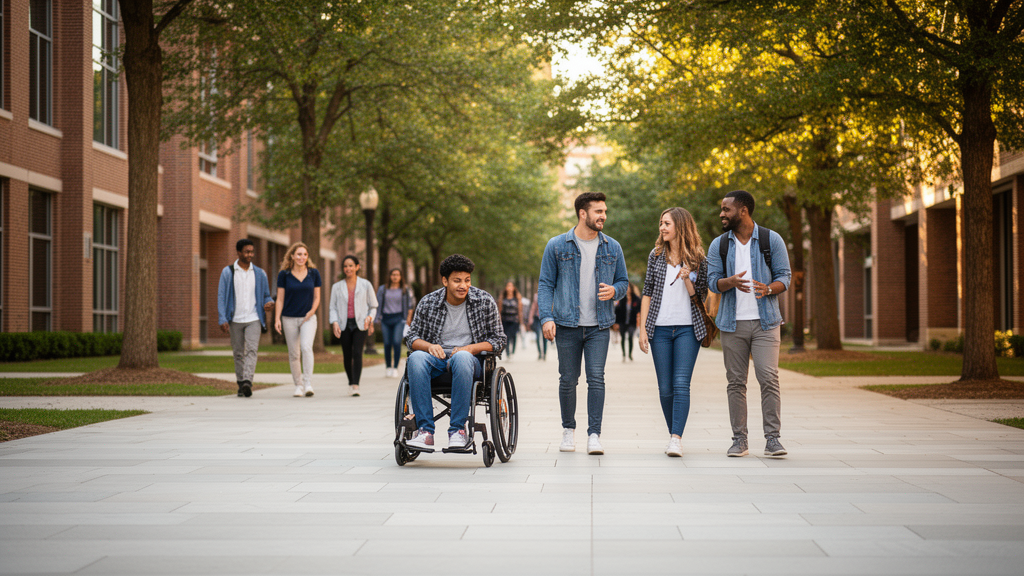
University students who are satisfied with their campus walkways are far more likely to keep using them, according to a cross-sectional survey of 369 students published in BMC Public Health. The study used Partial Least Squares-Structural Equation Modelling (PLS-SEM) to test how different perceived walkway attributes shape both satisfaction and the intention to continue walking between classes. The researchers grouped perceived walkway attributes into four categories: surface quality, accessibility and convenience, safety and security, and environmental aesthetics and integration.
Three of the four attribute groups significantly predicted walkway use satisfaction: accessibility and convenience, environmental aesthetics, and surface quality. Safety and security, by contrast, did not directly predict satisfaction, although the results showed it was associated with accessibility and convenience. In practical terms, students who found paths well maintained, easy to reach and pleasant to walk along reported a stronger intention to keep choosing walking over other forms of transport on campus. Walkway use satisfaction itself was a strong predictor of continued use intention, making it the key link between walkway attributes and sustained pedestrian behaviour in the model.
The survey was descriptive and cross-sectional, drawing on a single sample of university students, and the authors are careful to note that causal relationships cannot be firmly established from this design. Because satisfaction and use intentions were measured at the same time, it remains unclear whether favourable perceptions drive continued walking or whether students who already prefer walking rate walkway features more favourably. The authors recommend that future research adopt longitudinal or mixed-methods approaches to capture how walkway use changes over time and to probe the mechanisms behind the observed associations.
Campus walkways have received relatively little attention in sustainable mobility research compared with city-scale pedestrian planning, an area the authors describe as underexplored. The findings point to specific design priorities for universities seeking to promote healthier and more sustainable campus mobility. Improving surface condition, ensuring walkways are accessible and convenient, and investing in environmental aesthetics and integration with the surrounding landscape are the attributes the study identifies as most closely tied to satisfaction, and through satisfaction, to students’ continued use of walkways.
The authors suggest that improving walkway design, accessibility, aesthetics and maintenance can enhance user satisfaction and encourage sustained use, supporting healthier campus environments and reducing reliance on motorised transport. For campus planners, the immediate takeaway is that maintenance and aesthetics are not cosmetic extras: in this model they appear central to whether students keep choosing to walk.
Subject of Research: Perceived campus walkway attributes and their influence on student walkway satisfaction and continued use intention
Article Title: Perceived campus walkway attributes, walkway-use satisfaction and continued use intention among university students: a cross-sectional PLS-SEM study
Article References: Mireku, D. O., Amutenya, T., Bervell, B., Mensah, E., & Koomson, C. (2026). Perceived campus walkway attributes, walkway-use satisfaction and continued use intention among university students: a cross-sectional PLS-SEM study. BMC Public Health. https://doi.org/10.1186/s12889-026-29643-9
Image Credits: AI Generated
DOI: 10.1186/s12889-026-29643-9
Keywords: campus walkways, university students, walkway satisfaction, PLS-SEM, sustainable mobility, pedestrian infrastructure, cross-sectional survey, built environment, active travel, BMC Public Health, Perceived, campus
News Source: Ophelia Keating. (October 28, 2026). Campus Walkway Satisfaction Hinges on Accessibility, Aesthetics and Surface Quality, Survey Finds. Scienmag.