Applying an innovative survey framework to one of the Amazon basin’s most secretive forest ungulates, wildlife researchers have generated the first rigorous population density estimate for red brocket deer (Mazama americana) in Bolivia’s Madidi National Park and Natural Integrated Management Area (PNANMI Madidi). Using camera trap distance sampling (CTDS) across 43.37 square kilometers of mature tropical forest within the Tuichi Valley between July and November 2023, the investigation estimated a mean population density of 6.7 individuals per square kilometer, bounded by a 95 percent confidence interval of 5.2 to 8.6 individuals per square kilometer. This statistical modeling corresponds to an estimated absolute population of 287 individuals, with a 95 percent confidence interval ranging from 224 to 372 animals across the localized study grid. The empirical findings represent a major methodological milestone for monitoring elusive neotropical mammals that lack natural individually distinguishing markings, providing a robust quantitative baseline for an economically and ecologically foundational herbivore whose regional status has long been clouded by persistent data deficiencies.
The red brocket deer is widely distributed throughout Latin American forest environments, yet its solitary, shy, and predominantly nocturnal behavior has historically rendered direct visual observation exceptionally difficult in dense rainforest understories. Consequently, non-individually recognizable vertebrates have remained substantially under-represented in systematic camera trapping literature across the tropics. Because reliable demographic data across its continental range remain remarkably scarce, the International Union for Conservation of Nature (IUCN) Red List formally classifies the red brocket deer as Data Deficient (DD) with an entirely unknown global population trend, precluding targeted conservation status assessments.
Understanding the actual demographic density of Mazama americana is vital because the species plays an irreplaceable ecological role as a keystone frugivorous herbivore across lowland Neotropical ecosystems. Extensive dietary research indicates that fallen fruits and forest seeds constitute more than half of the deer’s annual dietary intake, frequently exceeding 80 percent of total food consumption in mature tropical forest habitats. The animal feeds extensively on fruits and seeds produced by a broad spectrum of canopy trees and foundational palm taxa, including structural genera such as Iriartea, Euterpe, Mauritia, and Oenocarpus, supplementing this diet with leaves, shoots, and forest flowers according to seasonal phenology. Through combined seed predation, browse herbivory, and seed dispersal—achieved both by masticating and spitting out larger intact seeds and passing smaller viable seeds through defecation—red brocket deer directly govern understory plant recruitment, forest regeneration trajectories, and broader trophic interactions throughout Amazonian ecosystems.
Beyond its profound ecological contributions to forest architecture, the red brocket deer represents one of the most critical terrestrial game resources for human subsistence hunting throughout South America. Across the wider Amazon Basin, the ungulate serves as a premier source of dietary wild meat and supplemental income for Indigenous and rural communities, including peoples residing within demarcated Indigenous territories and multi-use protected zones. Subsistence hunters operating in Neotropical forests typically focus their harvesting efforts on large-bodied terrestrial quarry such as brocket deer, which maximize caloric and meat yields per unit of hunting time and energetic investment.
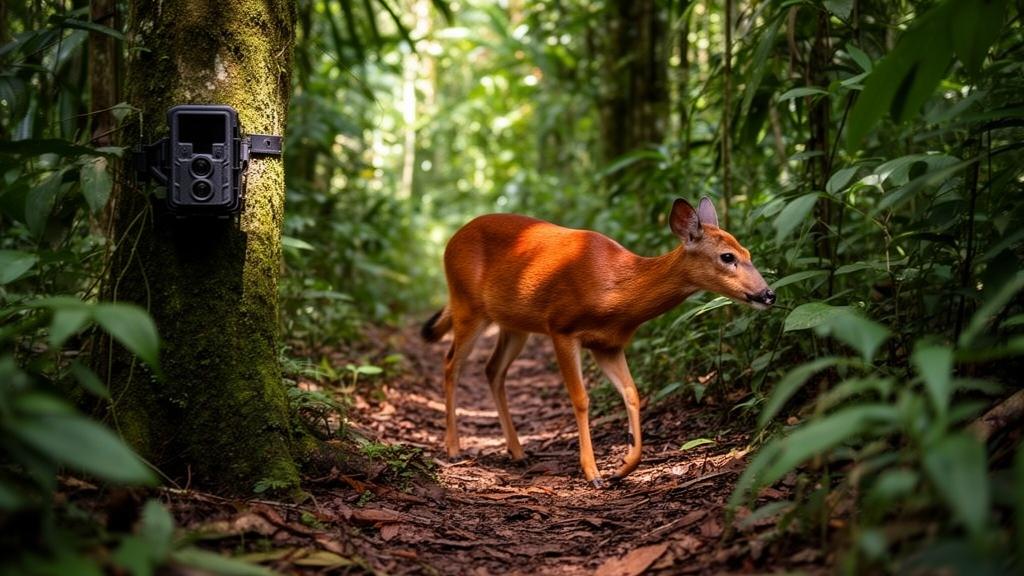
To overcome the historical limitations of indirect sign surveys without disturbing cryptic wildlife, the research team implemented camera trap distance sampling across the Tuichi Valley, where elevations span Amazonian foothill forests characterized by tall 30- to 40-meter canopies, dense understories, and diverse palm assemblages. Between July and November 2023, researchers established 100 single video camera trap stations deployed in a systematic random sampling design with a uniform inter-station spacing of 700 meters. Each station was equipped with a Browning video camera positioned exactly 45 centimeters above the forest floor and locked to a strict 170-degree compass azimuth. This fixed orientation eliminated solar lens glare during dawn and dusk while strictly preventing human field crews from selectively aiming camera lenses toward animal trails or micro-topographic features, satisfying the fundamental distance sampling assumption of random observer placement relative to animal movement.
Extracting accurate point-transect distance measurements from automated video recordings required a rigorous, station-specific calibration protocol completed during camera retrieval in the field. Field researchers deployed calibrated measuring ropes marked at precise one-meter increments out to a radius of 15 meters within each camera station’s 40-degree field of view, keeping natural understory vegetation undisturbed. A field researcher traversed the entire lateral detection sector displaying marked distance boards to generate an unambiguous baseline video of distance bands. Additionally, teams recorded a secondary structural calibration video measuring exact physical tape-measure distances to fixed natural landmarks, including living tree trunks, structural lianas, branches, and fallen logs. These paired calibration recordings provided empirical spatial grids that allowed analysts to accurately assign observed animals to defined radial distance bands during subsequent laboratory video reviews, ensuring high analytical consistency and geometric reproducibility.
The physical survey operated continuously 24 hours per day for 100 consecutive sample days, amassing 10,340 cumulative camera-trap days of active monitoring effort. Each automated camera was programmed to record 20-second video clips during darkness and 60-second clips in daylight whenever triggered, maintaining a rapid one-second re-trigger interval. Following established distance sampling principles, temporal effort was divided into discrete instantaneous snapshot moments spaced two seconds apart. Analysts recorded the exact radial distance to the anatomical mid-point of every individual red brocket deer present in a video frame at each two-second mark.
To avoid severe behavioral and geometric estimation biases, researchers subjected the raw observation records to strict data-filtering criteria before running population models. All observations displaying behavioral reactions to the camera hardware, such as approaching, inspecting, or sniffing the device—which occurred in 1.24 percent of instances and was concentrated within the zero-to-one-meter band—were eliminated from the dataset. Similarly, instances where an individual deer was positioned partially outside the camera’s field of view such that its anatomical mid-point could not be definitively localized, representing 13.85 percent of records, were completely excised. These filtering steps retained 7,759 verified, usable radial distance detections. As theoretically expected in distance sampling, detection counts initially rose across the nearest meter intervals before steadily declining with greater distance from the camera lenses.
Statistical density estimation was executed using the Distance software suite, modeling detection probability alongside explicit multipliers for camera geometry and species-specific temporal availability. Temporal availability was derived from 984 independent camera encounters by fitting a circular kernel distribution to circular activity profiles, showing that red brocket deer were active and available for camera detection 52.34 percent of the time, with a standard error of 3.18 percent. Activity exhibited pronounced bimodal peaks at dawn between 05:00 and 07:00 and dusk between 18:00 and 20:00, with a distinct midday lull. The camera’s 40-degree horizontal field of view yielded a fixed spatial sampling fraction of 0.11. After evaluating multiple truncation thresholds and key functions, researchers selected a simple half-normal detection model right-truncated at 8 meters and grouped into four 2-meter intervals (0–2 m, 2–4 m, 4–6 m, and 6–8 m) based on Akaike’s Information Criterion. This configuration avoided overfitting and accommodated the physical body dimensions of the deer, yielding an overall detection probability of 0.22 (95 percent confidence interval 0.215–0.226) and a exceptionally precise coefficient of variation of 12.8 percent.
The resulting density of 6.7 individuals per square kilometer indicates that the Tuichi Valley supports a remarkably robust population when contextualized within broader Neotropical literature. Parallel monitoring conducted across 431 square kilometers of the Tuichi and Hondo valleys for sympatric jaguars yielded a red brocket deer relative abundance index of 8.9 independent events per 100 station-days, remarkably consistent with the CTDS survey’s index of 9.5 events per 100 trap-days. This strong concordance demonstrates that the intensive CTDS survey grid accurately mirrors wildlife densities across the broader park landscape, confirming that Madidi’s long-term protected status, active park ranger patrols, flourishing community-based ecotourism, and Indigenous conservation commitments have successfully sustained healthy populations of vulnerable Amazonian forest fauna.
Subject of Research: Population density estimation of red brocket deer using camera trap distance sampling in Bolivia
Article Title: Using Camera Trap Distance Sampling to estimate population density for red brocket deer ( Mazama americana ) in Madidi National Park and Natural Integrated Management Area, Bolivia
Article References: Woodall, K., Ayala, G., Strindberg, S., Viscarra, M., & Wallace, R. B. (2026). Using Camera Trap Distance Sampling to estimate population density for red brocket deer (Mazama americana) in Madidi National Park and Natural Integrated Management Area, Bolivia. Neotropical Biology and Conservation, 21(4), 389–406. https://doi.org/10.3897/neotropical.21.e214641
Image Credits: AI Generated
DOI: 10.3897/neotropical.21.e214641
Keywords: Mazama americana, red brocket deer, camera trap distance sampling, Madidi National Park, Bolivia, Tuichi Valley, wildlife monitoring, population density, Distance software, temporal availability, detection probability, Amazonian biodiversity, subsistence hunting, frugivorous herbivore, camera trapping, wildlife conservation, tropical ecology
News Source: Margaret Porter. (November 19, 2026). Camera Trap Distance Sampling Reveals High Red Brocket Deer Density in Bolivia. Scienmag.